Still searching for your perfect jersey? Explore our best-selling products—we're confident you'll find a style that's just right for you in our diverse collection.
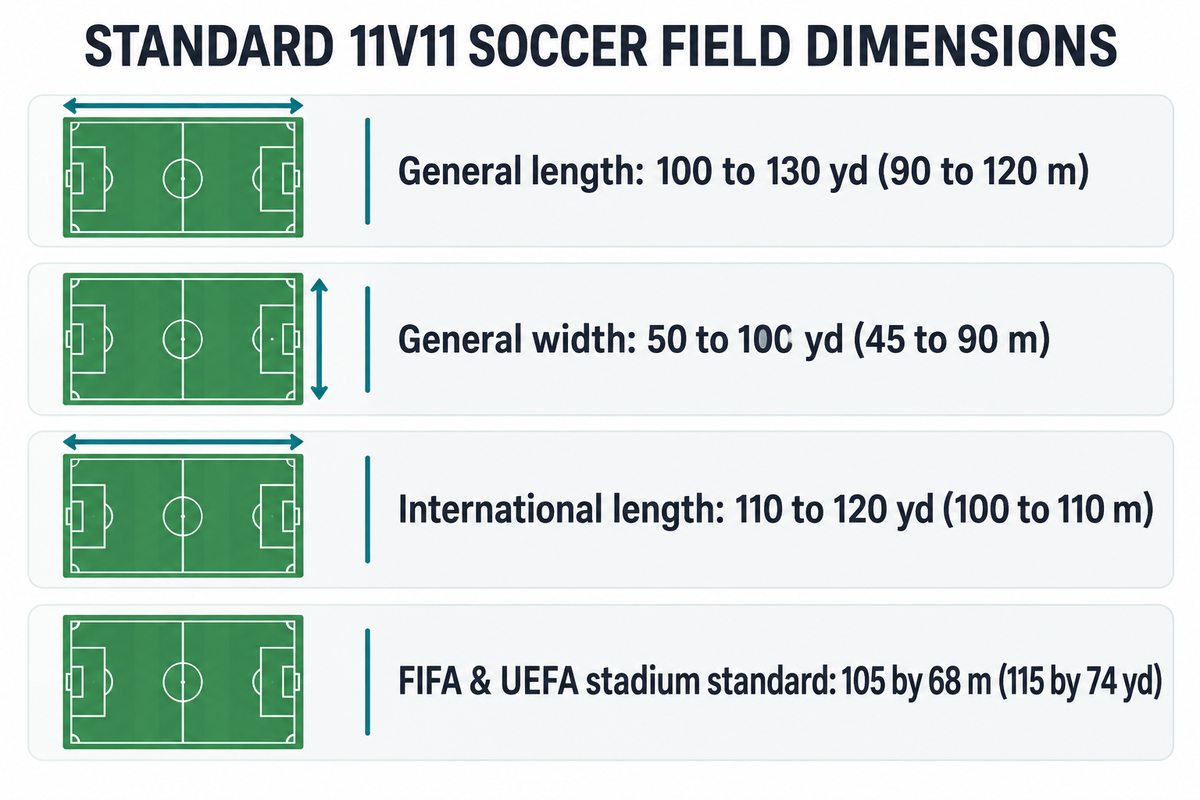
Regulation 11v11 soccer field dimensions stretch 100 to 130 yards long (90 to 120 meters, or 300 to 390 feet) and 50 to 100 yards wide (45 to 90 meters, or 150 to 300 feet) according to International Football Association Board (IFAB) Law 1. For elite professional clubs and international matches, FIFA soccer and UEFA stadium rules standardize the playing surface at 105 by 68 meters (115 yards long by 74 yards wide), provided the touchline always exceeds the goal line.
Outer pitch boundaries flex by competition and age group, but internal 11v11 field markings never scale. Every regulation adult soccer pitch uses the same 44-by-18-yard penalty area, 20-by-6-yard goal box, 12-yard penalty spot, and 10-yard arc radius.
Rules checked October 2026 against the 2025/26 and 2026/27 IFAB Laws of the Game, FIFA Stadium Guidelines, UEFA Stadium Infrastructure Regulations, and US Soccer youth mandates. SoccerKit publishes this technical reference for players, coaches, and groundskeepers.
What Are Standard Soccer Field Dimensions in Yards, Feet, and Meters?
Standard 11v11 soccer field dimensions span 100 to 130 yards long (90 to 120 meters) along the touchline and 50 to 100 yards wide (45 to 90 meters) across the goal line. The International matches reduce the official window to 110 to 120 yards long (100 to 110 meters) and 70–80 yards (64 to 75 meters) wide.
At senior levels, Association Football, the dimensions of a soccer field are set at 105 by 68 meters (115 by 74 yards) for top-flight stadiums, while grassroot levels work within the broader range of 100 to 130 yards in length and 50 to 100 yards in width. Law 1 of the Laws of the Game, published by IFAB and The FA stipulates a general minimum touchline at 90 meters or 100 yards, although 90 meters converts to 98.43 yards. When measuring a pitch diagram or provisioning a squad with soccer uniform kits for a match, one has to maintain metric and imperial measurements separately on the turf.
Regulation 11v11 soccer field size conversions across governing tiers
Competition tier
Length (touchline)
Width (goal line)
Total playing area
Limitations / Not suitable for
IFAB Rule 1 general minimum
90 m / 100 yd / 300 ft
45 m / 50 yd / 150 ft
4,050 sq m / 45,000 sq ft / 1.00 acre
Too narrow for senior international or top-flight club fixtures
IFAB Rule 1 general maximum
120 m / 130 yd / 390 ft
90 m / 100 yd / 300 ft
10,800 sq m / 117,000 sq ft / 2.67 acres
Cannot be laid out as a 90×90 m or 100×100 yd square
IFAB Rule 1 international minimum
100 m / 110 yd / 330 ft
64 m / 70 yd / 210 ft
6,400 sq m / 69,300 sq ft / 1.58 acres
Requires waiver for World Cup finals or UEFA Category 4
IFAB Rule 1 international maximum
110 m / 120 yd / 360 ft
75 m / 80 yd / 240 ft
8,250 sq m / 86,400 sq ft / 1.98 acres
Exceeds fixed 105×68 m broadcast and stadium template
FIFA & UEFA standard (105 x 68)
105 m / 114.8 yd / 344.5 ft
68 m / 74.4 yd / 223.1 ft
7,140 sq m / 76,854 sq ft / 1.76 acres
Requires 125×85 m total grass envelope under FIFA guidelines
Premier League historic waiver floor
100.0 m / 109.4 yd / 328.1 ft
65.0 m / 71.1 yd / 213.3 ft
6,500 sq m / 69,965 sq ft / 1.61 acres
Only permitted where existing stadium stands block expansion
NCAA college new facility rule
105.2–109.7 m / 115–120 yd
64.0–68.6 m / 70–75 yd
6,733–7,525 sq m / 72,450–81,000 sq ft
Applies to US collegiate soccer, not FIFA international play
NFHS US high school recommended
100.6 m / 110 yd / 330 ft
59.4 m / 65 yd / 195 ft
5,976 sq m / 64,350 sq ft / 1.48 acres
Wider than a 160 ft high school gridiron without apron turf
US Soccer U11–U12 (9v9 developmental)
64.0–73.2 m / 70–80 yd
41.1–50.3 m / 45–55 yd
2,630–3,682 sq m / 28,350–39,600 sq ft
US Soccer PDI format; not used for senior 11v11 play
“The field of play must be rectangular and marked with continuous lines which must not be dangerous; the touchline must be longer than the goal line.”
Why Do Regulation Soccer Fields Vary in Size Instead of Using One Fixed Measurement?
Association football codified its rules in 19th-century England across shared cricket ovals, public commons, and urban schoolyards before standardized stadium bowls existed. Preserving a permitted range between 100 and 130 yards long and 50 to 100 yards wide allows community parks, historic urban grounds, and multi-sport venues to host sanctioned 11v11 matches without demolishing surrounding stands or running tracks.
Although Rule 1 gives flexibility at its lower limits, pitch geometry quickly becomes severely constrained. Because the 18-yard penalty box is fixed at 40.32 meters (44 yards) wide regardless of outer pitch size, a minimum-width 45-meter metric pitch leaves just 2.34 meters (7.7 feet) of grass between each side of the penalty area and the touchline. Under the parallel imperial stipulation of 50 yards minimum width minus a 44-yard penalty box, only 3 yards (9 feet) remain on each wing.
How Do FIFA, IFAB Law 1, Premier League, and UEFA Pitch Size Rules Compare?
In general football, IFAB Rule 1 allows a greater length of 90 to 120 meters. While IFAB Rule 1 sets a broad 90 to 120 meter length allowance for general football, FIFA World Cup regulations, UEFA Category 4 rules, and Premier League Rule K.14 mandate a uniform 105 by 68 meter (115 by 74 yard) playing surface whenever stadium architecture permits. Stadium architecture permitting.
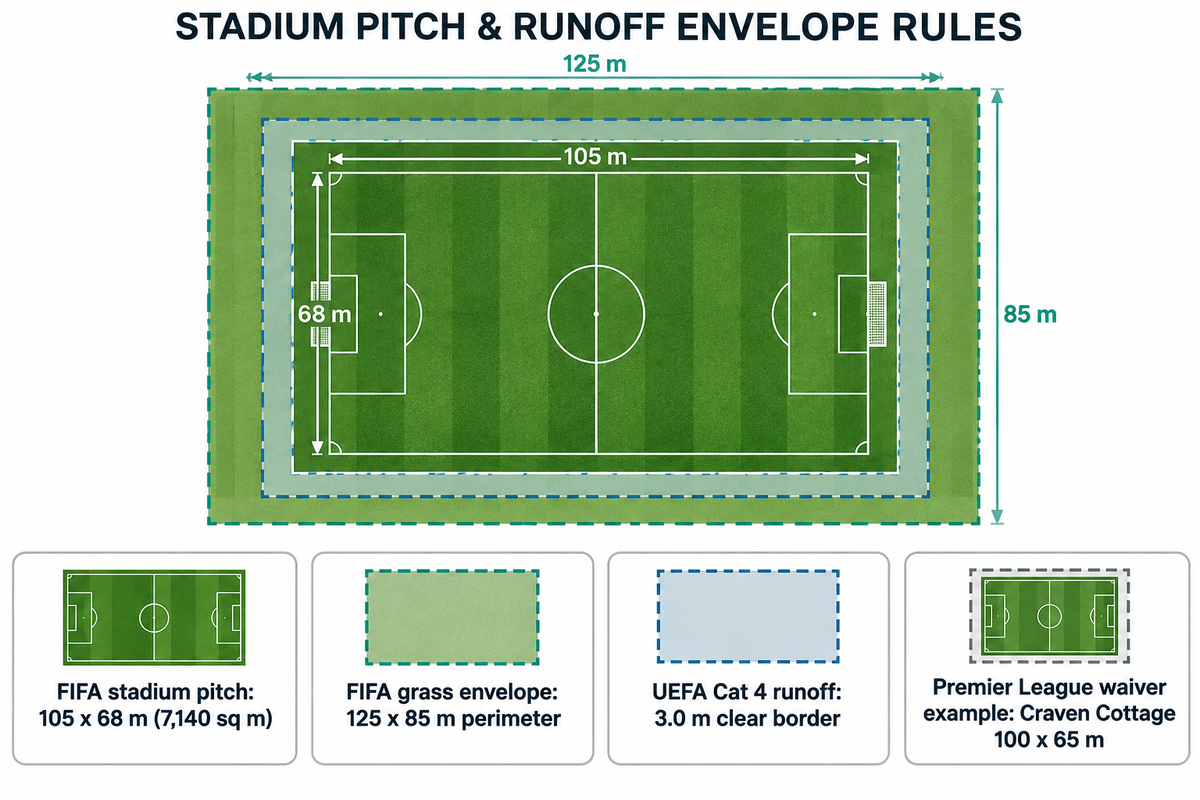
How professional clubs use pitch dimensions is shifting from strategic pitch design to strict standardization. According to the FIFA Stadium Guidelines for Pitch Dimensions and Surrounding Areas, elite tournament football stadia are required to have a 105 by 68 meter pitch with a 125 by 85 meter grass perimeter. The perimeter grants a 5 meter grass verge on each touchline and a 8.5 meter cushion beyond each goal line.
Continental club rules draw a finer distinction between grass verges and obstacle clearance. Under Article 5.07 of the UEFA Stadium Infrastructure Regulations, Category 4 stadiums need a 105 by 68 meter size field, as well as a 3.0-meter hurdle-free runoff space beyond the touchlines and goal lines, as well as a 1.0-meter clear space behind the goal net. Where older English grounds sit hemmed in by historic streets or riverbanks, Premier League Handbook Rule K.14 grants dimensional waivers: Wembley Stadium, Emirates Stadium, and Tottenham Hotspur Stadium all operate at the full 105 by 68 meter (7,140 square meter) standard, whereas Fulham plays on 100 by 65 meters (6,500 square meters) at Craven Cottage and Luton Town used 100.6 by 65.8 meters at Kenilworth Road.
Seating for managers, coaches, and players is located along the touchline. Under Rule 1, the technical area extends 1 meter (1 yard) on either side of the seating and forward to within 1 meter of the touchline. Disciplinary action can be warranted for entering the field of play to confront the officials, according to our guide to soccer red card and dismissal rules.
Penalty Area, 6-Yard Goal Box, and Penalty Spot Dimensions Explained
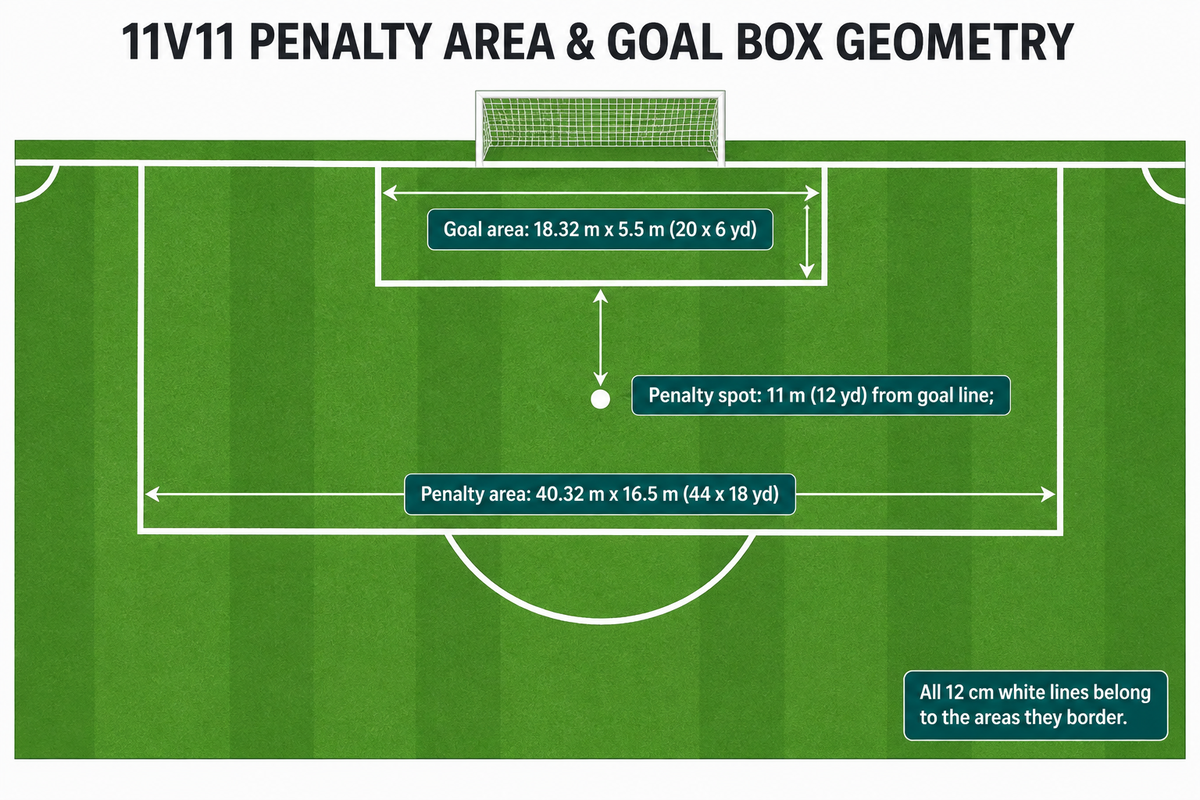
A regulation 11v11 penalty area measures 40.32 meters wide by 16.5 meters deep (44 by 18 yards), the 6-yard goal area measures 18.32 meters wide by 5.5 meters deep (20 by 6 yards), and the penalty spot sits 11 meters (12 yards) from the goal line.
Law 1 Zone-by-Zone Dimension Map
Rule 1 of IFAB places the exact dimensions of every internal goal-end marking box to the inside edge of both goalposts. With a regulation senior goal measuring 7.32 meters (8 yards / 24 feet) between the inside edges of the goalposts, the internal box width measures 7.32 meters (the senior goal opening) plus two wing extensions of the same length along the goal line.
Rule 1 Zone-by-Zone Dimension Map for 11v11 internal markings
Pitch zone or marking
Metric figure
Imperial figure
Linear paint length per pitch
How it is measured on the turf
Limitations / Not suitable for
Touchlines (2 sidelines)
90–120 m (105 m FIFA)
100–130 yd (115 yd FIFA)
210.0 m (689.0 ft)
Outer edge to outer edge along both long boundaries
Must always exceed the goal-line measurement
Goal lines (2 end lines)
45–90 m (68 m FIFA)
50–100 yd (74 yd FIFA)
136.0 m (446.2 ft)
Corner flagpost to corner flagpost across both ends
Line thickness must match goalpost width and depth
Halfway line & center mark
45–90 m (68 m FIFA)
50–100 yd (74 yd FIFA)
68.0 m (223.1 ft)
Divides pitch into two equal halves across the midpoint
Offside is judged from the second-last opponent or halfway line
Center circle
9.15 m radius (18.30 m dia)
10 yd radius (20 yd dia)
57.49 m (188.6 ft)
Swung 360 degrees from the center mark on the halfway line
Reduced to 8 yd radius on 7v7 and 9v9 youth pitches
Penalty area (18-yard box)
40.32 m wide x 16.5 m deep
44 yd wide x 18 yd deep
146.64 m (481.1 ft) for 2 boxes
16.5 m (18 yd) from inside of each goalpost, projected 16.5 m into pitch
Metric and imperial sums differ slightly due to rounded 8 yd goal width
Goal area (6-yard box)
18.32 m wide x 5.5 m deep
20 yd wide x 6 yd deep
58.64 m (192.4 ft) for 2 boxes
5.5 m (6 yd) from inside of each goalpost, projected 5.5 m into pitch
Does not scale down on narrow 11v11 pitches
Penalty mark (penalty spot)
11.0 m from goal line
12 yd (36 ft) from goal line
2 spots (22 cm dia)
Measured from midpoint between goalposts to center of spot
Distance is measured to the center of the painted mark
Penalty arc (the D)
9.15 m radius (14.63 m chord)
10 yd radius (16.0 yd chord)
33.89 m (111.2 ft) for 2 arcs
Arc swung from center of penalty spot outside the 16.5 m line
Not part of the penalty area for goalkeeper handling or fouls
Corner arcs (4 quadrants)
1.0 m radius quadrant
1 yd (3 ft) radius quadrant
6.28 m (20.6 ft) for 4 corners
Measured inside the playing surface from center of each corner flagpost
Ball only needs to overhang the 12 cm line to be validly placed
A close call on the field markings is ruled on a geometric basis by a certain Rule of governs: by Rule 1, all white lines belong to the areas they border. This means that a foul committed on the 12-centimeter (5-inch) line of the penalty area is a penalty kick, and the ball is in play until it completely crosses the outer edge of the touchline or the goal line. Details of how referees judge cautions in the 18-yard box are found in our guide to soccer yellow card rules and penalty-area cautions.
Center Circle, Penalty Arc, Corner Arcs, and Flagpost Clearances
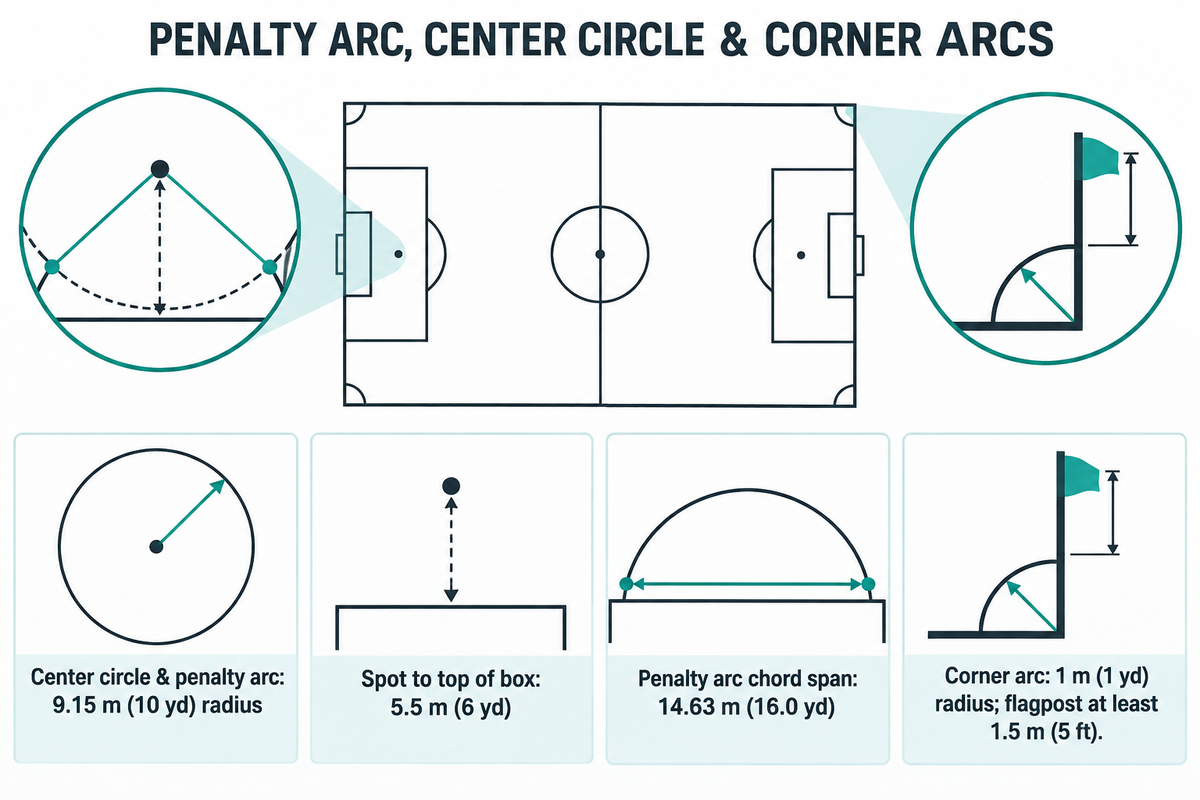
Both the center circle and the penalty arc use a strictly defined 9.15-meter (10-yard / 30-foot) radius to govern player encroachment distances at restarts and each of the four corners features a 1-meter (1-yard) internal arc and a flag post of at least 1.5 meters (5 feet) in height.
New fans are confused by the semicircular penalty arc sitting outside the top of the penalty box, and for a good reason: The penalty spot is 11.0 meters (12 yards) from the goal line and the penalty area extends 16.5 meters (18 yards) into the field. Because the penalty spot is 11.0 meters (12 yards) from the goal line and the penalty area extends 16.5 meters (18 yards) into the field, the distance from the penalty spot straight to the top edge of the box is only 5.5 meters (6 yards). Rule 14 states players other than the kicker and the goalkeeper must remain 9.15 meters (10 yards) from the ball until it’s kicked. Making a 9.15 meter arc radius from the 11 meter spot creates a “D” outside the box and a chord span of 14.63 meters (16.0 yards). Swinging a 9.15-meter arc radius from the 11-meter spot creates the familiar “D” outside the box, intersecting the 16.5-meter line across a chord span of 14.63 meters (16.0 yards).
According to Law 1, each of the four corners of the perimeter has a corner flag post with a non-pointed top that rises at least 1.5 meters (5 feet) above the turf. Grounds crews may also paint optional 9.15-meter (10-yard) tick marks outside the field layout, perpendicular to the goal line and touchline, to help referees keep defenders 10 yards back during corner kicks.
Regulation Soccer Goal Dimensions and Age-Group Goal Frame Scaling
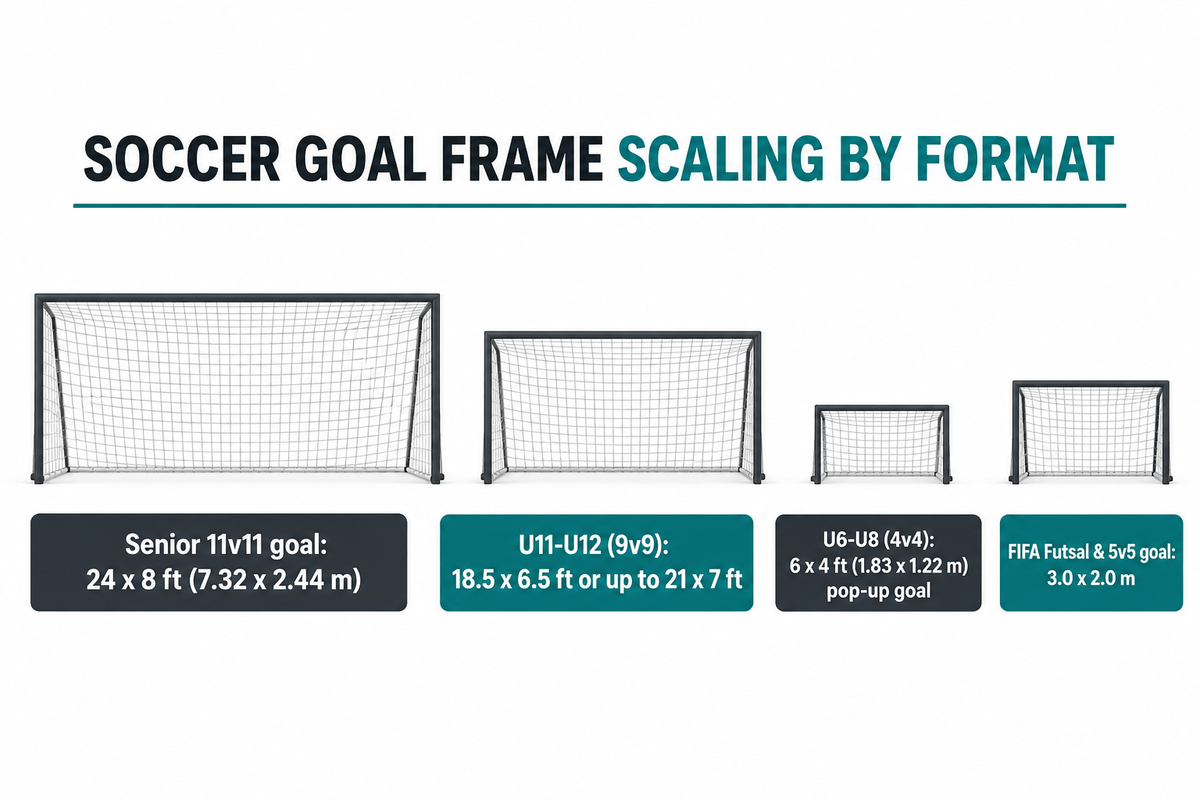
An official senior 11v11 soccer goal measures 7.32 meters wide between the inside edges of the vertical goalposts and 2.44 meters high from the ground to the lower edge of the crossbar (8 yards wide by 8 feet high, or 24 by 8 feet), covering a 17.86-square-meter (192-square-foot) scoring aperture.
Both goalposts and the crossbar must be manufactured from wood, metal, or another approved material, painted white, and share an identical cross-sectional width and depth not exceeding 12 centimeters (5 inches). As equipment supplier Net World Sports notes in its pitch and goal dimension guide, forcing young goalkeepers to defend a 24-by-8-foot adult frame distorts shot-stopping mechanics, so youth federations scale goal dimensions alongside pitch sizes.
Senior & U13+ (11v11 full-size): 24 ft wide x 8 ft high (7.32 m x 2.44 m); 192 sq ft mouth area.
Youth U11, U12 (9v9 developmental): 18.5 ft x 6.5 ft (5.64 m x 1.98 m) or maximum 21 ft x 7 ft (6.40 m x 2.13 m) under US Soccer PDI; 16 ft x 7 ft (4.88 m x 2.13 m) in England FA 9v9.
Youth U9, U10 (7v7 mini-soccer): 18.5 ft x 6.5 ft maximum (or 12 ft x 6 ft / 3.66 m x 1.83 m for entry-level 7v7 facilities).
Youth U6, U8 (4v4 small-sided): 6 ft wide x 4 ft high (1.83 m x 1.22 m) pop-up or weighted aluminum frames with no goalkeepers.
FIFA Futsal & 5v5 indoor hardcourt: 3.0 m wide x 2.0 m high (9.84 ft x 6.56 ft / 6.0 sq m mouth area).
Regardless of the size of goal dimensions used, movable soccer goals present tip-over risks on windy days and when players hang from crossbars. The U.S. U.S. Consumer Product Safety Commission movable soccer goal safety guidelines say that portable frames must be anchored to the ground using augers, tether stakes or counterweights, and that net pegs can’t be used to anchor the frame.
Youth Soccer Field Dimensions by Age Group (U6 to U19 Chart & Build-Out Lines)
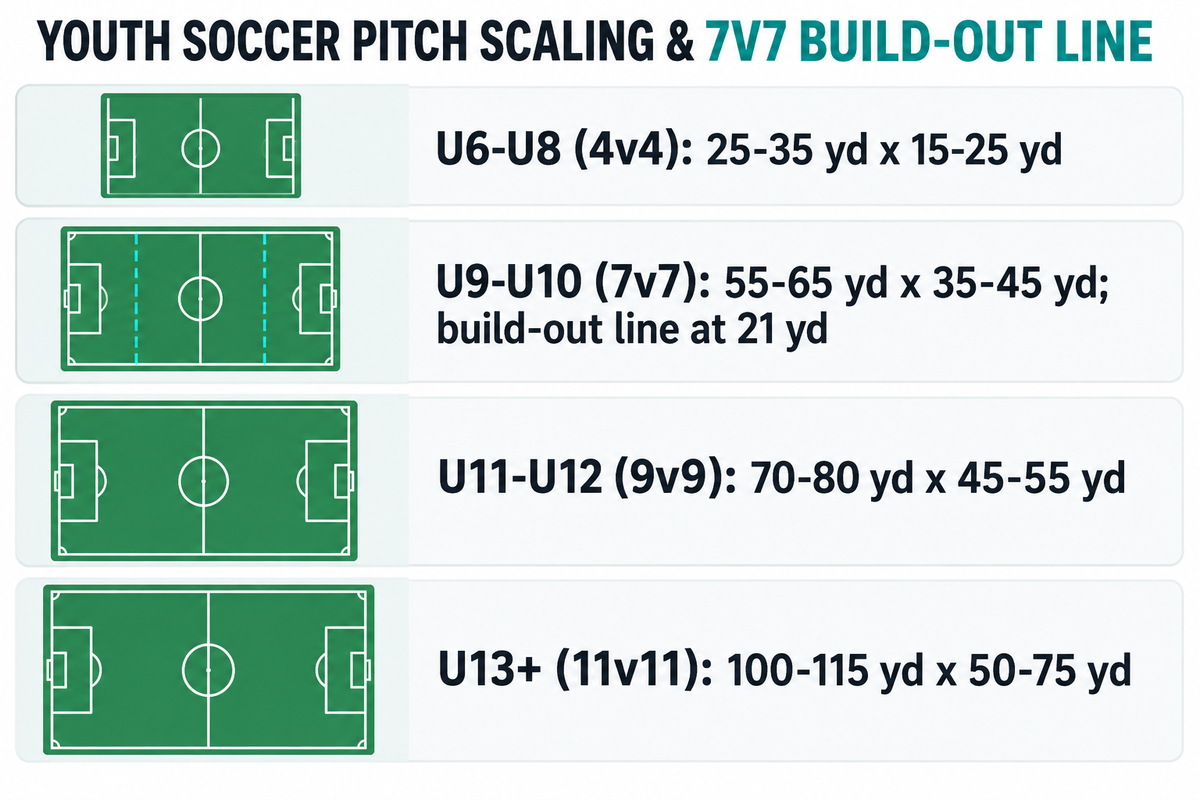
Youth soccer field dimensions scale by match format, rather than forcing kids to play on adult-sized fields. According to U.S. Soccer Player Development Initiatives (PDI), pitches begin at 25-35 by 15-25 yards (for U6-U8, 4v4), grow to 55-65 by 35-45 yards (for U9-U10, 7v7), 70-80 by 45-55 yards (for U11-U12, 9v9) and 100-115 by 50-75 yards (from U13 and above).
U6-to-Senior Pitch Scaling Schedule
Youth age groups’ schedules vary by location. The main matrix below outlines U.S. Soccer’s PDI standards, assessed against the Flick youth pitch guides and the SoccerBallWorld technical specifications. Unlike the U.S., FutureFit reforms by the England FA (effective 2026/27) endorses starting U7 with 3v3, and pushing back the introduction of 11v11 to U14. By contrast, England FA FutureFit reforms (effective 2026/27) introduce 3v3 at U7 and shift 11v11 entry to U14, while the Swedish Football Association (SvFF) keeps 10 to 12-year-olds on 7v7 pitches (50–55 by 30–35 meters), plays 9v9 (65–72 by 50–55 meters) at ages 13–14, and begins 11v11 at age 15. Read more about how match durations vary by age group in our guide to the length of a soccer game by age group.
U6-to-Senior Pitch Scaling Schedule (US Soccer PDI & International Benchmarks)
Age group & format
Length (yd / m)
Width (yd / m)
Penalty box & arc
Goal size & ball
Adult pitch fit
Limitations / Not suitable for
U7 Entry (3v3 England FA FutureFit)
20–30 yd / 18–27 m
15–20 yd / 14–18 m
No penalty box; no goalkeeper
Mini pop-up; Size 3
Up to 10 courts on one 11v11 pitch
Effective 2026/27 in England; US PDI uses 4v4
U6–U8 (4v4 US PDI)
25–35 yd / 23–32 m
15–25 yd / 14–23 m
No penalty box; no goalkeeper
4 x 6 ft; Size 3
Up to 8 fields on one 11v11 pitch
England FA FutureFit uses 3v3 at U7
U9–U10 (7v7 US PDI)
55–65 yd / 50–59 m
35–45 yd / 32–41 m
12 yd deep x 24 yd wide; 8 yd spot; build-out line
6.5 x 18.5 ft max; Size 4
2 fields side-by-side across width
Build-out line is US PDI specific, not IFAB global
U10–U12 (7v7 Sweden SvFF)
55–60 yd / 50–55 m
33–38 yd / 30–35 m
Marked goalkeeper area; retreat line
5 x 2 m; Size 4
2 fields across one 11v11 pitch
Nordic progression keeps U11–U12 in 7v7 instead of 9v9
U11–U12 (9v9 US PDI)
70–80 yd / 64–73 m
45–55 yd / 41–50 m
14 yd deep x 36 yd wide; 10 yd spot; 8 yd circle
6.5 x 18.5 ft or 7 x 21 ft; Size 4
1–2 fields depending on buffer
England FA 9v9 uses 16 x 7 ft goals
U13–U14 (9v9 Sweden SvFF)
71–79 yd / 65–72 m
55–60 yd / 50–55 m
Scaled penalty area; Size 4 or 5
6 x 2.2 m; Size 4/5
1 cross-field or main pitch
Delays full 11v11 entry until age 15
U13–U14 (11v11 US PDI)
100–110 yd / 91–101 m
50–65 yd / 46–59 m
Standard 18 x 44 yd box; 12 yd spot; 10 yd arc
8 x 24 ft; Size 5
1 full pitch (compact perimeter)
England FA FutureFit delays 11v11 until U14
U15–U19 (11v11 Youth)
100–120 yd / 91–110 m
55–75 yd / 50–69 m
Standard 18 x 44 yd box; 12 yd spot; 10 yd arc
8 x 24 ft; Size 5
1 full pitch
State cup finals often require 110 x 65 yd minimum
Senior Club / FIFA 11v11
115 yd / 105 m
74 yd / 68 m
16.5 m x 40.32 m box; 11 m spot; 9.15 m arc
2.44 m x 7.32 m; Size 5
1 elite stadium pitch
Too large for U12 and younger aerobic capacity
Where Does the U.S. Soccer Build-Out Line Go on a 7v7 Youth Pitch?
According to U.S. Soccer PDI, the dashed build-out line is painted parallel to the goal line, exactly equidistant between the top of the 12-yard penalty area and the halfway line. On a standard 60-yard-long 7v7 pitch where the halfway line sits at 30 yards and the penalty box extends 12 yards from each goal line, the build-out line sits 9 yards outside the penalty area (21 yards from the goal line). When the goalkeeper gains possession, opponents must retreat behind the build-out line until the ball is put into play, and the build-out line also replaces the halfway line as the offside line. The build-out line is also the offside line for this game situation.
High School (NFHS), College (NCAA), and Small-Sided / Futsal Pitch Dimensions
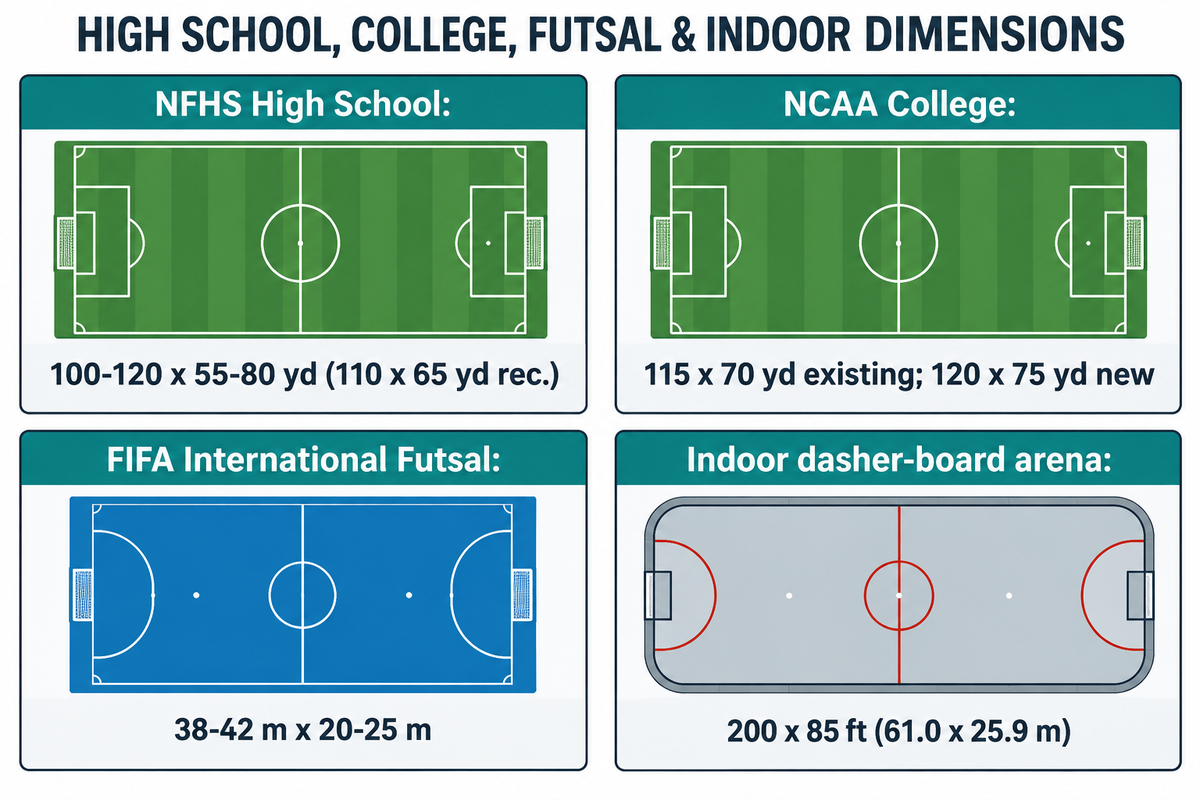
In North America, NFHS high school rules permit pitches of 100 to 120 yards long by 55 to 80 yards wide (recommended 110 by 65 yards), NCAA college rules require 115 to 120 yards by 70 to 75 yards for new facilities, and FIFA international futsal hardcourts measure 38 to 42 meters long by 20 to 25 meters wide. International FIFA futsal courts have a playing surface of 38 to 42 meters by 20 to 25 meters.
American scholastic and collegiate rulebooks set their own length and width floors that differ slightly from IFAB Rule 1 at the narrow end of the spectrum. While IFAB allows a 50-yard (45-meter) minimum width for grassroots play, the National Federation of State High School Associations (NFHS) sets its official width floor at 55 yards (165 feet) and recommends 110 yards long by 65 yards wide (330 by 195 feet). The NCAA Soccer Rules Book requires existing fields to measure at least 115 by 70 yards (105.2 by 64.0 meters) and newly constructed fields to measure at least 120 by 75 yards (109.7 by 68.6 meters).
FIFA Futsal Hardcourt (5v5)
International court: 38–42 m long by 20–25 m wide (125–138 ft x 66–82 ft).
Non-international / domestic court: 25–42 m long by 16–25 m wide.
Uses touchlines, a 6 m penalty area arc, 6 m and 10 m penalty marks, and 3 x 2 m handball-style goals.
North American Indoor Arena & Turf Cages
Dasher-board arena soccer (MASL): 200 ft long by 85 ft wide (61.0 m x 25.9 m), built on standard ice hockey rink footprints.
5v5 / 6v6 commercial turf cages: 30–40 yd long by 20–30 yd wide (90–120 ft x 60–90 ft).
7v7 adult recreational leagues: 50–65 yd long by 35–45 yd wide.
Soccer Field vs. American Football Field Size: Can a Regulation Pitch Fit on a Gridiron?
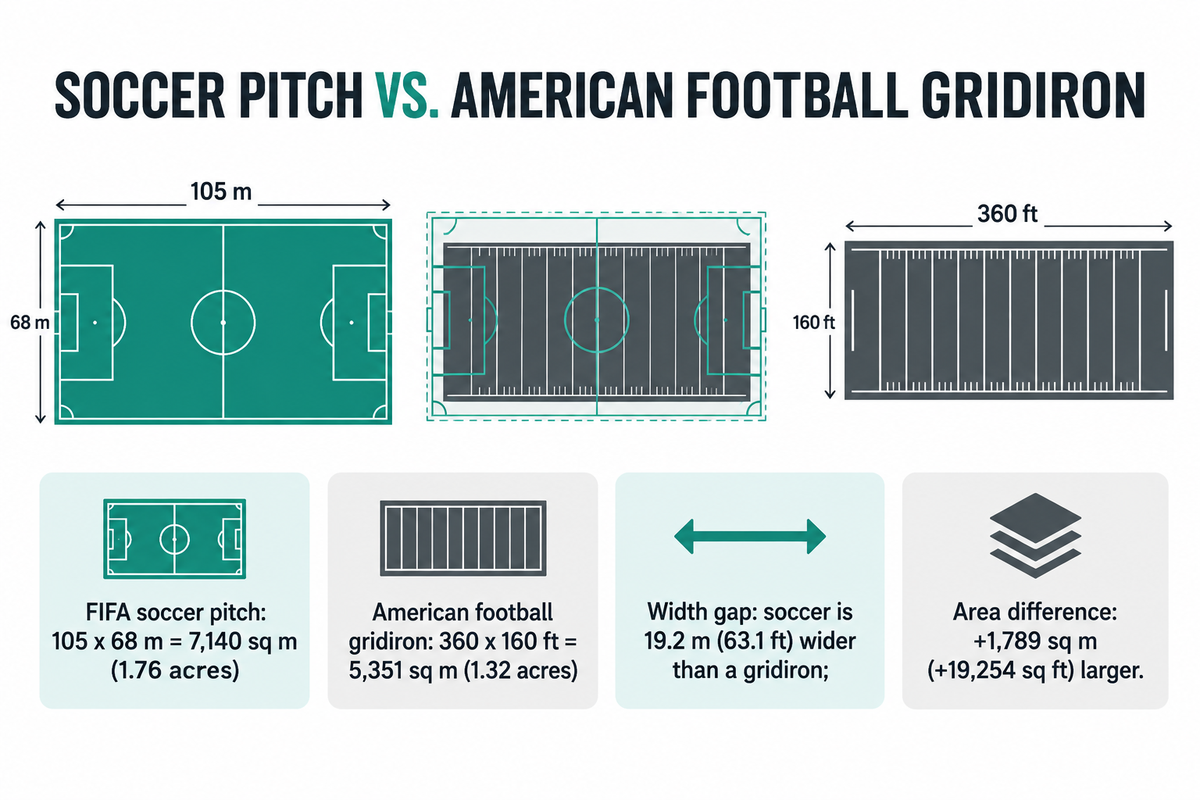
A FIFA 105 by 68 meter soccer pitch covers 7,140 square meters (76,854 square feet or 1.76 acres), making its playing surface 1,789 square meters (19,254 square feet) larger and 19.2 meters (63.1 feet) wider than an American football field’s 360 by 160 foot (57,600 square foot / 1.32 acre) gridiron rectangle.
Whether a fan asks how long is a soccer pitch compared with a gridiron, the central conflict in shared North American stadiums is width, not length. An American football playing surface measures 100 yards between goal lines plus two 10-yard end zones, totaling 120 yards (360 feet / 109.7 meters) long, which is slightly longer than a 105-meter (344.5-foot) FIFA soccer pitch. A regulation gridiron is 53.33 yards (160 feet / 48.8 meters) wide. Even at the high school level, NFHS soccer rules require a minimum width of 55 yards (165 feet), creating a 5-foot geometric pinch unless the synthetic turf apron extends past the football numbers and team bench areas.
Playing surface footprint comparison across major field and court sports
Sport & governing standard
Length
Width
Surface area (sq m / sq ft / acres)
Limitations / Not suitable for
Soccer (FIFA / UEFA 105 x 68 m)
105.0 m / 114.8 yd / 344.5 ft
68.0 m / 74.4 yd / 223.1 ft
7,140 sq m / 76,854 sq ft / 1.76 acres
Does not fit inside a 160 ft NFL gridiron without wide sideline aprons
American Football (NFL / NCAA / NFHS)
109.7 m / 120.0 yd / 360.0 ft
48.8 m / 53.33 yd / 160.0 ft
5,351 sq m / 57,600 sq ft / 1.32 acres
19.2 m (63.1 ft) too narrow for FIFA 68 m soccer width
Rugby Union (World Rugby max)
100.0 m play (144.0 m w/ in-goals)
70.0 m / 76.6 yd / 229.7 ft
7,000 sq m play (10,080 sq m total)
Easily accommodates a 105 x 68 m soccer pitch inside its perimeter
Basketball (NBA / NCAA court)
28.65 m / 31.3 yd / 94.0 ft
15.24 m / 16.7 yd / 50.0 ft
436.6 sq m / 4,700 sq ft / 0.11 acres
Approximately 16.3 NBA courts fit inside one 105 x 68 m soccer pitch
FIFA International Futsal Court
40.0 m / 43.7 yd / 131.2 ft
20.0 m / 21.9 yd / 65.6 ft
800 sq m / 8,611 sq ft / 0.20 acres
Almost nine futsal courts fit inside one full-size outdoor pitch
Identify the painted gridiron lines and the stadium’s physical lower-bowl envelope. While a 160-foot football rectangle is always 63.1 feet narrower than a 68-meter soccer pitch, whether a stadium must remove seats depends on how much concrete or turf apron exists between the football sidelines and the front-row retaining wall. As ESPN reported on 2026 FIFA World Cup NFL host stadiums, venues such as SoFi Stadium and MetLife Stadium had to engineer retractable or removable lower-corner seating blocks so the full 125 by 85 meter FIFA pitch and runoff envelope could clear the bowl corners. In Major League Soccer, Athletic Business documented how NYCFC fits its pitch into Yankee Stadium by orienting a 110 by 70 yard (100.6 by 64.0 meter) surface across the baseball outfield and excavating the pitch mound before each match.
How to Lay Out, Line-Mark, and Outfit a Full-Size 11v11 Soccer Pitch
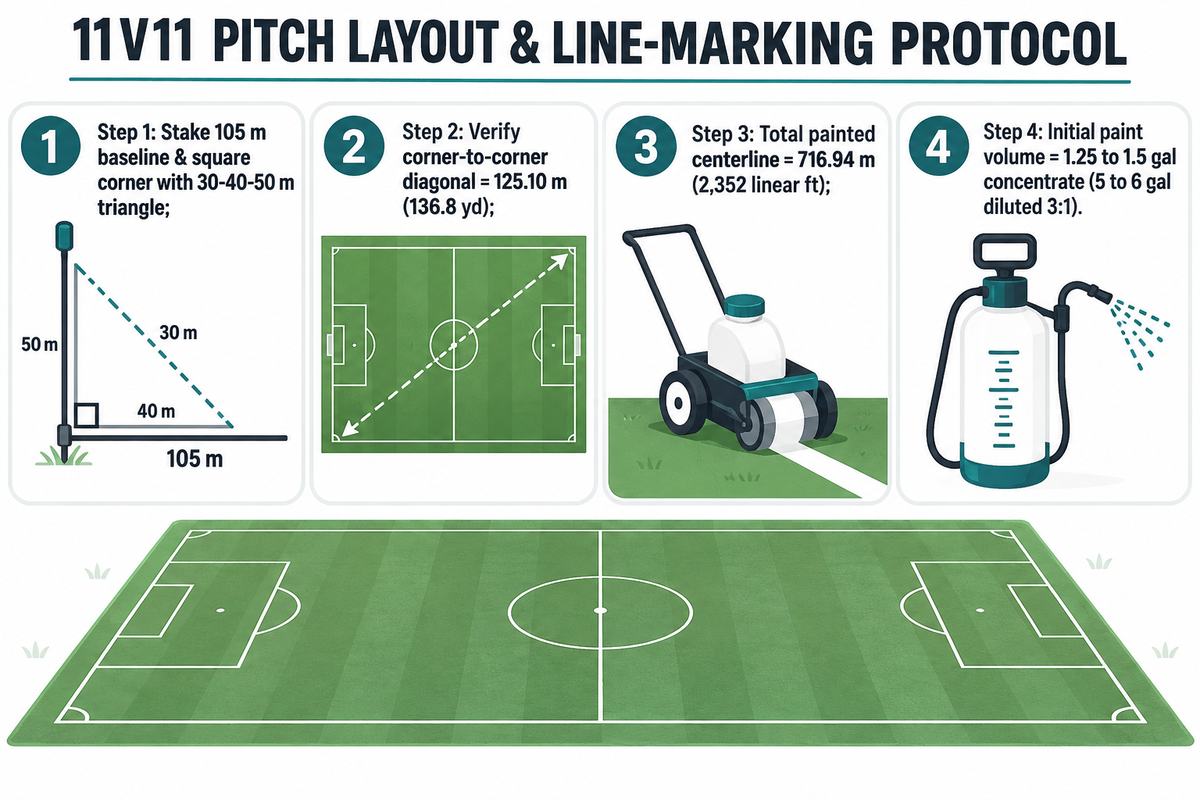
Laying out a regulation 105 by 68 meter soccer pitch requires squaring the baseline corner with a 3-4-5 right-triangle tape ratio, verifying the 125.10 meter (136.8 yard) corner-to-corner diagonal, and striping approximately 717 linear meters (2,352 linear feet) of 10 to 12 centimeter white lines.
3-4-5 Corner-Squaring Layout Protocol
Two 105-meter touchlines and two 68-meter goal lines laid out with fiberglass reel tapes without securing a 90-degree corner angle would form a skewed parallelogram. Field striping specialists at Fox Valley Paint and SoccerBallWorld’s pitch layout technical guide use the 3-4-5 triangle (30 m, 40 m, 50 m or 30 ft, 40 ft, 50 ft) and the Pythagorean theorem, followed by a full-field diagonal check.
Stake the primary touchline. Pull a 105 m (114.8 yd) baseline string along the sunny or main-stand touchline and drive temporary steel pins at both corner flags.
Square the first corner with a 3-4-5 triangle. Measure 30 m along the staked touchline, pull a second tape 40 m along the proposed goal line, and pivot until the diagonal tape between the 30 m and 40 m marks reads exactly 50.0 m.
Cross-check the full-pitch diagonal. Before staking the far corners, verify that both corner-to-corner diagonals across the 105 x 68 m rectangle measure 125.10 meters (136.8 yards / 410.4 feet) within a tolerance of plus or minus 3 centimeters.
Strike internal boxes from the inside of the goalposts. Center the 7.32 m (24 ft) goal frame at the 34.0 m midpoint of the goal line, measure 5.5 m (6 yd) and 16.5 m (18 yd) outward along the goal line from each inside post, and swing 9.15 m (10 yd) radii from the center mark and 11.0 m penalty spots.
How Many Gallons of Turf Paint Are Needed to Line-Mark an 11v11 Soccer Field?
The centerline sum of a 105 by 68 meter pitch yields 210.0 meters for two touchlines, 136.0 meters for two goal lines, 68.0 meters for the halfway line, 57.49 meters for the center circle ( radius 9.15 m ), 146.64 meters for the three painted sides of both penalty areas, 58.64 meters for both goal areas, 33.89 meters for the two penalty arcs ( 16.94 m each ), and 6.28 meters for the four corner arcs, totalling 716.94 linear meters (approximately 717 meters or 2,352 linear feet) .
In your budgeting, distinguish undiluted concentrate from diluted ready-to-spray mix. About 1.25 to 1.5 U.S. Striping 2,352 linear feet at a 4-to-5-inch line width on virgin grass with a walk-behind airless sprayer typically consumes 1.25 to 1.5 U.S. The paint is diluted 3:1 with water to make 5 to 6 gallons of ready-to-spray mix. Weekly mid-season re-striping over visible lines uses roughly half that volume (2.5 to 3.5 gallons of diluted mix), while GPS robotic line markers with low-flow atomizing nozzles can complete an initial layout using 0.75 to 1.0 gallon of concentrate (2.5 to 3.5 gallons mixed).
Which Match Kits and Field Equipment Brands Outfit Teams for Full-Size 11v11 Play?
Transitioning from compact 7v7 or 9v9 training pitches to a full 7,140-square-meter (1.76-acre) 11v11 surface increases player sprint loads and thermal output across 90 minutes. Teams typically use aluminum ground-socketed goals with corner flags from suppliers like FORZA (Net World Sports), Kwik Goal, Jaypro Sports, and Harrod Sport, and pair them with a FIFA Quality Pro size 5 match ball.
Frequently Asked Questions About Soccer Field Dimensions
Can a regulation soccer pitch be a perfect square under IFAB Rule 1?
No. The touchline must always be longer than the goal line.
No. Although IFAB Rule 1 lists a general minimum touchline length of 90 meters (100 yards) and a general maximum goal-line width of 90 meters (100 yards), Section 1 of Rule 1 explicitly mandates that the field of play must be rectangular and that the touchline must always be longer than the goal line. Even on a park pitch built to maximum width, groundskeepers must set the touchline to at least 91 meters (101 yards) so the surface remains a true rectangle.
How many acres is a full-size 11v11 FIFA soccer field?
A FIFA 105 by 68 meter pitch equals 1.76 acres (7,140 sq m).
A standard FIFA and UEFA 105 by 68 meter playing surface covers 7,140 square meters (76,854 square feet), which equals 1.76 acres inside the painted boundary lines. Across the broader IFAB Rule 1 range for non-international 11v11 football, official field size spans from 1.00 acre at minimum dimensions (90 by 45 meters) up to 2.67 acres at maximum dimensions (120 by 90 meters).
What is the smallest pitch size allowed in the English Premier League?
105 by 68 meters is standard, with a 100 by 64 meter international floor for waived grounds.
Under Premier League Handbook Rule K.14, clubs must lay out their pitch at 105 by 68 meters (114.8 by 74.4 yards) unless the physical construction of the stadium stands makes that impossible. When a historic ground receives a dimensional exception, its playing surface still can’t fall below IFAB’s international match minimum of 100 by 64 meters (110 by 70 yards). Recent examples include Fulham’s Craven Cottage at 100 by 65 meters (6,500 square meters) and Luton Town’s Kenilworth Road at 100.6 by 65.8 meters.
How tall must corner flags be on a regulation soccer pitch?
At least 1.5 meters (5 feet) tall with a non-pointed top.
IFAB Rule 1 requires a corner flagpost at each of the four intersections of the touchline and goal line standing at least 1.5 meters (5 feet) high with a blunt, non-pointed top to protect sliding players from injury.
How far do players run during a 90-minute match on a 105 m × 68 m pitch?
Outfield players typically cover 9.5 to 11.5 kilometers (5.9 to 7.1 miles).
On a regulation 105 by 68 meter pitch, elite outfield soccer players cover an average of 9.5 to 11.5 kilometers (5.9 to 7.1 miles) over 90 minutes, with box-to-box central midfielders and overlapping wing-backs frequently logging 12.0 to 12.5 kilometers.
Key takeaway
Before staking corners or ordering goals, confirm whether your fixture follows FIFA 105 x 68 m stadium standards, NFHS/NCAA scholastic rules, or regional youth age-group charts, then anchor every 11v11 internal box measurement to the inside edges of the 7.32 m goalposts.
Editorial note: Pitch measurements in this guide are compiled from official rule books of IFAB, FIFA, UEFA, and national associations checked in October 2026. Linear marking sums and paint volumes are geometric baseline calculations; always verify local league handbook modifications and turf paint manufacturer dilution sheets before striping a facility.
I write about football shirts in use and in club history. My articles compare training and match-day jerseys and revisit memorable Mohamed Salah Liverpool shirts, helping readers connect fit and purpose with the players and moments that made a kit familiar.