Still searching for your perfect jersey? Explore our best-selling products—we're confident you'll find a style that's just right for you in our diverse collection.
A soccer yellow card records a caution under the rules of the game. Normally, the player stays in the game. The confusion starts after the issuance of a caution. It could be another caution given the same day, the next day, the following week or before the deadline of a competition. Each of these may have a different effect.
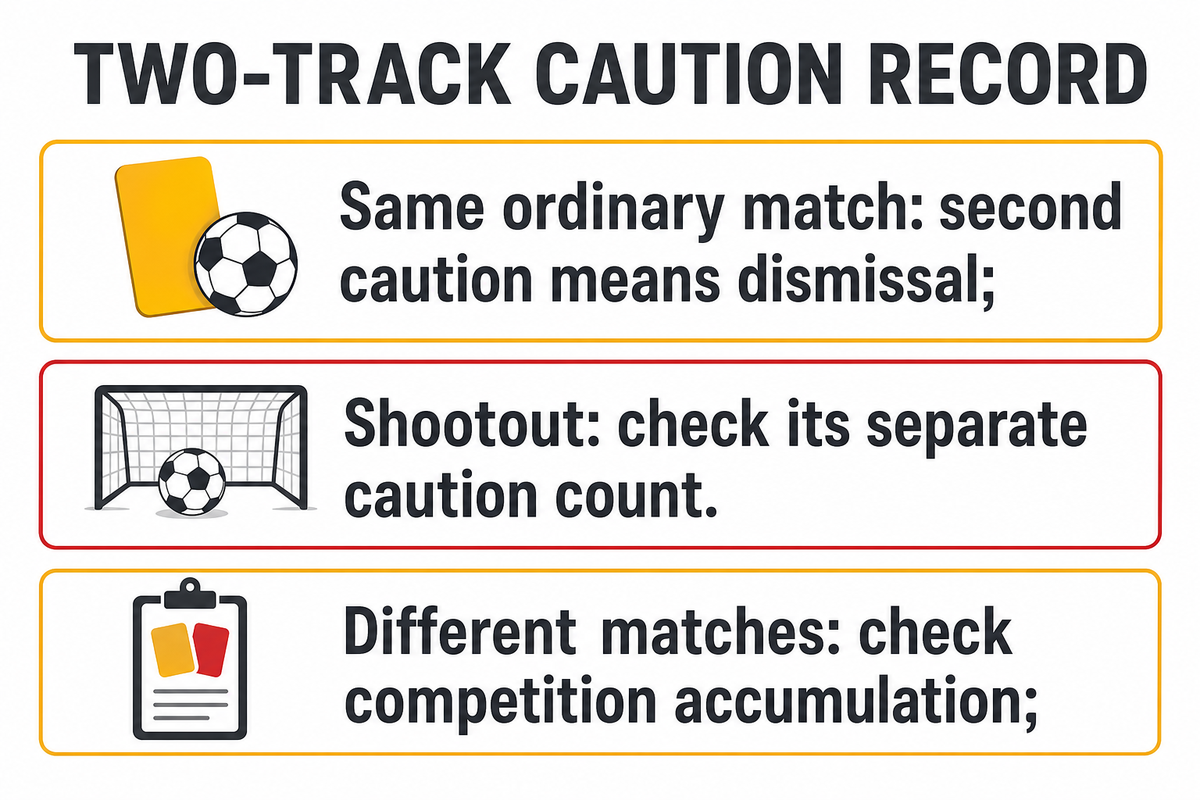
Keep the match record separate from the competition record. Two cautions in one ordinary match mean dismissal; accumulated bookings across matches trigger whatever suspension that competition specifies.
Rules checked October 2026. This document describes standard association football within the 2026/27 Laws of the Game, including named competition editions and permitted local variations. SoccerKit publishes this as fan education; it is not a disciplinary ruling.
Soccer yellow card meaning: a caution, not a dismissal
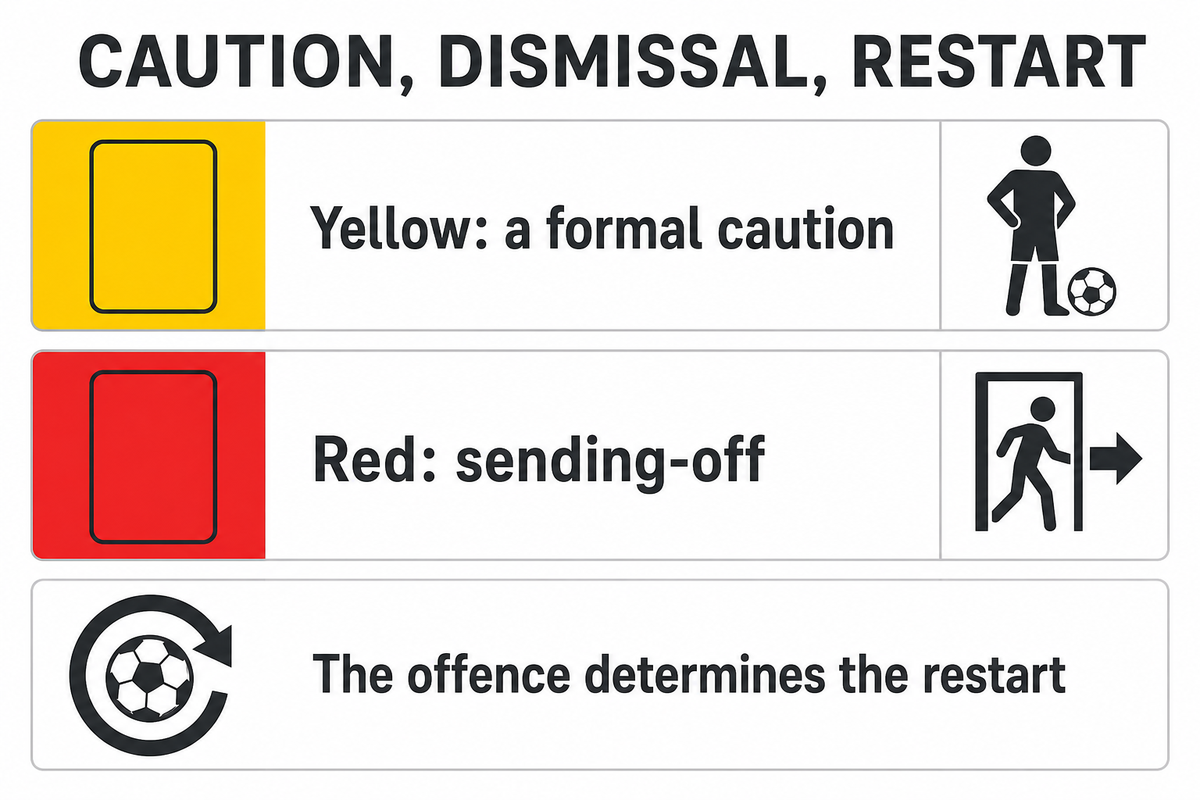
A yellow card in soccer is a formal caution for misconduct. Receiving a yellow usually allows continued participation and a red card means a sending-off. The yellow card serves as a warning recorded by the referee; a player isn’t required to be given a verbal warning prior to a cautionable offence being punished.
“The yellow card communicates a caution and the red card communicates a sending-off.”
Yellow card vs red card: the immediate difference
A player shown the yellow card is usually allowed to continue. A player who receives a red is sent off, or ejected from the game. Red and yellow card signals show the different disciplinary decisions to both teams and the spectators. When a yellow card is shown, the card also creates a record for the competition’s disciplinary process.
Yellow and red cards don’t determine the restart. Delaying an awarded throw-in can result in a yellow card without turning that throw-in into the opposing team’s free kick. The foul committed or the reason that play was stopped determines how play will resume. A penalty kick isn’t automatically followed by a yellow card.
Yellow card offences: fouls, dissent and celebrations
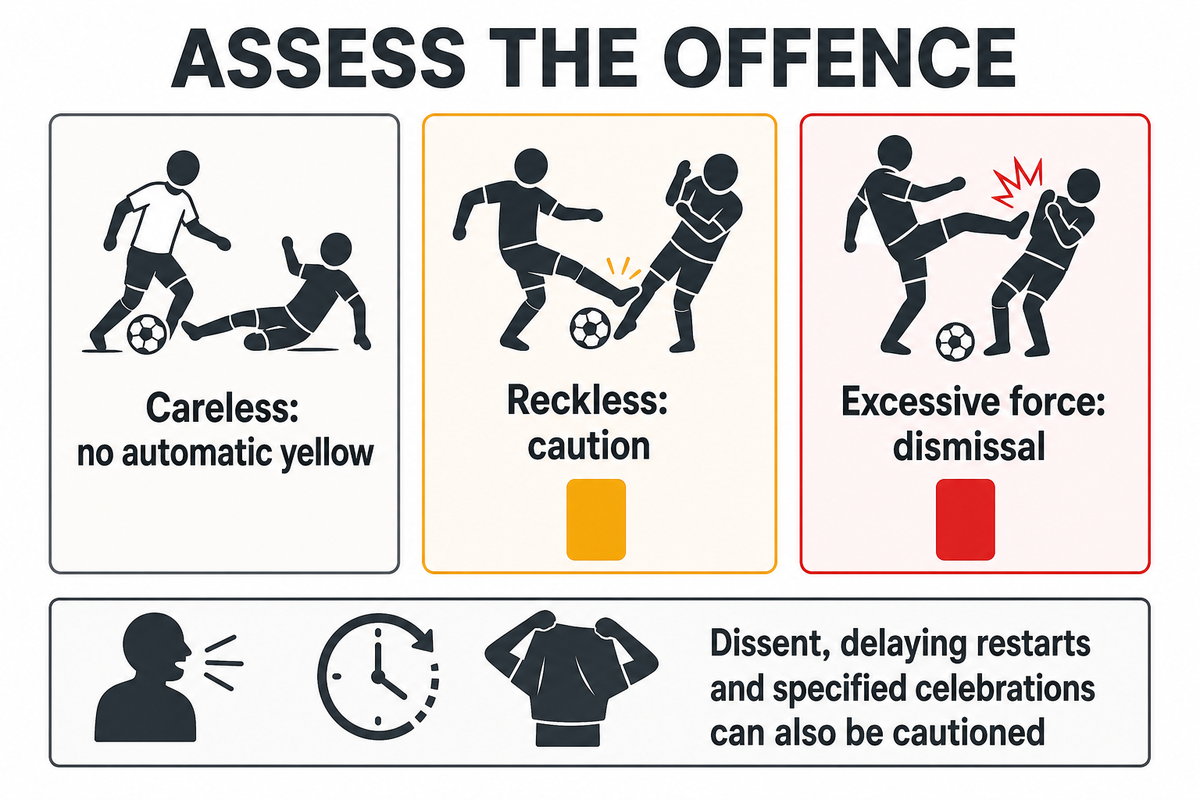
Yellow card offences include reckless challenges, dissent, delays in restarting play, repeated infractions and specified unsporting conduct. The referee assesses what happened and any relevant exception. A careless tackle need not warrant a booking; excessive force or serious foul play requires the severe penalty of dismissal without a prior caution.
The table groups common yellow card offenses by the reason for the sanction. It summarizes IFAB’s cautionable offences, rather than treating every collision or handball as the same infraction.
Caution types and their limits
Offence type
Why a caution can follow
Limitations / Not suitable for
Reckless challenge
Disregard for danger to an opponent
Careless is not automatically yellow; excessive force requires red
Dissent
Disagreement expressed through words or actions
Offensive, insulting or abusive conduct can require dismissal
Delaying the restart
Preventing play from resuming promptly
Identify deliberate delaying conduct, not simply elapsed time
Persistent offences
A pattern of repeated offending
No fixed number of fouls automatically defines persistence
Simulation
Attempting to deceive the referee
A player who was fouled can still exaggerate injury
Stopping a promising attack
A tactical offence interrupts the attack
Advantage and specified penalty-area exceptions can remove this caution basis
Handball misconduct
For example, deliberate handling that stops a promising attack
Not every handball offence warrants a card; apply the specific sanction
Restart distance
Failing to respect the required distance
Use the distance rule for that restart, not one value for every restart
Unauthorized entry or exit
Entering, re-entering or deliberately leaving without required permission
Ordinary movement over a boundary is not automatically misconduct
Shirt removal in celebration
Removing the shirt or covering the head with it
The caution still applies if the goal is disallowed
Provocative celebration
Provocative, derisory or inflammatory behaviour
Leaving the field to celebrate alone is not a cautionable offence
“Unsporting behavior,” more commonly known as unsportsmanlike conduct, includes several of these behaviors. A player can receive a yellow card for dissent when arguing with an official; violent conduct belongs to a different sanction category. Intent alone doesn’t determine whether a yellow or red card is given.
Common mistakes when judging a booking
Being booked once doesn’t mean the next offense is automatically a second bookable offense. The Premier League and Pro Ref 2026/27 guidance states that officials should assess subsequent fouls independently while considering persistent offending. A clear cautionable offence should still be punished when the player is already booked.
Disciplinary consequences may change depending on advantage. Under 2026/27 Law 12 changes, an offence denying the opposing team an obvious goal-scoring opportunity doesn’t warrant a caution on that basis when advantage results in a goal, while a separately reckless challenge still warrants a caution.
Maintaining caution when administering bookings in the penalty box is critical. Some attempts to play or challenge for the ball that stop a promising attack are not cautioned when a penalty is awarded. Holding, pulling and deliberate handball are assessed differently. Whether a yellow card is given is determined by the identified offence and not the fact a penalty shot is awarded.
Two yellow cards in one match vs cards across matches
Two yellow cards in one ordinary match lead to a red card and dismissal. Two cautions in different matches don’t result in an immediate sending-off. Bookings are accumulated under the competition’s counting rules and are assessed for a suspension for the next game or other stipulated fixture.
Two-Track Caution Record
Yellow cards and red cards describe match sanctions, but their accumulation warrants a separate check. Consider the disciplinary record for the current match along with the competition’s running tally. A number of cards on a broadcast graphic doesn’t provide this information.
Match record
Ask whether both cautions occurred in this match.
A second caution ordinarily brings a sending-off.
Check the separate shootout rule before combining cards.
Competition record
Ask which competition and season count the bookings.
Apply its accumulation threshold and cutoff.
Check separately whether a suspension is already due.
How many yellows before a red?
Normal IFAB rules state that players who receive two yellow cards in one game are dismissed. The referee will show a red card after that second yellow; the player can’t continue for the rest of the match. There’s no allowance for three yellow cards in a single ordinary match. Approved temporary dismissal systems have their variations and allowances explained below.
As an example, if cautions are given in the 25th and 70th minutes of a game, the player is dismissed for the remainder of the game. Cautions given on two different Saturdays result in an accumulation check. Even two separate cautionable offenses close together in the same game can result in two bookings given by the referee.
Two match cautions are often referred to as “equal a red card”. That describes the dismissal, not all competitions’ bookkeeping rules. For players who receive a red card, including changes to the team, see our soccer red card and team-number guide.
How long does a yellow card last?
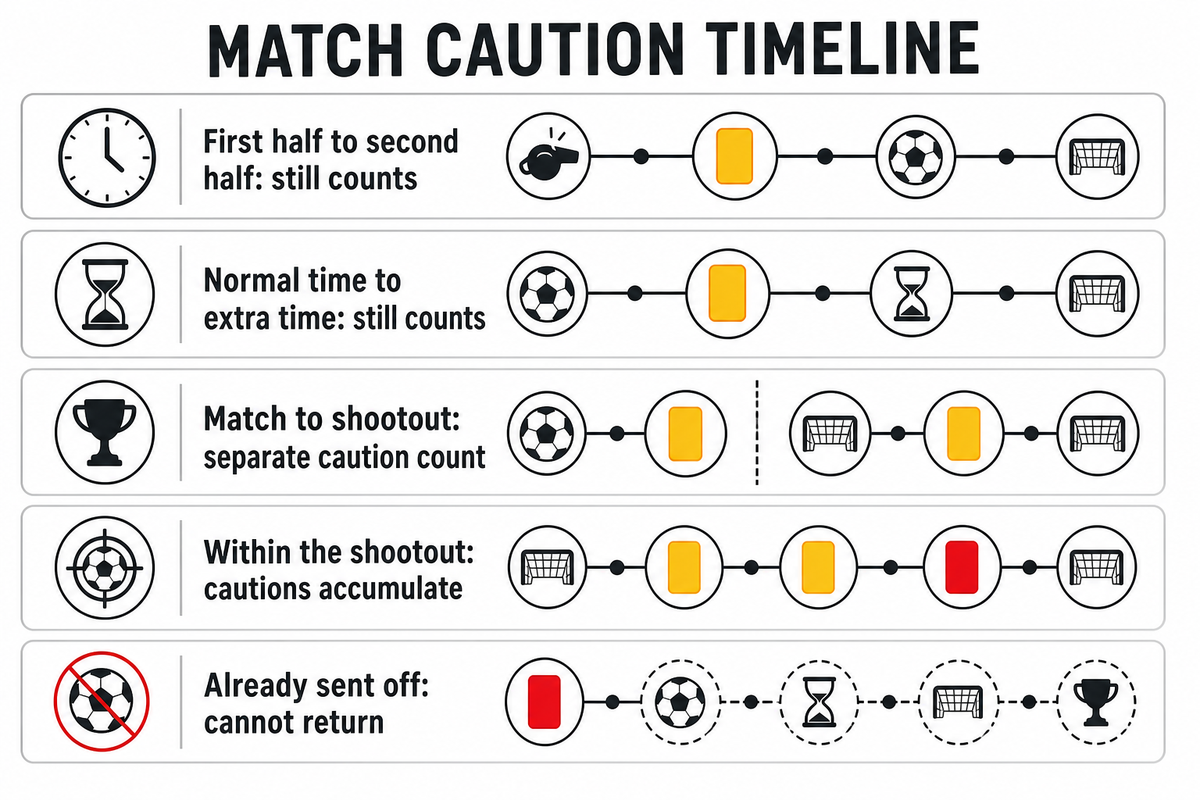
A match caution is relevant for the remainder of the game and any extra time. A match caution doesn’t expire after a certain number of minutes. Penalties after the match use a separate caution count under IFAB Law 10; competition accumulation across later games follows its own deadlines, so “lasting until full time” is an incomplete answer.
Match caution timeline
Boundary
Does the earlier caution still count?
Practical consequence
First half to second half
Yes
A second caution after the interval can dismiss
Normal time to extra time
Yes
Extra time does not provide a fresh caution allowance
Match to penalty shootout
No, for the shootout caution count
A match caution plus one shootout caution does not alone dismiss
Within the shootout
Yes
Two shootout cautions can cause dismissal
After a prior sending-off
Dismissal remains effective
The player cannot return for the shootout
Law 10.3 separates match and shootout counts. The referee report doesn’t change, and both cautions are reported when a player is booked once during the match and once during penalties.
Do soccer yellow cards carry over to the next game?
Bookings in a match can count towards that competition’s accumulation, and a player doesn’t begin the next game with a match caution. A new match starts a new caution count. The rules of the competition and when the reset happens determine whether a player is ineligible to play.
A hypothetical caution in the 80th minute followed by another in extra time remains a same-match pair: the offender leaves for the remainder of the match. A later shootout caution is counted differently. Our guide to soccer match length and extra time explains the timing; the disciplinary boundary comes from Law 10.
Yellow card accumulation: totals, cutoffs and suspensions
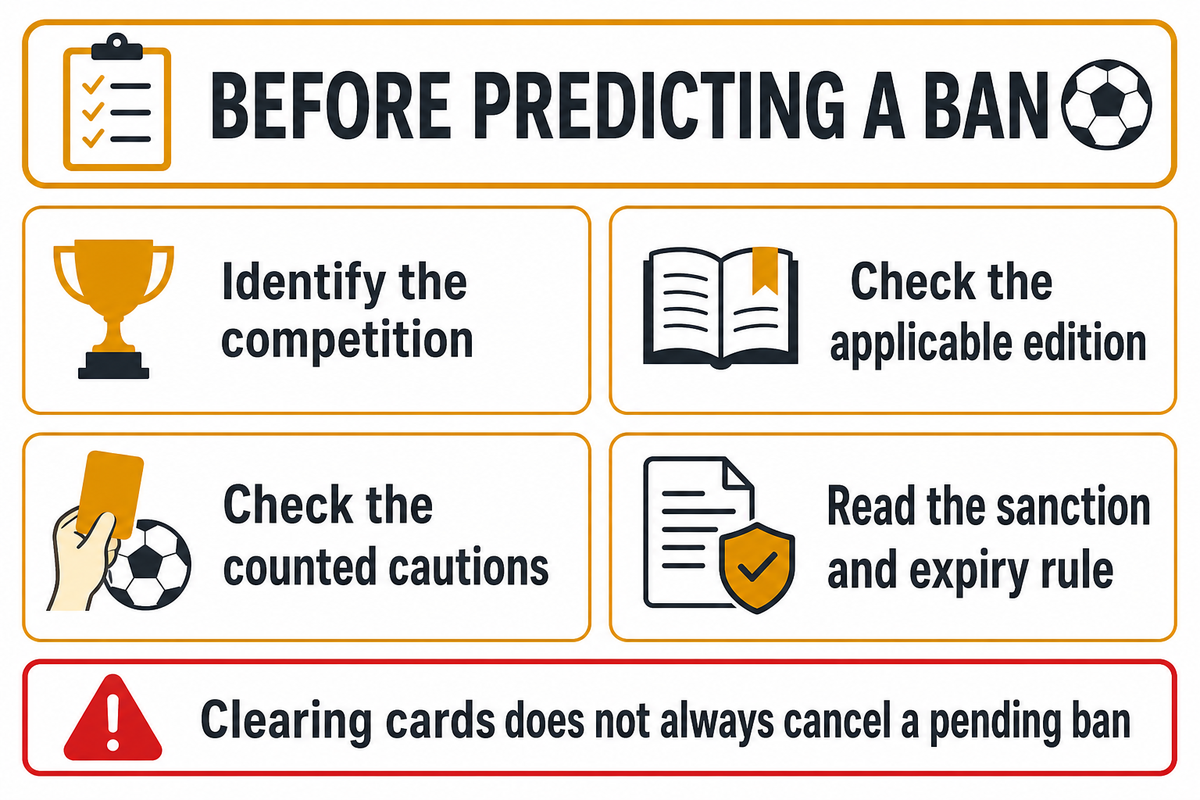
Yellow card accumulation links bookings across matches to a competition-specific sanction. To determine a yellow card suspension, identify the competition, season, threshold, counting deadline and fixtures impacted. Clearing a running total and cancelling an already incurred ban are different provisions, and neither should be assumed from the word “reset.”
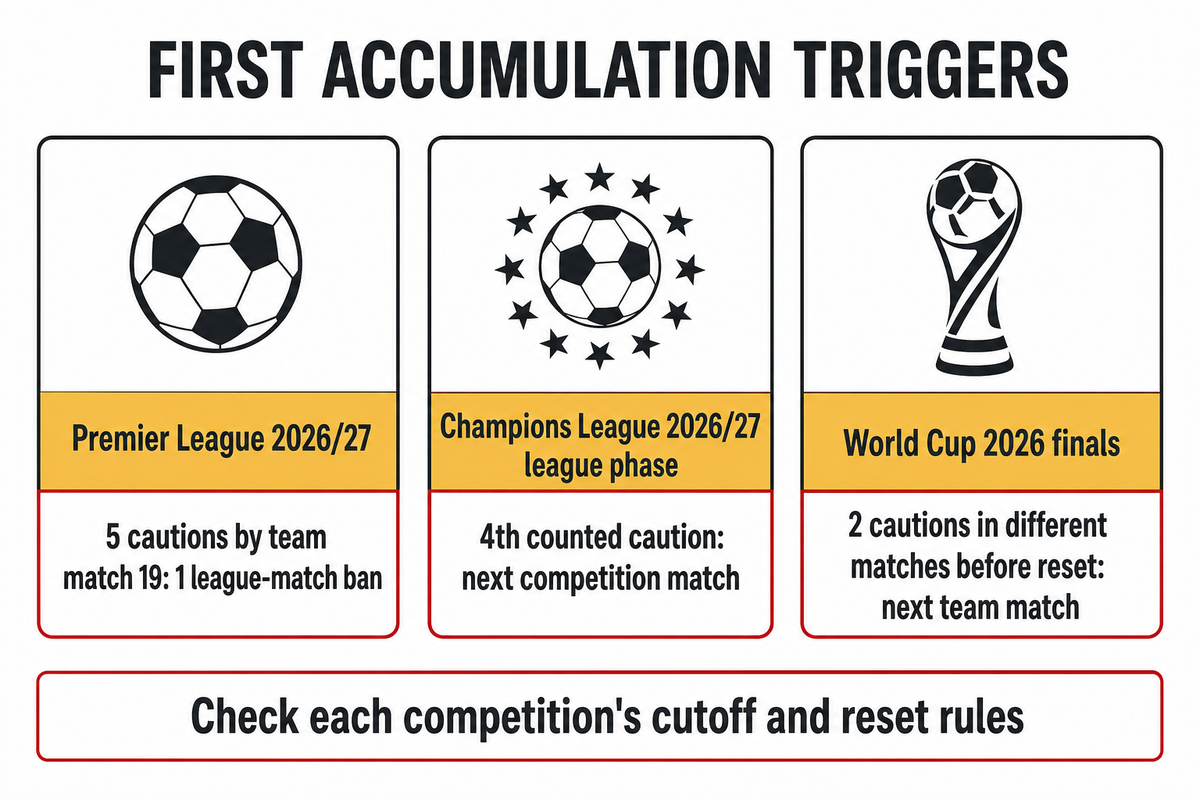
The language in the Premier League cutoffs is regarding fixtures and not appearances. The league’s current suspension guidance states the team’s first 19 league matches of the season will be used for the five-booking threshold. Therefore, a player who has missed games won’t get a personal 19-match window for the five-booking threshold.
If a player receives a fifth booking in the team’s 19th Premier League match, that player will receive a one-game suspension in that competition. A fifth booking in the team’s 20th Premier League match won’t result in that five-booking suspension. The bookings aren’t simply forgotten: the ten-caution threshold through the team’s 32nd league fixture remains relevant. The ten-booking threshold for the team’s 32 league matches will be enforced.
Identify the competition. League, domestic cup and continental cup records can differ.
Check the applicable edition. Find the season or tournament regulation and counting cutoff.
Check the counted cautions. Do not assume every card in a dismissal contributes to accumulation.
Read the sanction. Confirm which fixtures serve the ban and whether a specific expiry provision applies.
UEFA provides an important exception to a general “existing bans never reset” rule. Its 2026/27 Champions League Article 63.04 clears pending yellow-card suspensions after the qualifying play-offs. After the quarter-finals, the rule clears yellow cards, while an already triggered suspension remains due.
Don’t assume a player will be available solely from the next scheduled club match or news that an appeal has been submitted. Read the governing body’s relevant discipline and appeal decisions. We aren’t assuming that filing an appeal automatically lifts or pauses a suspension.
Premier League, Champions League and World Cup yellow cards
The World Cup, Premier League and Champions League have different yellow-card thresholds and reset points. Comparing the thresholds and reset points, below are the editions we checked: domestic and European club rules for 2026/27, and the 2026 FIFA World Cup finals. The numbers below must not be extrapolated to other leagues and tournaments.
Player reduction applies after every 2 eligible registered rounds
Champions League 2026/27 from league phase
4th caution, then 6th, 8th and so on
Suspension from the next competition match
Count cautions that did not result in a red card
After Champions League qualifying play-offs
End of qualifying play-offs
Yellow cards and pending yellow-card suspensions expire
Do not extend this exception to every later reset
After Champions League quarter-finals
End of quarter-finals
Yellow cards expire
Already incurred suspension still has to be served
FIFA World Cup 2026 finals
2 cautions in different matches before an applicable reset
Suspension from the team’s next match
Single cards clear after groups and quarter-finals; a triggered ban remains
The qualifying reduction requires attention: after every two rounds for which a player was registered and eligible, UEFA reduces that player’s total of non-suspension yellow cards by one. Don’t apply that reduction to the league phase and don’t consider a round as a single match. Article 63 also states that yellow cards and pending yellow card suspensions expire at the end of the season.
How many yellow cards before suspension in World Cup?
In FIFA’s 2026 finals regulations, a player or team official is suspended for the next team match for two cautions in different matches. Single yellow cards are cancelled after the group stage and after the quarter-finals. A second booking that triggered a suspension isn’t cancelled by those single-card resets.
If a player receives a second counted caution in the final group game, they could be suspended for the following game even though unused single cautions clear. Unused single cautions clear from player records, but no red card is issued merely because counted cautions happen in different matches. In the Premier League, cautions accrued in domestic cup game tournaments are considered separately from cautions earned in league matches. A line-up checker would need to determine the competition in which the infraction occurred, to determine how it would impact that competition’s player record.
Yellow cards for substitutes, coaches and youth players
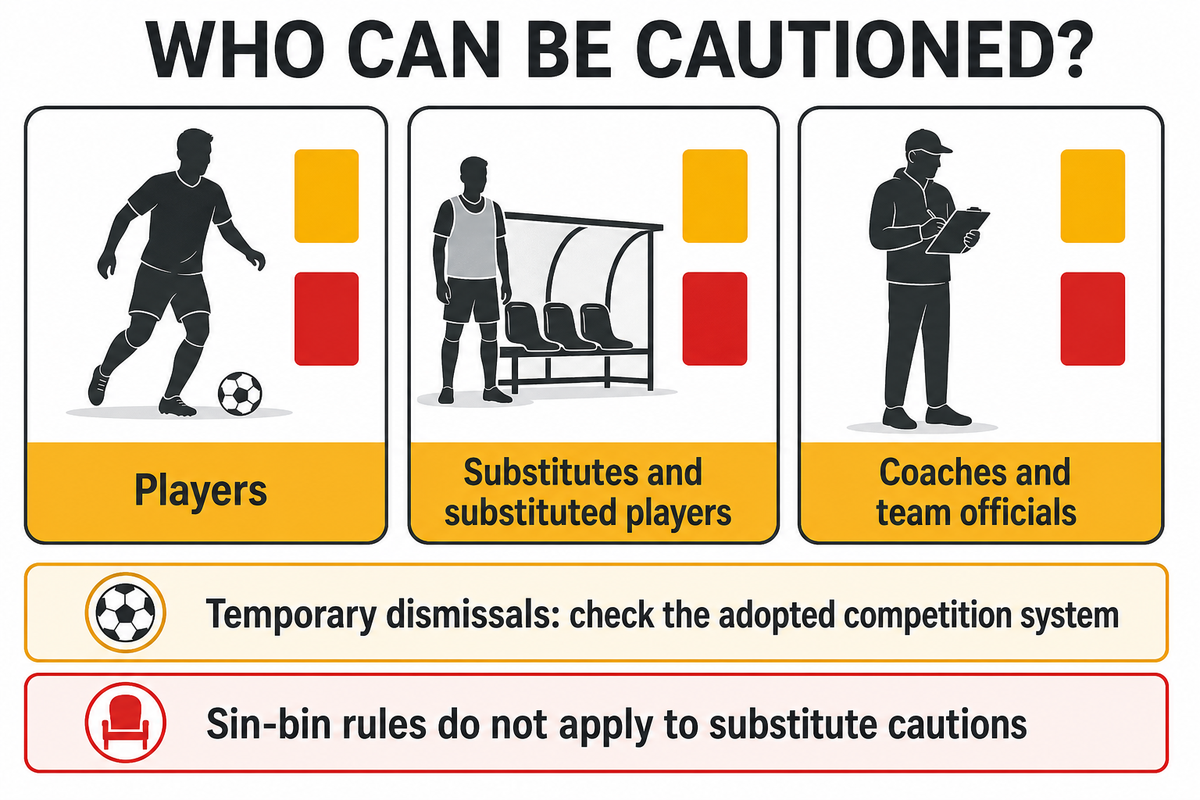
Players, substitutes, substituted players and team officials can all receive yellow. Being off the field of play doesn’t make misconduct exempt. The role is pertinent for the defined consequences, while changes may have been approved for youth and grassroots competitions. Read their rules before assuming the elite-game procedure applies.
Substitutes and substituted players: dissent, delaying the restart, unauthorized entry and unsporting behaviour can be cautionable.
Coaches and other team officials: Law 12 separates warning, caution and sending-off offences. Minor disagreement isn’t automatically the same as persistent unacceptable behaviour.
Youth and grassroots players: a competition may use an approved temporary-dismissal system; this isn’t a worldwide default.
Law 5.3 allows the referee to issue cards from entering the field of play at the start of the match until after it ends, including at half time. Disciplinary authority outside of the match begins with the pre-match inspection. The final whistle doesn’t grant immunity from the consequences of dissent on the field.
According to IFAB’s temporary-dismissal guidelines, sin bins are for players, but not for cautionable offences committed by substitutes or substituted players. For System A, a second caution after returning from the first temporary dismissal means a second temporary-dismissal period and no further participation; replacement afterwards requires unused substitution capacity; a player who commits another cautionable or sending-off offence during a temporary dismissal cannot return and may not be replaced. For System B, two cautions mean a sending-off. For these reasons, the examples shown in this guide refer to an ordinary match.
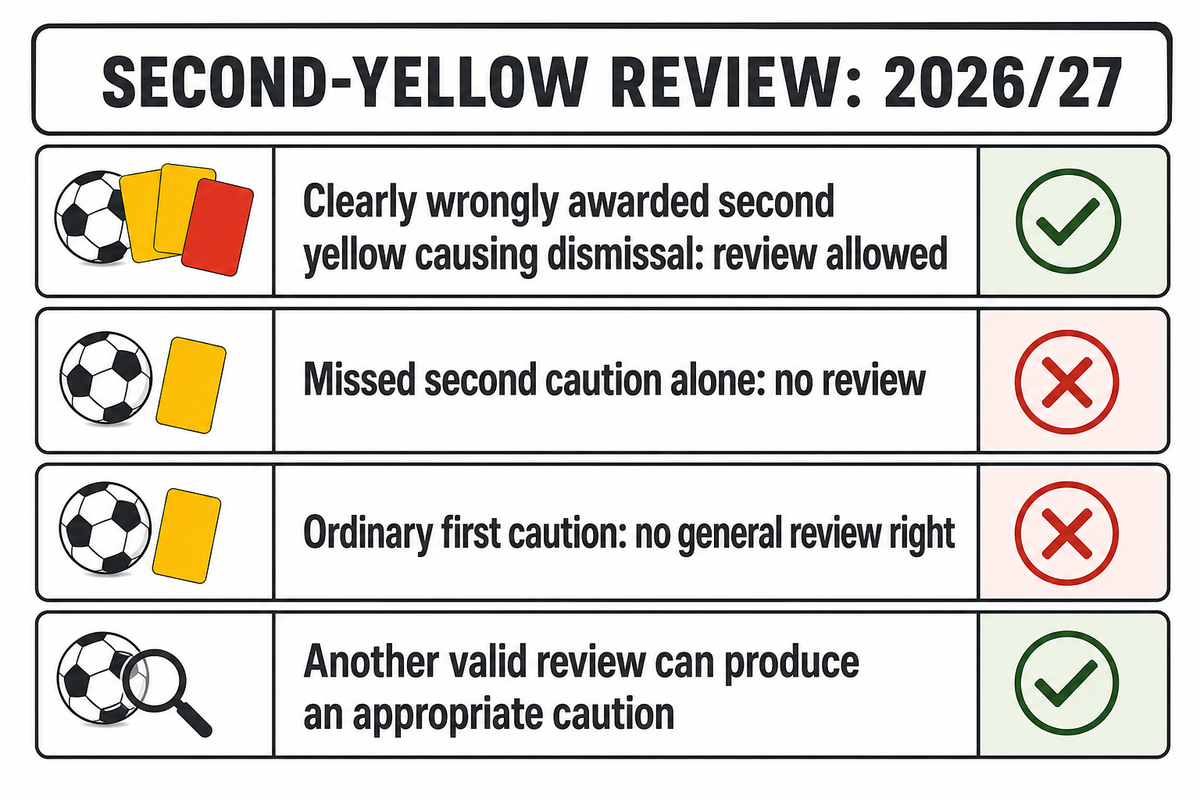
Second-yellow reviews: what changed for 2026/27?
According to the 2026/27 video assistant referee protocol, a red card can be reviewed if it arose from a clearly incorrect second yellow. A potentially missed second caution by the on-field referee isn’t independently reviewable. This corrects a specified wrongful dismissal, and doesn’t provide for video review of all yellow card decisions.
As announced by IFAB on 28 February 2026, the 2026/27 laws of the game allow review of a red card arising from a clearly incorrect second yellow card. IFAB announced the change on 28 February 2026 , with the new laws effective from 1 July 2026 and early adoption available for competitions starting sooner. The 2026/27 Premier League implementation of the change confirms this.
Video-review boundary
Incident
Standalone review?
Clearly incorrect awarded second caution causing dismissal
Yes, under the applicable 2026/27 protocol
Potential second caution that was not awarded
No
Disagreement with an ordinary first caution
No general review right
Another legitimately reviewable incident
Its review may produce an appropriate caution
For cases of mistaken identity, the current protocol allows for correction of the person booked without generally reviewing the underlying ordinary caution. The final decision and later disciplinary appeals are separate processes.
Another change affects a penalty kick or shootout: IFAB removed the automatic caution for the kicker solely because the kicker and goalkeeper offended simultaneously. An independently cautionable offense (such as illegal feinting) would still apply. Read the amendments to Law 10 and Law 14, as extracted pages can display deleted text next to the inserted text.
FAQ: Soccer yellow card questions
Is every foul a yellow card?
No. A foul can be careless without requiring a caution.
A reckless challenge must be cautioned, while excessive force or endangering an opponent’s safety requires dismissal. Separate misconduct, such as dissent or delaying a restart, can also produce a booking without a physical foul against another player. The referee assesses the offence and its sanction, not simply whether contact was intended or whether a free kick was awarded.
Are soccer players fined for yellow cards?
There is no single worldwide cash penalty for a caution.
Any fine depends on the governing association, competition rules and sometimes the club’s internal disciplinary policy. The referee records the caution; the applicable disciplinary process determines additional consequences. Check that competition’s current regulations rather than treating a reported fine from another league as the amount every player pays. A financial charge and a match suspension are separate questions.
Can celebrations draw a yellow card?
Yes. Specified celebration offences require a caution.
Removing the shirt or covering the head with it must be cautioned. Provocative, derisory or inflammatory behaviour can also bring a booking. A goal being disallowed doesn’t automatically cancel misconduct during its celebration. Distinguish those rules from simply leaving the field to celebrate, which isn’t automatically a caution. The conduct, rather than the celebration itself, determines the sanction.
When were yellow cards introduced?
Red and yellow cards were introduced at the 1970 World Cup in Mexico.
FIFA’s historical account credits Ken Aston’s traffic-light inspiration after a communication problem at the 1966 tournament.
Does a yellow card mean time in a sin bin?
Only where an approved competition system provides for temporary dismissals.
Ordinary elite association football doesn’t impose a sin bin for every booking. IFAB allows approved youth, veterans, disability and grassroots competitions to use temporary dismissals for all or some cautionable offences. Its guideline recommends a period of 10–15% of total playing time, giving 10 minutes in a 90-minute match and 8 minutes in an 80-minute match as examples. Check the competition’s adopted duration and system. A yellow card is used with the referee’s temporary-dismissal signal; don’t assume a universal blue card rule or that every second caution has identical replacement consequences.
Key takeaway
Before predicting a ban, check whether the cards belong to one match or several, then read the named competition’s current counting and expiry rules.
Editorial Method: This article uses publicly available governing body rules, along with dated competition regulations to provide examples. The match-minute examples described in this article are hypothetical. SoccerKit doesn’t claim to have firsthand knowledge of refereeing tests, or the authority to decide a player’s eligibility.
I write about football shirts in use and in club history. My articles compare training and match-day jerseys and revisit memorable Mohamed Salah Liverpool shirts, helping readers connect fit and purpose with the players and moments that made a kit familiar.