Still searching for your perfect jersey? Explore our best-selling products—we're confident you'll find a style that's just right for you in our diverse collection.
What’s offside in soccer? It’s an offence that involves an attacker’s position when a teammate plays or touches the ball, as well as the attacker’s subsequent actions. Standing beyond a defender doesn’t, by itself, stop the game. The timing of the touch and what the attacker does next are of great importance.
Watch the teammate’s touch first. Compare the attacker with the ball and the second-last opponent. Then follow the action: did that attacker play the ball or affect an opponent?
Updated October 2026. This guide is concerned with the standard practice of association football as codified in the 2026/27 Laws of the Game. In sanctioned trials and youth competitions, alternative rules may be in force; check the applicable regulations.
What Is Offside in Soccer? Position Is Only Half the Rule
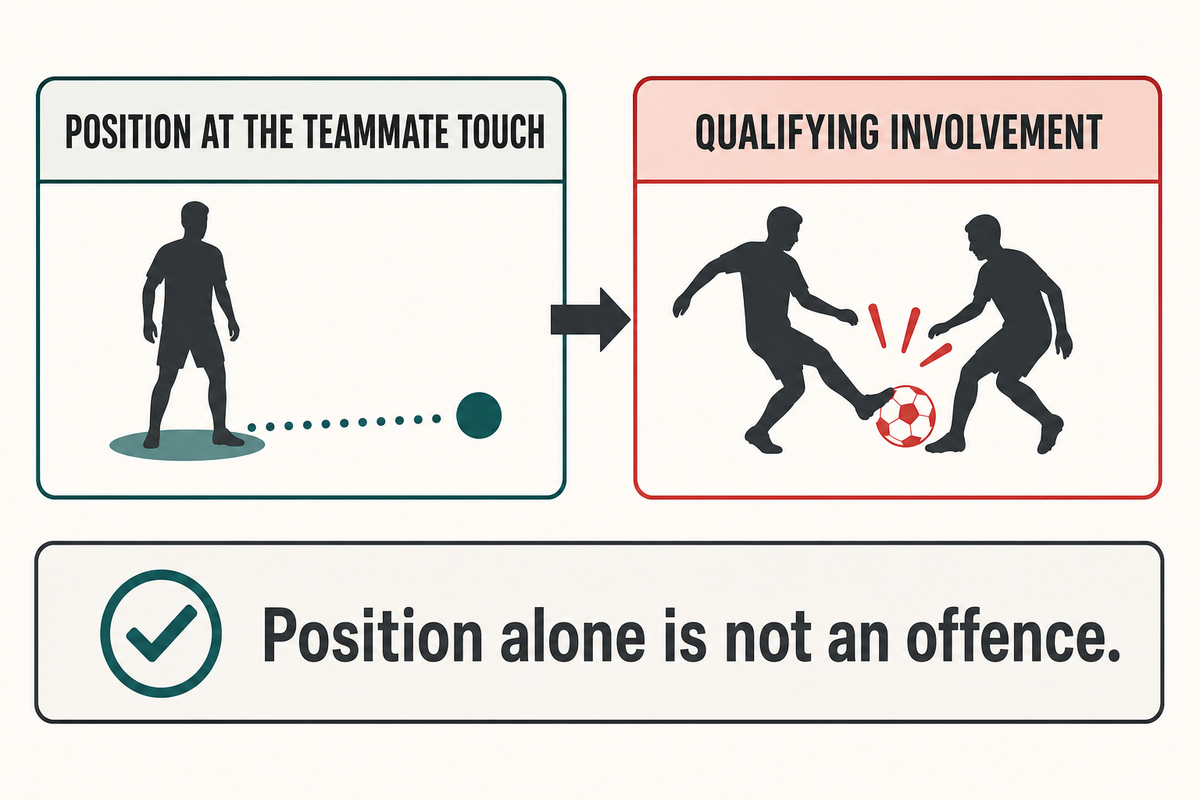
In soccer, offside means more than just being near the opposing goal. A player has to occupy an offside position at that teammate touch, and then become involved in active play in any of the ways defined by Law 11. An attacker can maintain that position without committing an offside offence.
“It is not an offence to be in an offside position.”
Imagine a striker stands beyond the defensive line while a teammate dribbles on the other wing. If the striker leaves the ball alone and doesn’t block, challenge or otherwise affect an opponent in the ways defined by Law 11, that striker’s position alone doesn’t justify an offside call. But, move that striker into the goalkeeper’s line of sight during a shot and the case may be different.
When there’s an offside offence, the opposing team receives an indirect free kick at the place where the infringement occurred. The location may not be where the attacker was at the earlier touch. Repeated offside doesn’t mean a player is automatically booked; caution rules address other forms of misconduct like dissent. There are also separate dismissal rules that cover other forms of conduct.
Some commentators say “offsides” but the law refers to that as offside. The distinction is whether it’s an offside infraction or a position, whichever term is used.
Offside Position: The Ball and the Second-Last Opponent
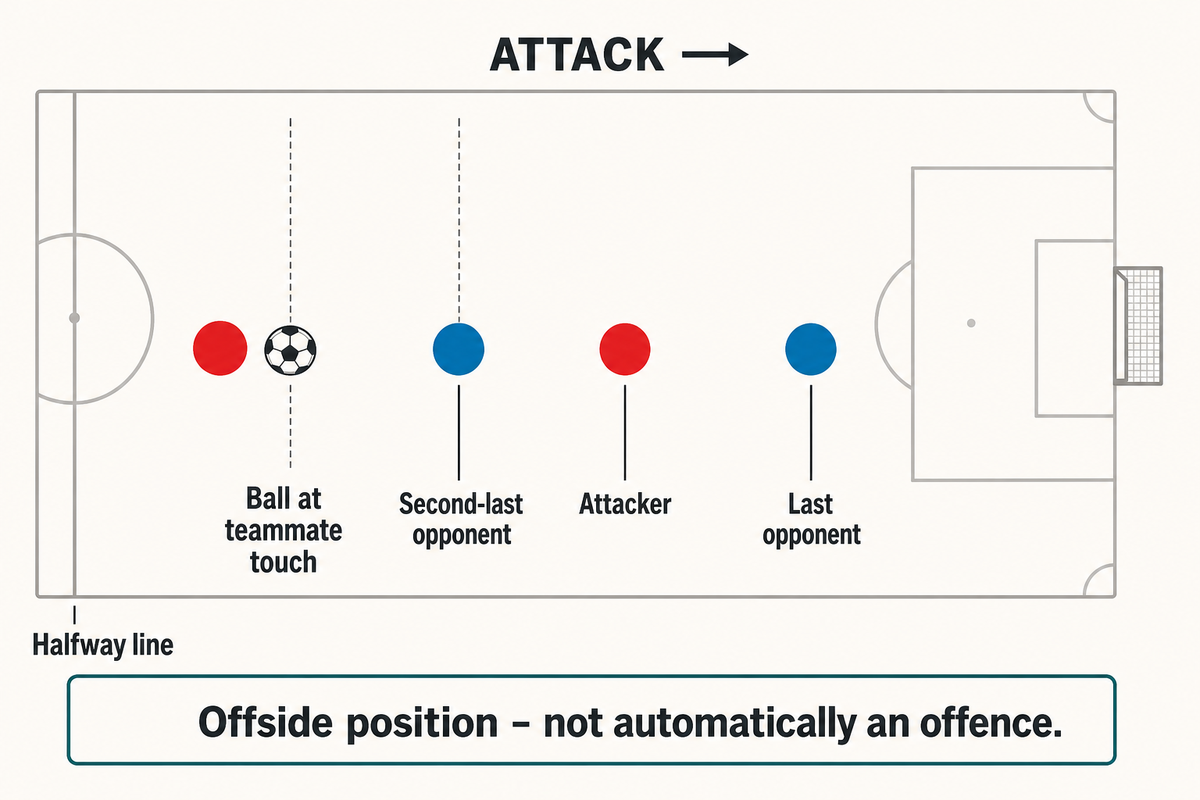
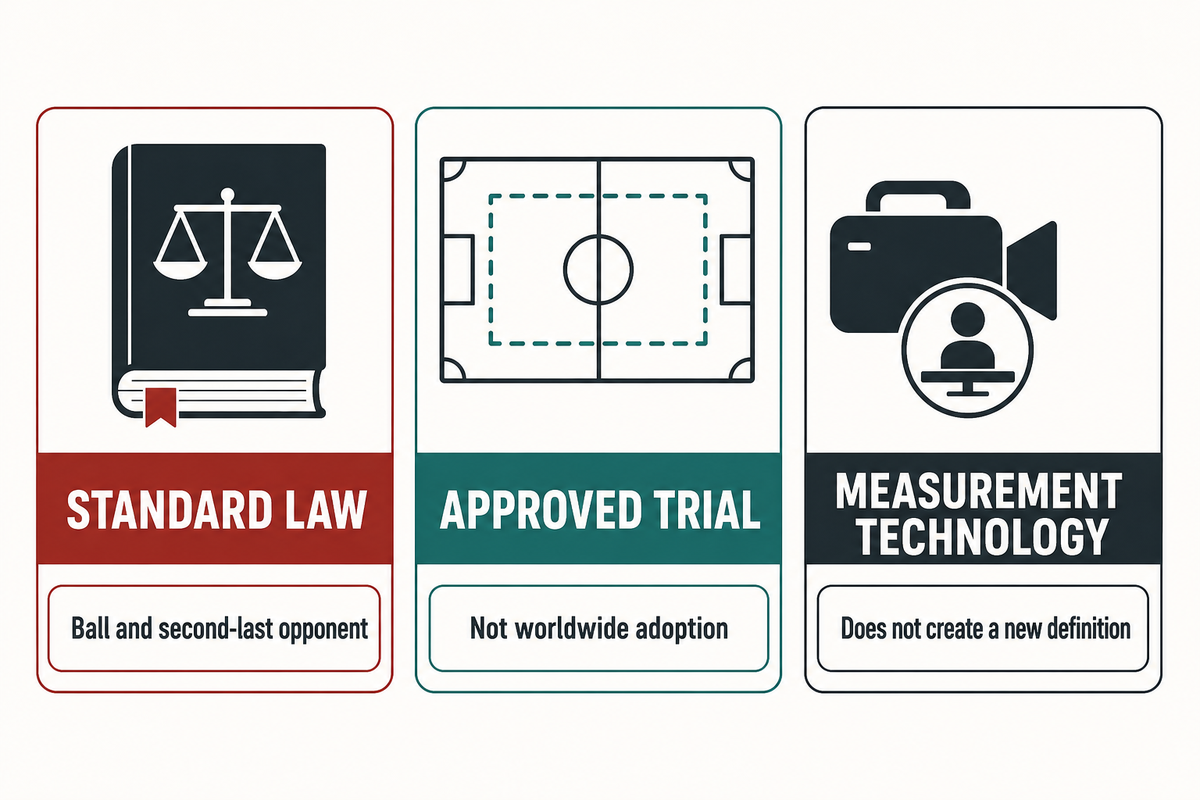
A player is in an offside position when any part of their head, body or feet is in the opponents’ half and is nearer to the opponents’ goal line than both the ball and the second-last opponent. The halfway line doesn’t count as the opponents’ half.
Which body parts count for offside?
Legs and feet can count for offside position. Hands and arms can’t. For the purpose of a position finding, consider an attacker’s eligible part in relation to the ball and the second last opponent at the relevant touch. Stretching an arm beyond the line doesn’t constitute an offside position.
The comparison also includes any part of the head, body or feet that may count under the law. A forward leaning foot may count, while an outstretched hand doesn’t. The boundary of the arm is the bottom of the armpit, and the exclusion also applies to a goalkeeper. Determine which eligible body part is closest to the goal line, rather than measure from the nearest defender or the ball carrier’s chest.
Count opponents in all roles. The goalie is usually the last. So, in commentary, an outfielder is usually the second last defender. An outfield player can be last if the keeper rushes up. Don’t set their order until you see the picture.
An attacking player is considered onside if level with the second-last opponent or the last two opponents. A player beyond the entire defending line can also be onside by being level with or behind the ball. Likewise, just being positioned beyond the last defender doesn’t decide all cases. One needs to identify the ball and the midway line.
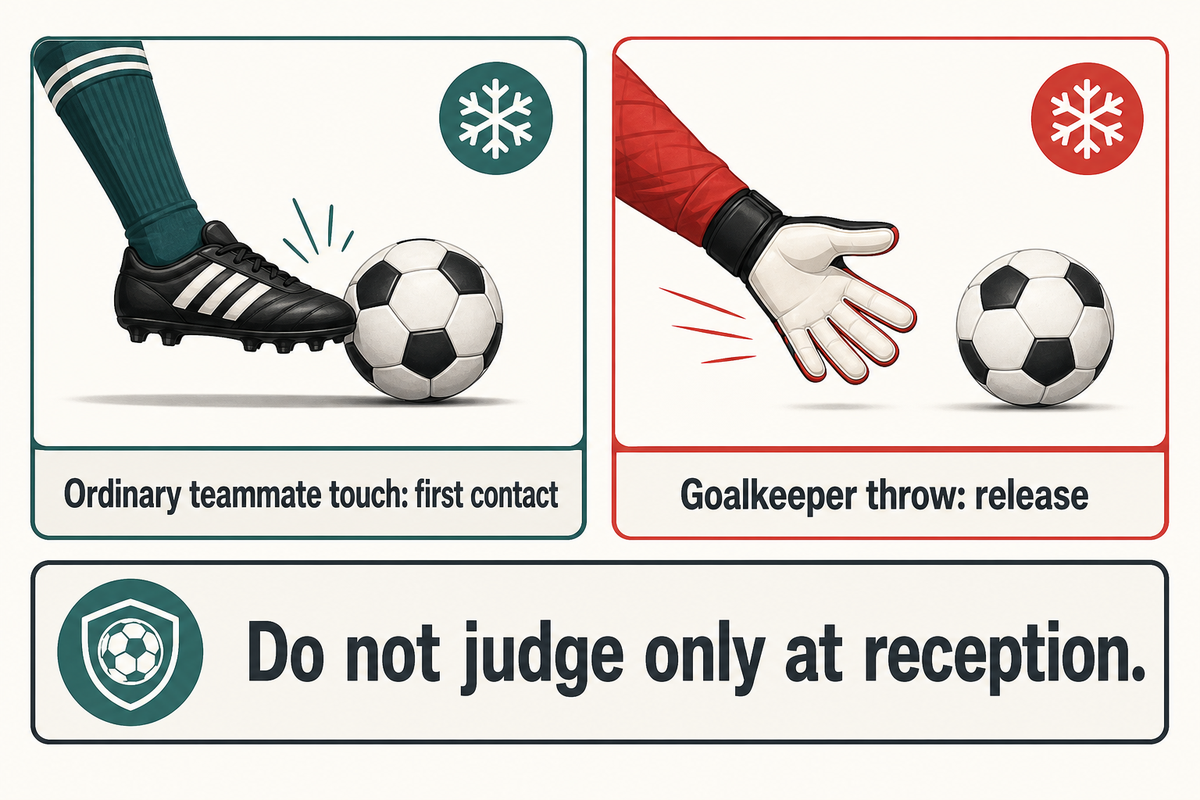
For an ordinary teammate play or touch, offside position is judged at the first point of contact with the ball. A goalkeeper’s throw is the exception. Use the last point of contact, when the ball is released. Receiving the pass later doesn’t replace that earlier contact moment.
A winger can start level with the defensive line and receive the ball with nobody but the keeper ahead. That run is legal from an offside perspective if the winger was onside when the ball was played by a teammate. The player receiving the pass shouldn’t be considered offside solely because the receiving position looks advanced.
The touch doesn’t have to be an intentional pass. If a shot brushes another attacker before reaching a forward, that teammate contact creates a new position check. Look for the frame when the ball is touched rather than assuming the original shot is always the only relevant event.
“Time of the pass” is useful shorthand, but can cover up those unintentional touches and the goalkeeper-throw exception. When the ball is kicked, identify the first contact, then draw a line. The match clock, including how match time is counted, tells you when the incident happened. It doesn’t indicate which contact frame to select.
When Position Becomes an Offside Offence
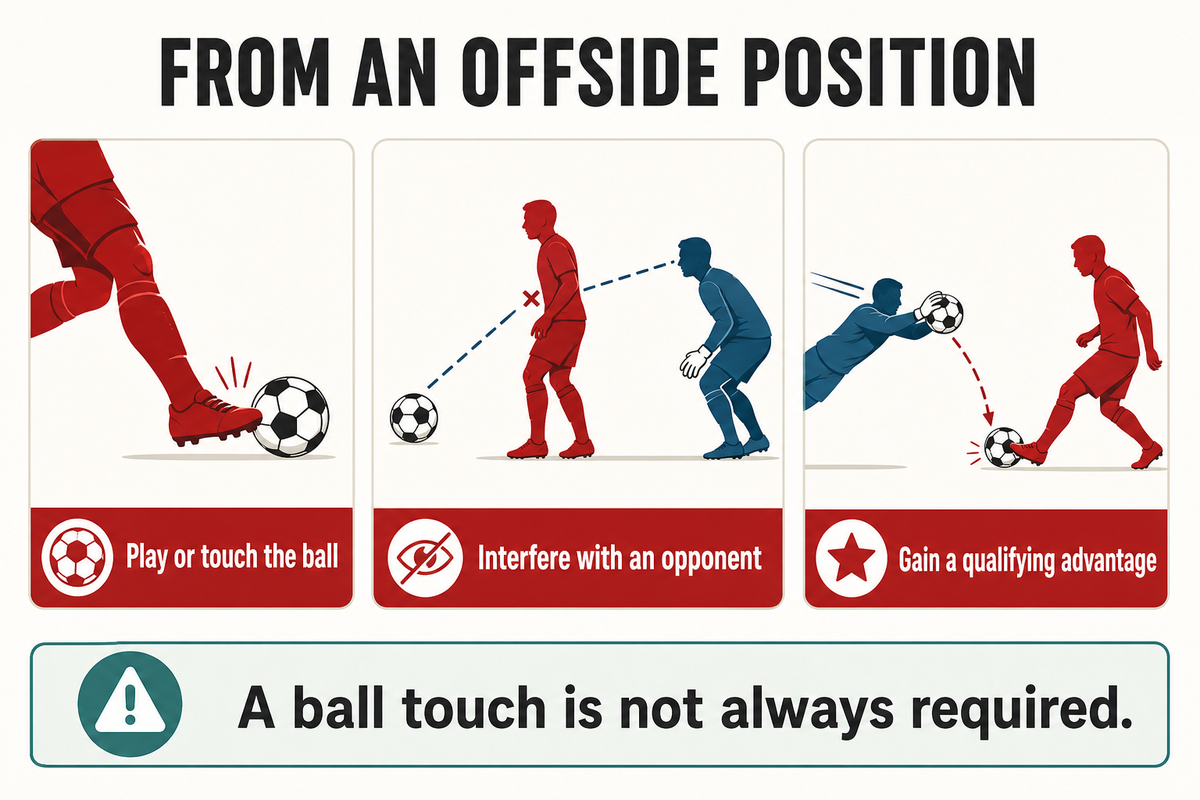
A player in an offside position can commit an offence by playing a teammate’s ball, interfering with an opponent, or becoming involved after a qualifying rebound, deflection, or save. The referee must determine the relevant action. Merely standing nearby, making a run, or being shown on TV isn’t sufficient.
Is a player offside if they do not touch the ball?
A player can commit an offside offence even if they don’t touch the ball, for example by clearly blocking an opponent’s view of the ball, challenging an opponent for the ball, or making an obvious action that clearly affects their ability to play a ball. Merely being in the right place isn’t sufficient; the effect on the opponent is important.
Interfering with play: playing or touching a ball passed or touched by a teammate.
Interfering with an opponent includes, for example, screening a goalkeeper’s view of a shot or challenging a defender for the ball.
Clearly trying to play a close ball can be interpreted as an offense if it has an adverse impact on an opponent, even if the attacker misses the ball.
Gaining an advantage: involvement after the relevant rebound, deflection or deliberate save, discussed below.
Compare two shot scenes. In the first, an attacker stands to the side and leaves the ball alone and affects no one. In the second, the attacker stands between the shot and the keeper and blocks the view. In both cases, the attacker started in a similar position relative to the defense. Where they differed was in how they got involved and affected the goalkeeper.
UEFA’s offside guidance focuses on interference. If the attacker physically blocks an opponent’s path, the referee may also need to consider whether an impeding offense has occurred under Law 12. Not every case where an attacker occupies an offside position results in the same restart.
Deliberate Play, Deflections and Saves
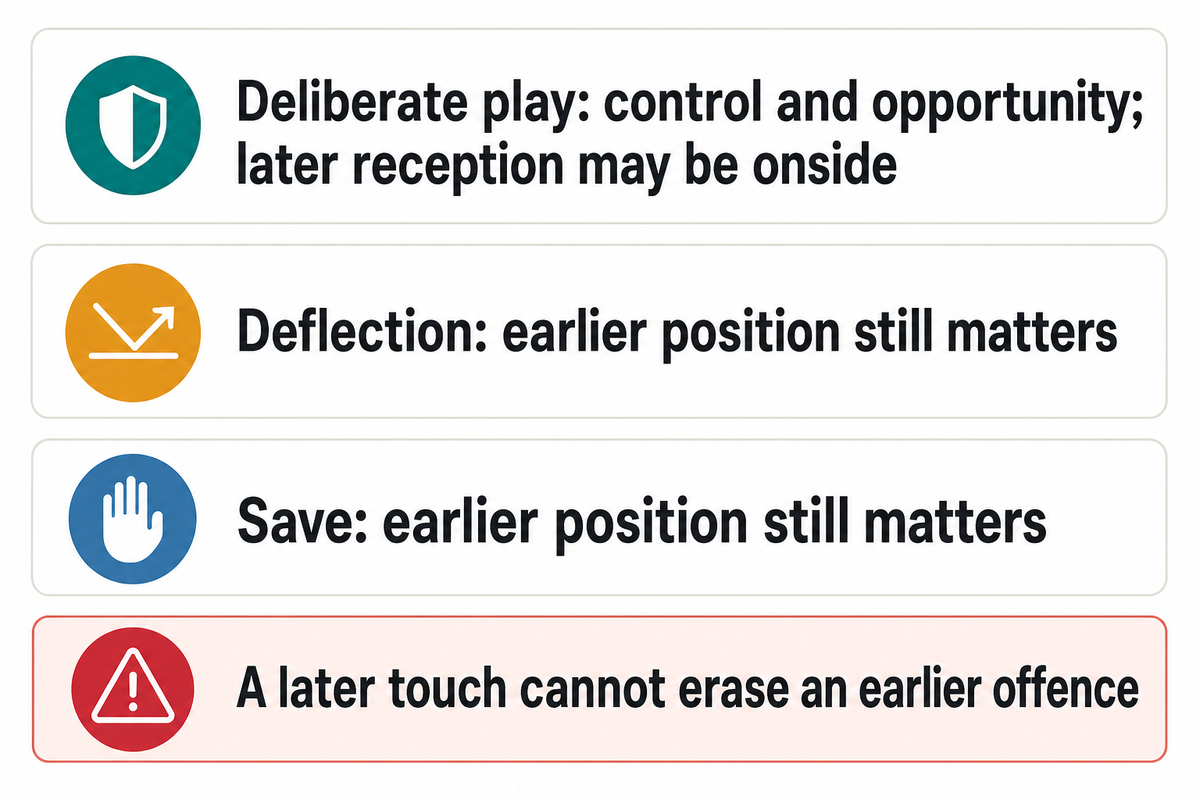
An opponent’s deliberate play can eliminate the offside result of an attacker’s prior position, as long as no earlier offside offence has occurred. A deflection or save, for example, doesn’t remove the offside result. It will ultimately depend on control and the nature of the play.
Opponent-Touch Comparison
What the opponent’s touch changes
Touch or action
What to examine
Effect on the earlier position
Deliberate play
Control with an opportunity to pass, gain possession or clear
A subsequent reception is not penalized for gaining an advantage from that earlier position
Inaccurate controlled clearance
Enough view and time to coordinate; poor execution despite control
Can still be deliberate play; a mistake alone does not make it a deflection
Deflection
Unexpected close-range contact without the relevant control
Earlier position still matters if the attacker becomes involved
Deliberate save
Stopping or attempting to stop a ball entering or passing very close to goal
Earlier position still matters, including a legal save by an outfield opponent
Deliberate outfield handball
Intentional handling, not a lawful save with an eligible body part
Different treatment: advantage may allow a subsequent goal; do not classify it as a legal save
As defined in IFAB’s guidance on deliberate-play, to judge whether a player deliberately played the ball, consider control and the ability to pass, gain possession or clear it; see whether the player had time to coordinate before making contact. In the case of a defender making a clearance, for example, distance and speed may have been judged, but time to coordinate may have been lacking.
A keeper need not make the save. Imagine the goalkeeper placed well up-field, a defender placed on the goal line, and an attacker between the two. The defender legally blocks a shot with a leg; the ball reaches that attacker who’s beyond the second-last opponent at the shot. Playing the rebound can be offside. If the defender deliberately handles the ball, IFAB’s published example states that advantage applies and a goal should be awarded if the attacker then scores. The body part changes the analysis.
Finally, a later controlled touch can’t negate an earlier offense. If an attacker has challenged a defender from an offside position, the sequence has crossed the boundary. Check the order before describing any touch as a “reset.”
No Offside Directly from These Three Restarts
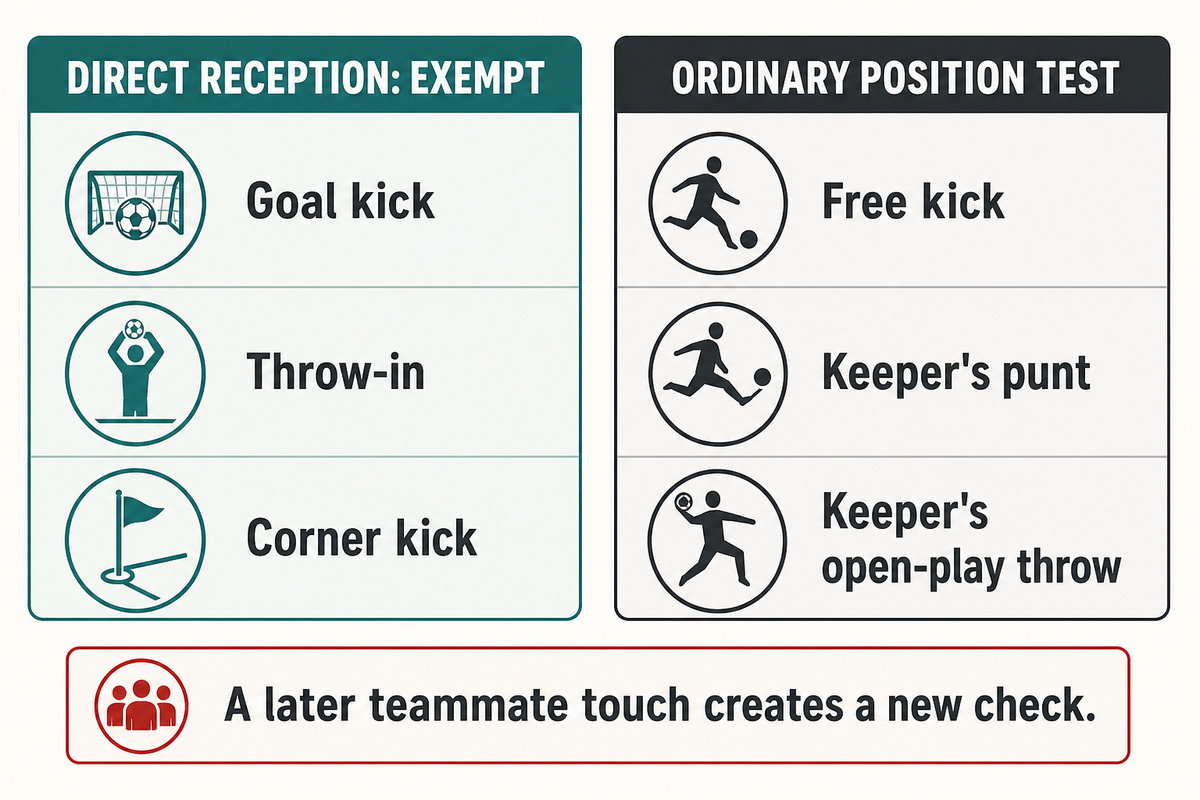
It isn’t an offside offense if a player receives the ball directly from a goal kick, a throw-in, or a corner kick. Those are the three direct reception exceptions of Law 11. A free kick, a goalkeeper’s punt, or a goalkeeper’s throw during ordinary play doesn’t grant the same exception.
Direct restart exception
Goal kick
Throw-in
Corner kick
Ordinary position test applies
Free kick
Keeper’s punt
Keeper’s open-play throw, judged at release
“Directly” has a specific meaning. A player can collect the original corner delivery without an offside offence. If a teammate then returns the ball to the corner taker, assess the taker’s position at that new teammate touch. The first kick’s exception doesn’t cover the entire attacking move.
Unlike receiving directly from a goal kick, receiving a later header by a teammate is subject to a new offside position check. Don’t substitute the general instruction ‘any touch cancels the exception’: the case in point presented by IFAB regarding throw-in allows play to continue when an opponent merely deflects the throw to an attacker and no teammate has played it. In such cases, analyze who touched the ball and how.
Offside Examples: Read the Freeze-Frame, Then the Play
To determine offside in a replay, take a position snapshot and note the subsequent action. Determine where the attacker stood at the time of teammate touch, and then ascertain whether his/her involvement invokes the law. The direction of the pass, the location of the ball at the time of the reception, and the goalkeeper’s usual position can’t substitute these two checks.
Two-Frame Offside Replay
Freeze: identify the relevant teammate contact, with the throw-release exception.
Compare: locate the ball, halfway line and second-last opponent.
Follow: identify the attacker’s touch or interference and any intervening opponent action.
In all examples presented below, the attack moves from left to right. “Ahead” is defined as being closer to the right hand goal line. These are didactic scenarios and not reports of games.
Position first, involvement second
Scenario type and starting position
What happens next
Decision and reason
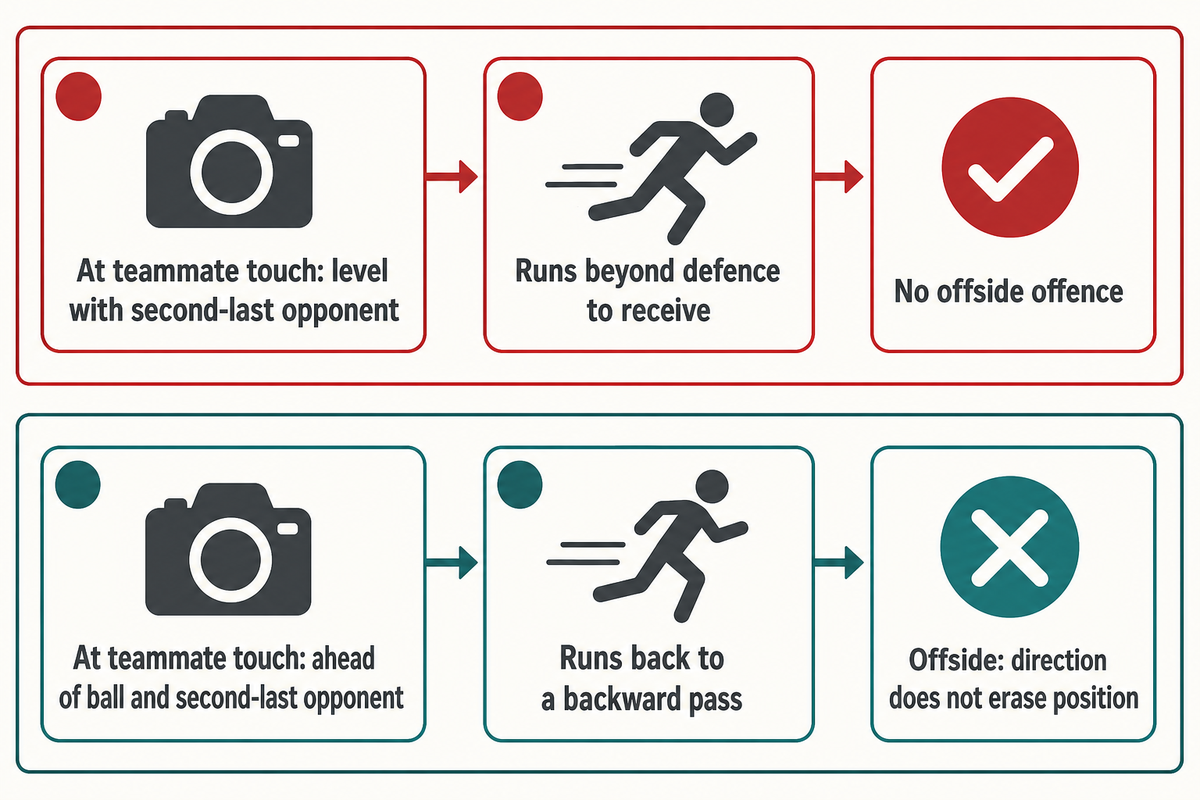
Attacker level with the second-last opponent
Runs beyond the defence to collect a forward pass
No offside offence: the later run does not change the earlier snapshot
Attacker beyond both references in the opponents’ half
Leaves the pass alone and affects no opponent
No offside offence from position alone
Attacker ahead of the ball and second-last opponent
Runs backwards to collect a backward pass
Offside offence: the pass direction does not cancel the starting position
Attacker behind the ball but beyond the defence
Collects a square pass and shoots
No offside offence: the attacker was not ahead of both references
Attacker onside when a teammate shoots
Runs forward to score a goal after the keeper saves
No offside offence from that shot: the attacker was initially onside
Returning runner: attacker beyond both references in the opponents’ half
Runs into their own half and plays the teammate’s pass
Offside offence: the receiving half does not erase the earlier position
Screening: attacker in an offside position at a shot
Clearly blocks the goalkeeper’s view
Offside offence can occur without a ball touch
Direct restart: attacker beyond the second-last opponent
Receives a teammate’s throw-in directly
No offside offence: the direct throw-in exception applies
Corner taker receives a teammate’s return pass
At that return touch, taker was beyond ball and second-last opponent
Offside offence if in the opponents’ half: assess the second pass separately
Reading an offside trap
An offside trap tries to leave an attacker beyond the relevant line when the pass is made. Defenders move together, usually away from their own goal. One opponent staying deeper or a delayed attacking run can defeat the tactic. Understanding the offside rule means checking the actual positions, not treating a defender’s raised arm as a decision.
Can a player be offside if the ball is played backward?
Yes. An attacker can start ahead of both the ball and the second-last opponent and run backwards to receive a backward pass and still commit an offside offense. The position test measures distances from the goal line at the teammate touch. It doesn’t require the ball to be played forward.
For a simple tabletop demo, place the ball to the left of an attacker that has already passed the second-last opponent. Move the ball to the left and let the attacker run back to it. Then do it again with the attacker starting behind the ball. With the change to the starting position, the answer changes. Whether the ball is played forward by a teammate or backward, assess the runner’s position and involvement under the same offside rule.
Attacking and defending teams should use contrasting colors. When using players, make training and match day tops or bibs very different so everyone can easily identify which team made a touch.
Current Offside Rules, VAR and Trial Proposals
The 2026/27 offside rule in soccer still uses the ball, eligible body parts and second last opponent. A named competition can permit the use of an approved alternative position test. Semi-automated offside technology measures incidents within the rules of the competition; using this technology doesn’t create a new definition.
FIFA announced on 31 March 2026 that a Canadian Premier League trial would begin on 4 April. For this trial, the “daylight” interpretation states that an eligible body part of an attacking player can be even with or behind the second-last opponent. That particular communication isn’t evidence of the “daylight” interpretation’s worldwide adoption. This guide won’t draw a conclusion from the trial.
We can look at the Premier League’s 2024/25 technology announcement for details of up to 30 cameras, some at 100 FPS, and an anticipated average reduction of about 30 seconds for close calls. Those figures are for that particular technology rollout and aren’t predictions for the world of VAR for the 2026 FIFA World Cup. Human match officials still review the decisions and judge incidents of interference.
When watching a World Cup game or your local game, check the competition first. Small-sided youth football can vary as well. U.S. Soccer’s 2017 guidance demonstrates youth game adjustments. For the time being, focus on your local league, not interpreting old age group adjustments universally.
Frequently Asked Questions
Can a player be offside in their own half?
An attacker cannot occupy an offside position in their own half, but can commit an offence there after returning from an earlier offside position.
The two moments must be kept separate. If the attacker is in their own team’s half of the field when the relevant teammate contact occurs, the position requirement is not met. If they were in the opponents’ half and beyond both references at that contact, running back across halfway does not make a subsequent reception legal. The indirect free kick is taken where the offence occurs.
How do you explain offside to a child?
Explain offside with two moments: where the attacker starts when a teammate touches the ball, and what the attacker does next.
Use a ball and differently coloured markers. Point towards the defending goal, place the last two opponents, and freeze the pass. First let an onside attacker run forward to collect it. Then start the attacker beyond both references and repeat. Show a third case where that attacker leaves the ball and opponents alone. For children’s matches, check whether the competition uses modified rules.
Why is the offside flag sometimes delayed?
An assistant referee may delay the flag in specified clear attacking situations under the video assistant referee protocol.
The official protocol limits this to situations such as an attacker about to score or having a clear run into or towards the penalty area. Waiting preserves the immediate attacking outcome for review; it does not change the position test. Do not expect the same procedure in every grassroots game, or assume that the assistant always waits for a video instruction.
How to tell if a player is offside?
Check position at the relevant teammate touch, then check involvement.
Use the ball and second-last opponent as references, exclude hands and arms, and confirm the attacker is in the opponents’ half. Position alone is insufficient.
Is offside good or bad?
An offside offence stops the attacking move, so it benefits the defending team in that incident.
For an attacker, the practical goal is to time the run legally. Being advanced without committing an offence can still be useful.
SoccerKit sells soccer kits for matchday and publishes guides for people following the game. We built the two-frame examples and opponent-touch comparison from the linked official rules, rather than claiming refereeing experience or reporting invented matches. The illustrations teach position and involvement; they aren’t calibrated evidence for judging a real incident. Prepared for SoccerKit’s football guide collection.
I write about football shirts in use and in club history. My articles compare training and match-day jerseys and revisit memorable Mohamed Salah Liverpool shirts, helping readers connect fit and purpose with the players and moments that made a kit familiar.