Still searching for your perfect jersey? Explore our best-selling products—we're confident you'll find a style that's just right for you in our diverse collection.
Soccer Training Jersey vs Match Day Jersey asks what you’ll do in a soccer jersey. Wear your training top in practice, your team’s official uniform in sanctioned games, and your favorite fan gear to games. You’ll have to decide for yourself if it’s worth the cost to buy the game gear.
The complicated nature of this topic stems from the double meaning of the phrase “match day.” Wearing your favorite game gear to the game qualifies as “match day” behavior. The terms “authentic” and “replica” describe retail versions. Understanding key differences helps patrons decide when to wear their favorite gear to a game or use the gear in practice, and determine when they’re really paying for a feature they won’t use.
Training, Pre-Match and Match Jerseys: What the Labels Mean
Official gear for practice, pre-match, and games can differ. So can the gear types sold to patrons. Sometimes a supporter will wear a replica jersey to a game, and a player will wear his team’s gear to practice. There are exceptions. For example, a player may wear a shirt with his team’s crest to a practice that focuses on drills to hone a specific skill.
Training and pre-match gear is designed for practice and warm-ups before kickoff, respectively. Fan gear doesn’t indicate that the item was worn by a player. A retail “Match” jersey doesn’t mean that jersey was worn by a player in a game. A pre-match jersey is different from the jersey worn by players in a game.
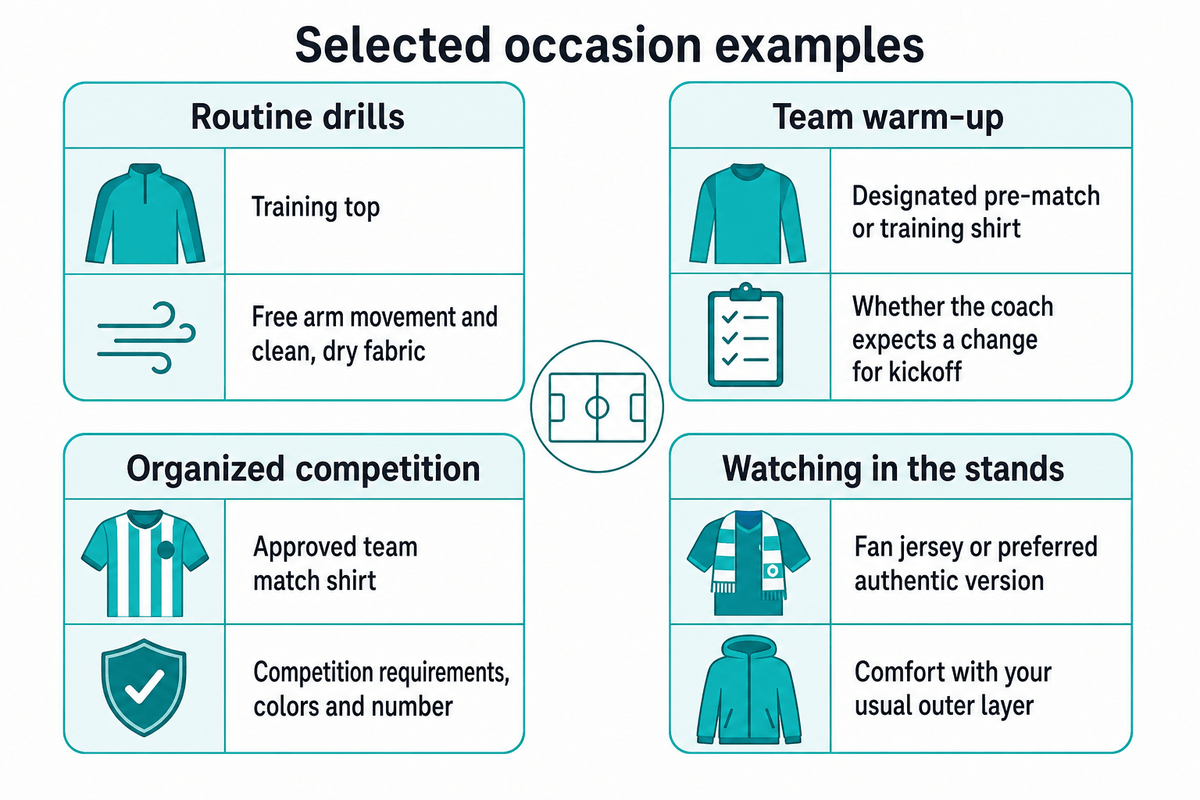
Use type and occasion
Useful starting choice
Check before wearing
Routine drills
Training top
Free arm movement and clean, dry fabric
Scrimmage at practice
Training top or permitted club shirt
Coach’s color or bib instructions
Team warm-up
Designated pre-match or training shirt
Whether the coach expects a change for kickoff
Organized competition
Approved team match shirt
Competition requirements, colors and number
Goalkeeper appearance
Approved goalkeeper shirt
Color distinction from other players and officials
Watching in the stands
Fan jersey or preferred authentic version
Comfort with your usual outer layer
Watching at home
Any comfortable supporter shirt
Personal preference rather than a performance tier
Casual everyday wear
A jersey that fits comfortably
Measurements and how it sits when seated
Collecting or displaying
Chosen collectible shirt
Condition and provenance rather than training suitability
What’s the difference between a match jersey and a stadium jersey?
Nike uses the term ‘Match’ to describe the non-replica versions of items in its product line. ‘Match’ can be considered Nike’s label for its ‘Authentic’ offering. For true differentiation, examination of item descriptions may be required. In some cases, variations in fabric technology, finished item dimensions, and total item weight may differ between the ‘Match’ and ‘replica’ versions. Ultimately, your preference and rationale for use is the primary consideration, and whether the item is appropriate for your activity.
For a more complete comparison of authentic vs replica soccer jerseys, see our player version vs replica soccer jersey comparison. When is it acceptable to wear each? The answer depends on the occasion and team requirements. Neither version of the shirts automatically replaces your team issue shirts. Likewise, possession of either of these shirts doesn’t denote you own a game-worn shirt. If you want a game-worn shirt, it’s important to verify the seller doesn’t list the item as a retail version.
When a Training Jersey Makes Sense
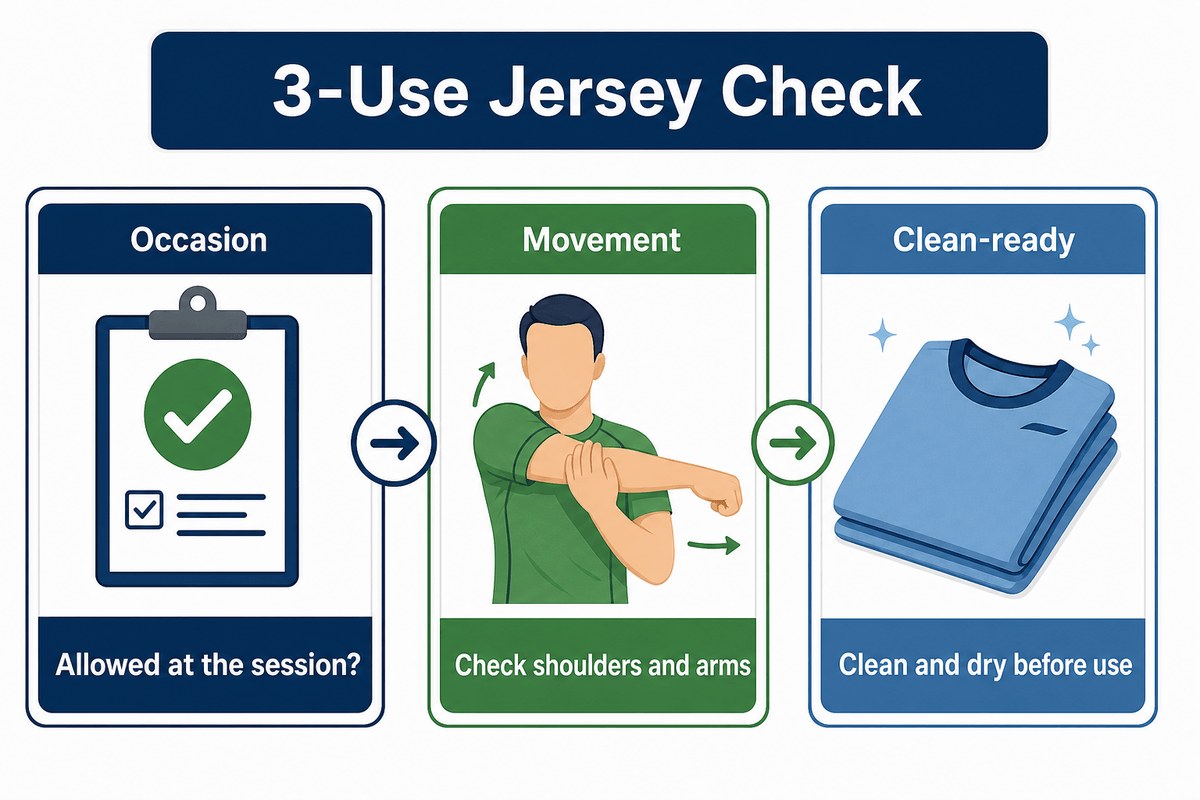
Generally, shirts worn for training and games should be clean. A training or practice shirt can also be considered for repeated drills, conditioning or informal games if it suits the activities and can be washed as required. Use the 3-Use Jersey Check: occasion, movement and clean-ready availability.
The 3-Use jersey test helps to answer the question “Is this the right shirt to wear?” The first step is to determine if the shirt is allowed at the session. The second step is to check the range of motion in the shoulders and arms. The final step is to ensure the shirt is clean and dry.
Consider the player who trains on the days listed in their schedule, but owns signed shirts from their club. That player presumably doesn’t wear their signed shirts to train and for good reason. They likely understand that training drills with a teammate could damage a keepsake shirt. This choice doesn’t establish how long training gear will last compared with shirts worn in a match. The same personal-value choice applies when selecting training gear.
Your club shirt can still be suitable for practice. Team colors, fit and condition decide that question; a training label alone doesn’t. Nike’s 2026 kit announcement even includes Aero-FIT training collections, so premium fabric technology isn’t reserved for match shirts.
The what to wear to soccer practice guide offers advice for the other gear you train with. Before listing other items your gear bag may contain, it’s suggested that you listen to your coach and wear the gear he/she recommends.
What to Wear on Match Day: Playing or Supporting
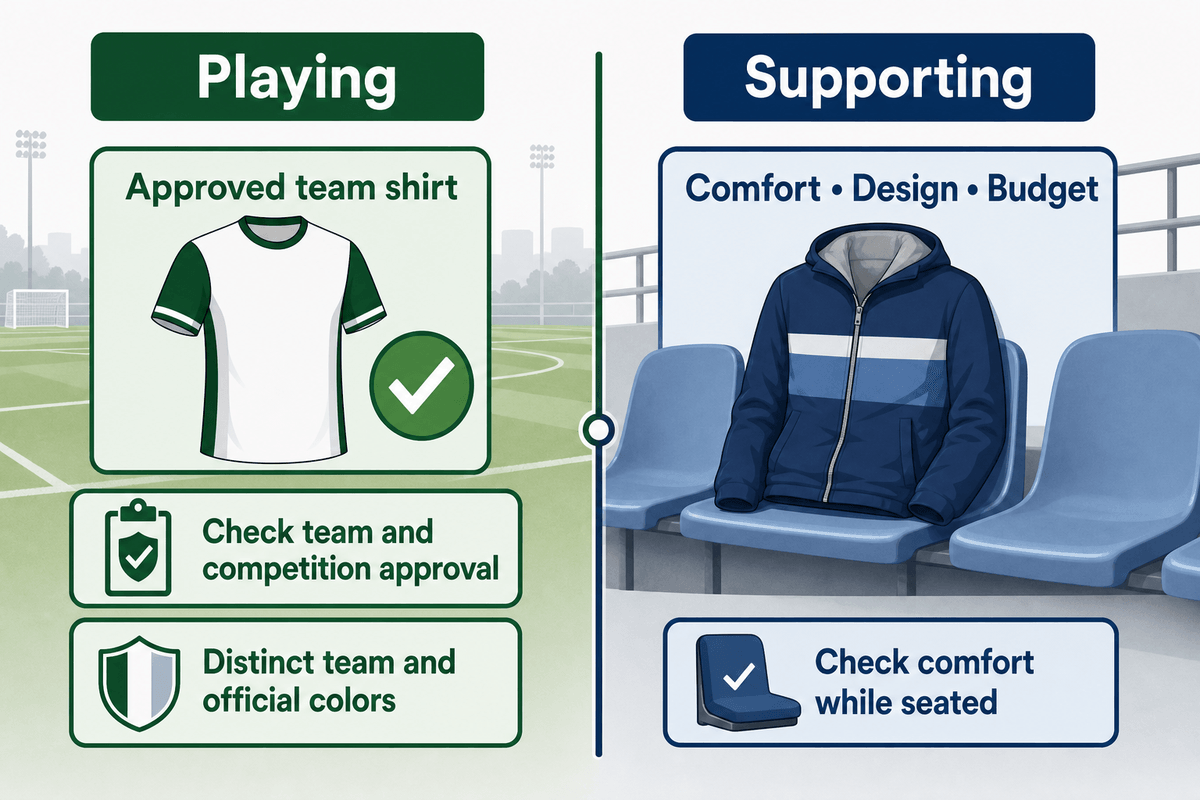
Players on the field need approved shirts for organized matches; spectators in the stands can choose for comfort, design and budget. Therefore, fans are advised to wear the team shirt when supporting the team in the stands. For the shirt that you wear when supporting the team, it’s up to you to decide on the most appropriate shirt to wear, provided that you don’t discourteously wear an inappropriate shirt to the grounds. A team kit’s cost or how the kit is styled doesn’t determine who can attend a match or who supports the team.
IFAB Law 4 requires shirts with sleeves and colors that distinguish the teams from each other and the match officials. This color differentiation is required. A team shirt should be part of the team’s authorized equipment. The team and competition authority determine which shirts are approved to be worn in the sport. Therefore, a national team shirt shouldn’t replace a team’s authorized shirt equipment.
The two teams must wear colours that distinguish them from each other and the match officials
Consumers may make different choices. Parents may be more concerned about room under a jacket on a cool evening than about player-style detailing. Someone who attends a last match of the season may prefer a more decorative design of an authentic football jersey. The difference between the authentic and the supporter version may be more important to that consumer. However, for the price-conscious consumer, a fan jersey with the supporter version may be an adequate alternative. For either an authentic or a replica shirt, check what the product actually offers.
Don’t overpay because you believe replica shirts are prohibited. Compare the shirt with the bottoms you’ll wear. Will it be okay to wear it during the game? Will it be comfortable on the trip there and back? Will it be alright to wear it while you’re seated and after the game? Will it be okay to wear it while you’re waiting for the game to end?
Fit and Fabric: Compare the Actual Shirt
Consult the size chart and check the cut and construction to decide between the training top and the premium match top version. Fit may vary between training and premium match top versions of the same shirt. A top may also fit differently from what you expect depending on the fabric used. For example, a polyester top’s composition alone doesn’t tell you how tightly it will fit. When in doubt, check the actual product.
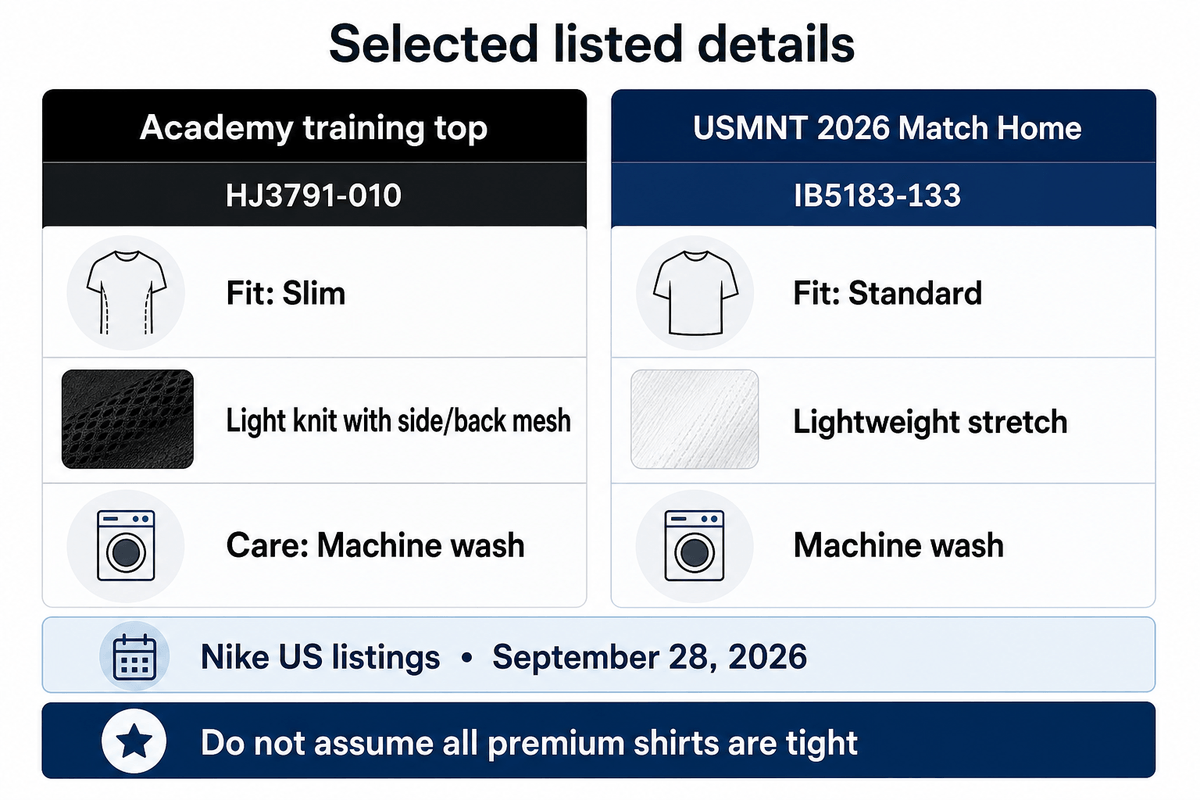
The data in the table shows the US listings of Nike checked on September 28, 2026. Prices presented aren’t SoccerKit prices or prices across the market. Additionally, these prices don’t come from a controlled fabric test. The prices reflect two independent products and may change.
Listed detail
Academy training top
USMNT 2026 Match Home
Product style
HJ3791-010
IB5183-133
Retail position
Training top
Authentic Match jersey
Nike US listed price
$32 USD
$175 USD
Listed fit
Slim
Standard
Fabric description
Light knit with side/back mesh
Lightweight stretch
Named technology
Dri-FIT
Aero-FIT
Composition
100% polyester body and mesh
100% polyester
Care listing
Machine wash
Machine wash
Practical implication
Check the tailored cut
Do not assume all premium shirts are tight
The training top, as mentioned earlier, is slim-fit. But this authentic jersey is listed as standard-fit. In practice, fit and fabrics need to be checked on the actual shirt. Polyester is polyester, but that doesn’t mean a 100% polyester top would be drapey. Replica jerseys, too, are model-specific. To top it off, the jersey you fancy may or may not be an exact match for the one your favorite player wears.
Should you size up in an authentic soccer jersey?
No one wants to be that person that sizes up all of the time. It’s usually a good idea to check model measurements before deciding to stick with your usual size. Cuts and fabrics can change between releases, so check the fit of the exact shirt. When checking a jersey, be sure to test the movements you think you’ll make the most, like an overhead reach. You should always test to see if the hem will ride up, or if the shoulders pull down. If you’re considering sizing up, check the fit and length again; a larger size may solve one problem and create another.
Determine whether your seller provides body measurements or finished-garment measurements. They can’t be compared as the same measurement, and one being greater than the other doesn’t settle which size fits. Please see our soccer jersey Sizing Guide for more information. You must use consistent units. The measuring method shown in the pictures must be used.
One Premium Shirt or a Training Rotation?
Two basic shirts can be more useful than one premium shirt when getting clean clothes ready between your training sessions is difficult. One shirt may be enough if you can take care of it in time for your next session. The right comparison here is how much you paid for the shirt and how long you have to wait in order for it to be ready to wear again. The cost and the turnaround time are the most important factors here.
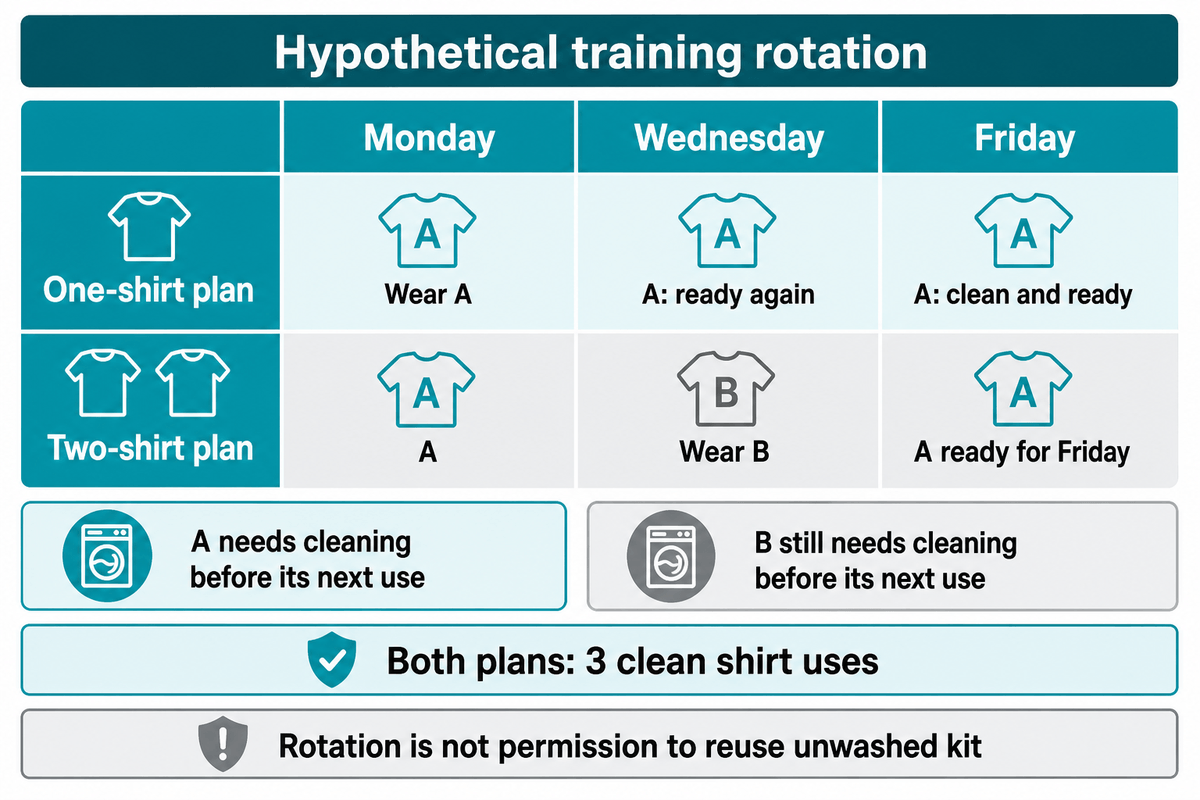
The 3-Session Shirt Rotation below is a hypothetical Monday, Wednesday and Friday plan. Each day features the use of a fresh shirt. Shirts A and B represent separate garments. The calendar changes when shirts must be ready again; it doesn’t magically clean dirty shirts.
Session
One-shirt plan
Two-shirt plan
What changes
Monday
Wear A
Wear A
A needs cleaning before its next use
Wednesday
A must be ready again
Wear B
A can be prepared for Friday instead
Friday
A must be ready again
Wear A
B still needs cleaning before its next use
In that example, both plans provide 3 clean shirt uses. Wearing two shirts doesn’t affect the number of wear events in this example. Owning 2 shirts doesn’t reduce the 3 worn-shirt events, promise fewer wash cycles or prove a lower environmental impact. The benefit is flexibility: The advantage of the plan is having the freedom to not rely on the shirt from Monday being ready to wear for the session on Wednesday.
Using the dated listed prices above, 2 Academy tops would total $64 USD before tax or delivery, compared with $175 USD for 1 USMNT Match shirt. The $111 USD price difference is purchase-price arithmetic only. It says nothing about comparative durability, cooling, licensing of a separate retailer’s stock or cost per wear.
For a parent buying training clothing, a second suitable top can solve a scheduling problem. For a collector buying a team’s special edition top, the extra cost for the authentic version may be worth it. Buying the cheaper replica top can add to your costs if you later replace it with the premium design you wanted. If there are already enough clean practice tops in your collection, there’s less reason to buy more jerseys just for a rotation. Expensive shirts are unnecessary if there are existing tops that serve the same purpose.
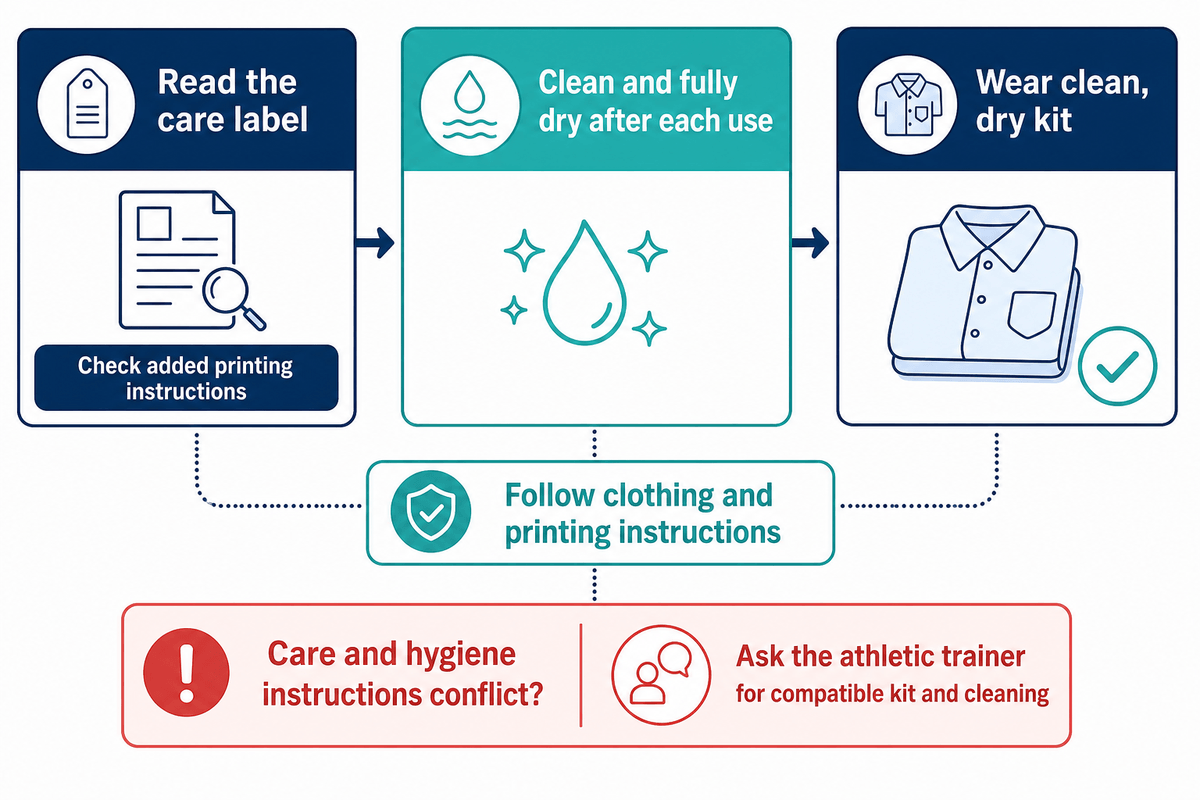
Treat cleanliness as part of readiness. CDC guidance for athletes calls for cleaning and fully drying sports clothing after use. Follow your team’s hygiene requirements and choose garments whose care instructions are compatible with them; a rotation isn’t permission to reuse unwashed kit.
Check the Listing Before You Buy
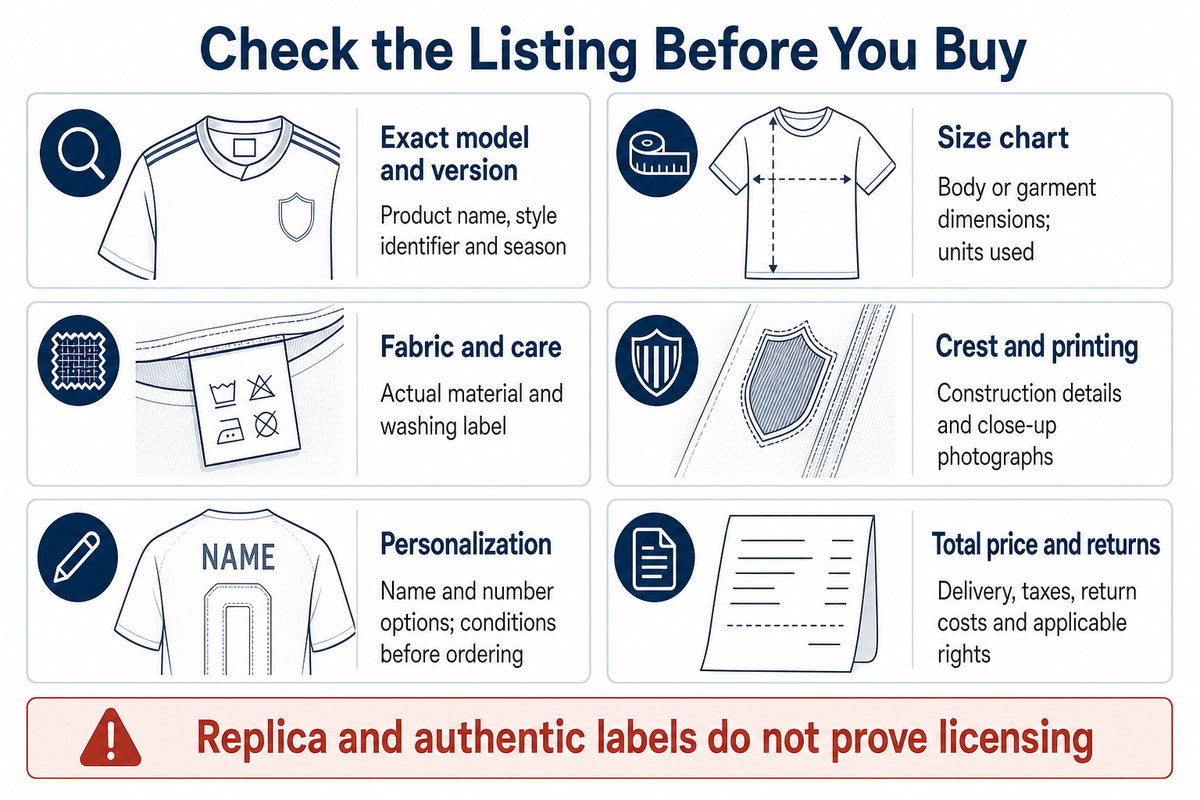
The best listings provide a clear photo of the entire shirt with measurements, and show the full purchase price. Look at the care label, the fabric and the model/version/style number. These help verify the listing. Also check the seller’s return policy and the ID of the person you’re buying from. Lastly, replica and authentic labels don’t prove officially licensed.
The FTC’s online-shopping guide recommends comparing manufacturer or model details, size and total cost, and checking return conditions. Applied to football jerseys, that means getting past a picture that looks nearly identical to a club’s playing kit.
Listing detail
What to check
Decision it supports
Exact model and version
Product name, style identifier and season
Whether the comparison is like for like
Size chart
Body or garment dimensions; units used
Which size to consider
Fabric and care
Actual material and washing label
Whether it fits your routine
Crest and printing
Construction details and close-up photographs
Whether the finish matches your preference
Personalization
Name and number options; conditions before ordering
Whether to commit before confirming fit
Total price and returns
Delivery, taxes, return costs and applicable rights
Whether the offer fits your budget
Are replica jerseys fake?
In an official brand range, a replica soccer jersey may be the supporter version rather than the premium player-style version. Fake jerseys are a different issue. “replica” doesn’t indicate authenticity any more than the word “authentic” does. Team branding, a badge, or heat-pressed trim doesn’t resolve this. You can’t reliably discern this from a distant promotional picture. For team branded merchandise, ask the seller to describe the product clearly and provide full and fair disclosure of the details behind the advertised claim.
Check a newly delivered shirt for quality before washing it or adding a personalized name or number. Look at your consumer rights and the seller’s policy to check your rights for the purchase of custom soccer jerseys. You shouldn’t expect a personalized item to have a no questions asked return policy. A seller’s policy allowing returns of personalized items doesn’t replace your consumer rights for that item. Don’t assume that every personalized item can be returned for a change of mind.
When browsing replica soccer jerseys, compare each listing’s details rather than transferring claims from the manufacturer examples in this article. SoccerKit’s about page describes the store as an independent retailer; this guide doesn’t establish authorized-dealer status or licensing for an individual product.
Jersey Care: Wash, Dry and Protect the Details
Caring for your jersey gear is relatively simple. Read the care labels and follow those instructions. Additionally, don’t let dirty gear wait until the next use before cleaning it. Printed designs may fade with excessive wear and rubbing. And be sure your gear is clean and dry before you use it again. The two specific examples of retail gear above can be machine washed, per their instruction labels.
The May 2022 edition of Nike’s jersey-care guide suggests cold, gentle washing, turning shirts inside out, avoiding fabric softener and air drying for routine garment care. For the purposes of this discussion, the focus will be on the recommended methods of washing shirts. The suggestions are meant to extend the life of the shirt and aren’t part of standard infection control practices. There’s no assurance that all embroidered crest shirts endure the same number of washes.
Athletic hygiene can require a different process. The CDC’s athlete infection-prevention guidance specifies washing and completely drying clothing after each use, including dryer-based drying, while also directing readers to follow clothing labels. If your team’s hygiene protocol and a shirt’s care label conflict, ask the responsible athletic trainer which compatible kit and cleaning process to use.
Normal care: Check pockets and keep the shirt separate from rough fasteners to prevent snagging. How jerseys are constructed determines which areas require protection. For additional printing, consult its care instructions as well as those for the base garments. The machine-wash symbol on the shirt doesn’t answer every care question about later personalization.
For more detail on washing soccer jerseys, see our dedicated guide. Design alone shouldn’t affect your decision when purchasing a shirt. A shirt that adds an additional and heavy burden to your already restrictive schedule (i.e. work, school, family, etc.) is a poor choice.
What Changed in 2026 Jersey Technology
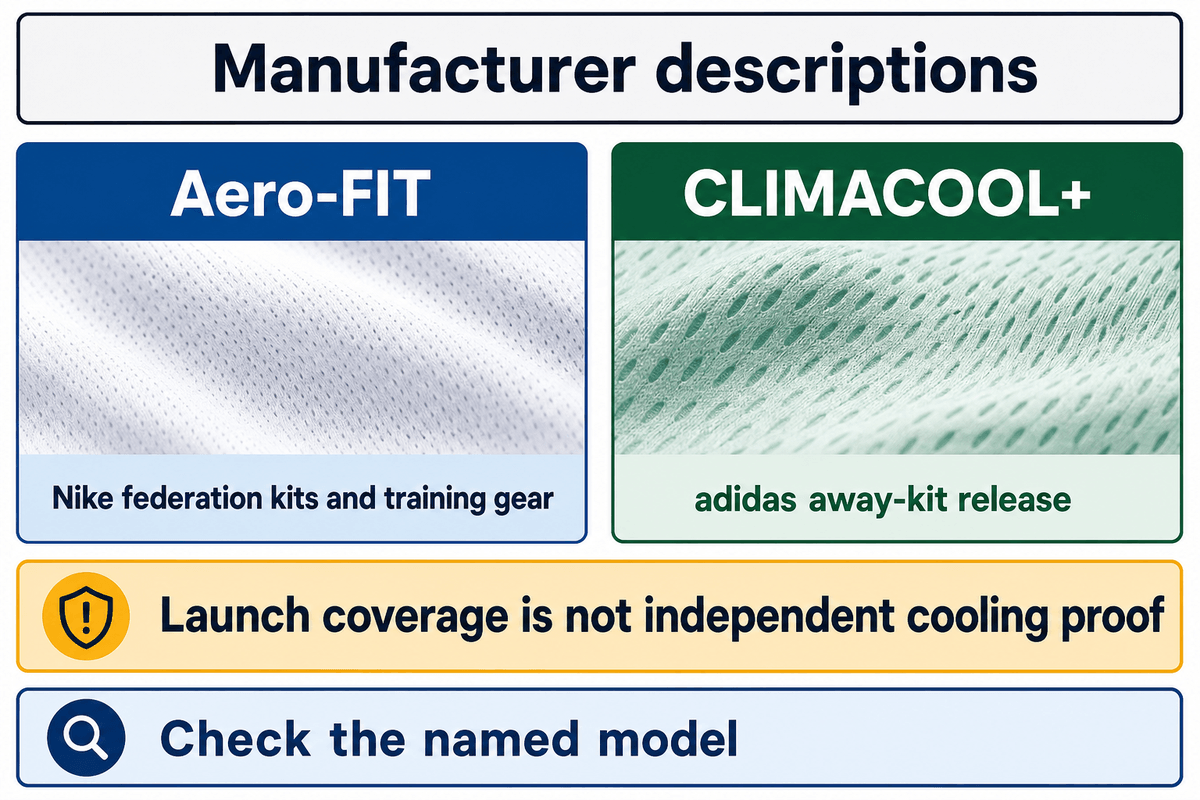
The 2026 kits introduced different names for some fabrics shoppers will encounter. In the federation kits and training gear, Nike introduced Aero-FIT. Elsewhere, CLIMACOOL+ was spotted in the away-jersey kit from adidas. Newer kit models and releases come with new fabric technologies. When considering fabrics, look at the kit models and releases rather than assuming technologies from older kit models and releases still apply.
Brands like Nike, adidas, and PUMA have their items classified, so shop within those categories. With adidas shirts, compare the named model instead of treating the brand name as a specification. Different replica kits don’t necessarily share the same technology. The same is true for all other kits. When checking the items, consider for whom and for what the item will be used and how it will be cared for. Information on what professional players wear can provide useful context. This information is helpful when determining if an item is right for you. This information, however, can’t tell you what size to purchase or help you with your laundry.
Choose a practice shirt for the work it needs to do, keep the approved match uniform ready, and buy a supporter version for the design and feel you enjoy. If nostalgia drives your choice, explore the store’s vintage and retro soccer jerseys with condition and intended wear in mind.
FAQ
What’s the difference between soccer jerseys?
Soccer jerseys differ by purpose, retail version and the construction of the specific model.
Soccer jerseys vary by purpose, and by the different ways they’re offered for sale and constructed. Occasions are described as Training and Pre-match. Versions are described as replica and Authentic. The term replica describes a retail version; training and Pre-match describe uses, while the required playing shirt is a separate question from replica versus authentic versions. Fabric, fit, printing and the shirt’s care label should all be compared, rather than treating one label as a complete specification. Shirts are sold for public fan wear, but players first need a shirt approved for their activities.
Which version of jersey is best?
The best version is the one that fits your intended use, body and budget.
In the end, it’s up to the consumer to decide which version satisfies his needs and budget. A shirt worn by a player during a game may be desirable to a collector, but no single version is best for everyone. However, for a shirt to be game worn, it doesn’t mean that the shirt is of the best quality. The shirt, if of the best quality, may have been manufactured for practice rather than a game.
What’s the difference between a game jersey and a player jersey?
The difference between authentic and replica tells you about retail positioning; game and player labels need a separate explanation. Ask what the seller means.
It’s necessary to understand the terminology used by sellers. Often the term player version describes a performance-oriented retail shirt, while game jersey may describe the team’s playing design. A shirt described as Game jersey doesn’t necessarily mean it was worn by a player. For collectability, it’s important to study the individual items and not generally accept the description given.
What are the two types of jerseys?
Authentic and replica are two common retail versions, but they are not the only jersey categories.
Though Authentic and replica are the two most recognizable categories of jersey, there are others. These include training, pre-match, and goalkeeper shirts as well as shirts for supporters. When a seller uses a different term, it’s important to read the product description to determine the reason for the distinction.
How to tell if jersey is game used?
Game-used status needs evidence linking that individual shirt to actual use; a retail Match label cannot provide it.
To prove a jersey was game used, one must provide evidence that links the jersey and the player who wore it during the game. A Match label by itself doesn’t provide sufficient evidence. Ask the seller for a description of how they obtained the jersey. For a game used claim, ask why the description, pictures and documentation provided support linking that individual jersey to the named player or match. Ask for pictures and information on the jersey that support the seller’s claim, and keep copies of the listing.
Appearance alone can’t be used to conclude a shirt was game-worn. The jerseys in shops may resemble the design players wear, but that doesn’t show those individual shirts were used by players. The shirts sold in shops shouldn’t be assumed to be the individual shirts worn by players during games. The seller has to provide evidence of the shirt’s game-worn status and distinguish between match-issued and match-worn shirts to support that claim. If there’s no evidence of game-worn status, collectors shouldn’t pay a game-worn price.
SoccerKit is an independent vendor of football shirts, so this article concerns choosing training shirts or match-day jerseys for real occasions. The model examples come from public manufacturer listings checked in September 2026; the rotation calendar is hypothetical. No laboratory cooling tests or long-term wash trials were conducted to verify the claims made in this article. Long standing technologies in kits remain the property of the respective companies.
I write about football shirts in use and in club history. My articles compare training and match-day jerseys and revisit memorable Mohamed Salah Liverpool shirts, helping readers connect fit and purpose with the players and moments that made a kit familiar.