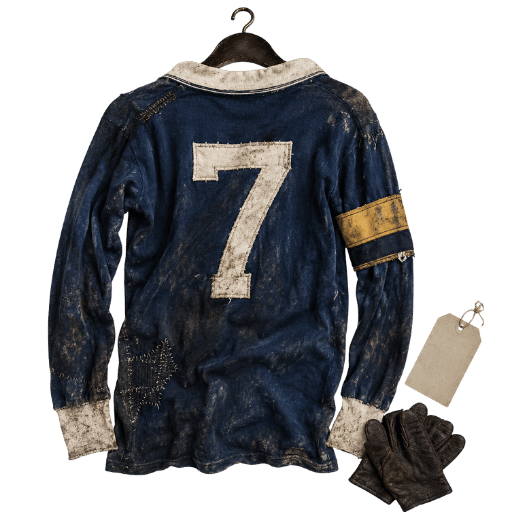
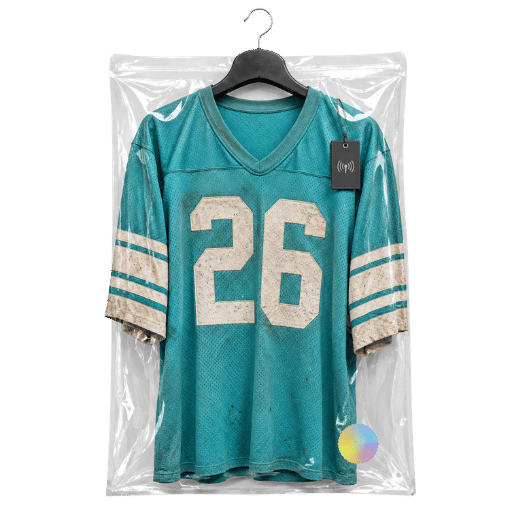
Still searching for your perfect jersey? Explore our best-selling products—we're confident you'll find a style that's just right for you in our diverse collection.
Updated June 2026 · Reviewed by the Classic Football Shirts technical team
Few labels in shirt collecting cause more confusion than these three. The core of the match worn vs match issued vintage jersey question is simple once you anchor it to one fact: a match worn shirt was physically worn by a player during a game, while a match issued shirt was prepared and given to the squad for a specific fixture but never actually worn. Player issue shirts sit one rung lower, built to professional specification, but not tied to any single match. Get those three apart and you stop overpaying, and you stop buying the wrong tier for what you actually want.
This guide lays out the full ladder, the physical tell, the authentication trail that matters more than any certificate, how the football terms map onto American “game worn” language, and what each tier is realistically worth — so you can tell the difference between worn and match issue shirts at a glance.
Quick Reference: The Three Terms
Match worn
Worn by the player on the pitch in a specific game. Often unwashed; carries sweat, grass and wear. Highest value.
Match issued / prepared
Fully prepared for that fixture (correct nameset, badges, sponsor, size) but never used — a bench shirt or a spare.
Player issue
Pro-spec, non-commercial shirt made in the player’s match technology, but not tied to one game or personalised for it.
What “Match Worn,” “Match Issued” and “Match Prepared” Actually Mean
Start with the definitions, because the whole hobby hangs on them. Put simply, a match worn football shirt is one a player wore during an official game. A match issued (or match prepared) shirt is one the kit manager readied for a named player and a specific fixture, correct competition badges, sponsor, nameset and size, that never made it onto the pitch.
Those two shirts can be physically identical; the only difference is whether the garment saw play. You will also see these written with a hyphen as match-worn and match-issued, or compressed into a single word, matchworn, and they all describe the same thing.
Where do match issued shirts come from? Two routes. Clubs prepare multiple shirts for each player, so spares stay in the locker room — these shirts are prepared for a player and a named fixture, then simply never used. And a player named on the bench who never comes on still had a shirt prepared for him. Both feed the match issued market. The Reddit collecting community is blunt about how often this gets blurred: match worn versus match issued versus player edition is, in their words, the most misunderstood thing in the hobby, and a large share of “match worn” listings on resale apps are simply mislabelled. Getting the tier right is also your defence against fakes, a market so large that U.S. authorities seized more than 214,000 counterfeit sports items ahead of a single Super Bowl.
Match worn vs match issued vs player issue: the four questions that separate them.
Type / Tier
Worn in a game?
Prepared for one fixture?
Personalised & badged?
Pro (non-retail) build?
Match worn
Yes
Yes
Yes
Yes
Match issued
No
Yes
Yes
Yes
Match prepared
No
Yes
Yes
Yes
Player issue
No
No
Not necessarily
Yes
Match authentic (retail)
No
No
Optional
Retail-grade
Replica
No
No
Optional (shop print)
No
Game worn (US term)
Yes
Yes
Yes
Yes
Game issued (US term)
No
Yes
Yes
Yes
Team issued (US term)
No
No
Not always to that player
Yes
Counterfeit (avoid)
No
No
Faked
No
The Pitch-Proximity Ladder: Five Tiers from Retail to Match Worn
The cleanest way to remember every shirt type is to rank them by one thing: how close the garment got to actual play. We call it the Pitch-Proximity Ladder. Value rises with every rung, because each step up means the shirt is one step closer to a real player in a real game.
The 5-Tier Pitch-Proximity Framework
The Pitch-Proximity Ladder — five tiers ranked by how close the shirt got to the pitch.
Rung
Tier
Closest it got to the pitch
Relative scarcity
5 (top)
Match worn
On the player, in the game
Rarest — one shirt, one half, one player
4
Match issued / prepared
Into the locker room for that fixture
Scarce — spares and bench shirts
3
Player issue
Made to the player’s pro spec
Limited — non-commercial production
2
Match authentic (retail)
Shop version of the on-pitch spec
Common — sold to the public
1 (base)
Replica
Fan kit, lighter build
Mass market
One nuance keep the ladder honest: the middle rungs blur. Specialist seller Walkouts splits out a “match authentic” retail shirt that mirrors the on-pitch specification yet is sold to the public, sitting just under player issue. So a shirt can look pro-grade and still be a shop purchase. That’s exactly why the rung you’re paying for must be proven, not assumed, and why outright counterfeits, which U.S. Customs and Border Protection calls a global problem, sit below even the replica at the base of the ladder.
Match Worn: What Actually Counts as “Worn”
What makes a shirt match worn rather than match issued?
A shirt earns the match worn label only when a player actually wore it in a game, and you can show it. The shirt that never left the bench is prepared, not worn. That single distinction, saw play or didn’t, is the whole game, and it is what separates a genuine match worn shirt from a match issued one.
Modern players often go through multiple shirts in a single match: a typical setup is a spare, a first-half shirt and a second-half shirt. Shirts worn during play are the ones actually used by the player on the pitch, and they pick up the sweat and scuffs that prove it. First-half shirts now usually stay with the club for auction, while second-half shirts are often the player’s to keep, give away or throw to the crowd.
“Usually, players have three shirts at their disposal: a spare, one for the first half, and one for the second half. They take off the first-half shirt and put on the one they’ll wear in the second half. The third shirt might stay at the club, reused by the kit manager, or sometimes made available to fans. That one isn’t technically match worn but is prepared and differs slightly from a store shirt. These locker-room shirts are called match issue.”
Filippo Delprete, Italian Jersey Collector
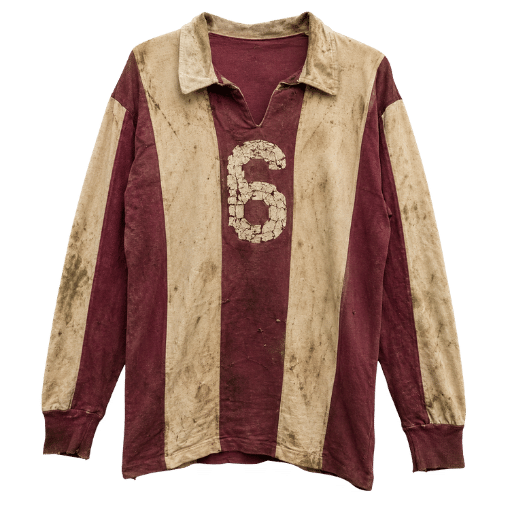
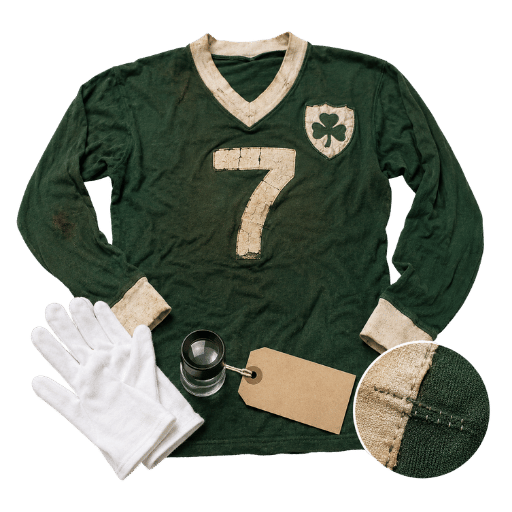
Physical tells of genuine wear are specific, and no single one is decisive on its own. Look for print micro-chipping, grass or rubber-crumb transfer from the pitch, abrasion on the sleeve cuffs, faint mud tide lines, deodorant marks and adhesive sheen changes around the patches, plus minor thread pulls at high-contact zones. Genuine match worn shirts feel consistent across all of those details. One clean sign next to ten missing ones is a red flag, and artificially aged “wear” is common, which is why U.S. agencies seized roughly 276,000 fake sports items in a single year ahead of major tournaments.
📐 Collector Note
A common mistake is reading dirt as proof. Sweat, grass and stains can be faked or simply transferred from storage. Wear has to be the right wear, in the right places for that sport and that position, and consistent with the specific fixture. That’s why a dirty shirt with no provenance is worth less than a clean one with an airtight trail.
Match Issued and Match Prepared: Pitch-Ready but Never Worn
When does a player issue shirt become match issue?
A player issue shirt becomes match issue only when every element of a specific fixture is present. Collector Tianse17 frames it as an equation: match issue = player issue + personalisation + badges + competition regulations, and match worn = match issue + match.
Personalisation means the correct match nameset and number in the official player font, not a shop font. Badges means the right competition patches for that game. And competition regulations means the shirt obeys the rules of the tournament it was prepared for.
Those regulations matter more than collectors expect. In the UEFA Champions League only one sponsor logo is allowed and it’s capped at 100 cm², so a domestic shirt lose sponsors to qualify. Premier League sleeve patches differ by build, too: roughly 6.5 cm across on a replica versus about 8 cm on a player-issue shirt. Even namesets shift: a player’s surname sits above the number in the Champions League because the club name is banned there, while it sits below the number in many domestic leagues. Buy a shop print and a normal badge and stick them on a player issue shirt, and you’ve a personalised player issue shirt, not a match issue one.
This is exactly where the most expensive mistakes happen, and it’s the biggest risk in the whole category. Because every match issue shirt must carry the official player font and the correct competition badge, fraudsters take a genuine player issue shirt, add a shop-bought nameset, and sell it as match issue, a switch that can inflate the price by several hundred dollars. In practice, the tells are the details a kit manager with years of routine never gets wrong: the 8 cm Premier League sleeve patch (versus 6.5 cm on a replica), the exact match font, and the sponsor downscaled to the 100 cm² Champions League limit. Get any of those wrong and the shirt is a personalised player issue, not a match issue, and you’ve overpaid for the wrong tier. Formal authentication programmes grew up to fight exactly this kind of fraud, an approach documented in academic research on game-used memorabilia.
Player Issue vs Replica vs Authentic: The Lower Rungs
Below the match shirts sit the tiers most buyers actually meet first. Built in the player’s match technology, tighter cut, heat-applied or pro-grade nameset, performance fabric, a player issue shirt is still non-commercial and not tied to a fixture — and not necessarily worn in any specific game. Match authentic retail shirts mirror that on-pitch spec yet sell in shops. Replicas are the fan version: lighter fabric, simpler printing, relaxed fit. None of these is fake; they’re just different rungs. Our guides on the player version vs replica soccer jersey question and the wider authentic vs replica jersey differences go deeper on the fabric and print tells.
One honest edge case keeps the lower rungs interesting: players sometimes wear replicas. Collectors have documented top-flight players in a shop-spec shirt for one half and a player issue version for the other. So “the player wore one like it” isn’t the same as “the player wore this one.” Only photo matching closes that gap.
✔ Why collectors buy player issue
Genuine pro-spec build at a fraction of match worn prices
Pristine condition for display, no sweat or repairs
Closer to the real thing than any shop replica
⚠ Limitations to accept
No link to a specific match or moment
Easily passed off as match issue by adding a print
Lower long-term scarcity than a worn shirt
Game Worn vs Game Issued: Translating the Football Terms to NFL, NBA and NHL
If you cross into American sports collecting, the vocabulary change and the traps move. In US sports the closest term to match worn is game worn (sometimes “game used”); match issued maps to game issued or player issued; and there’s an extra tier with no clean football equivalentteam issued. This is the single most useful translation a football collector can carry across, because the same shirt sold under two vocabularies can be priced very differently.
The Football-to-US-Sports Tier Map — football and NFL/NBA/NHL terms, side by side.
Football (soccer) term
US sports equivalent
What it means
Match worn
Game worn / game used
Physically worn by the named player in a game
Match issued / player issue
Game issued (a.k.a. player issued)
Made for a specific player and game, never worn
(no clean equivalent)
Team issued
Pro-cut for the team; the name may not reflect who it was made for
Match authentic (retail)
Retail authentic
On-field spec sold to the public
Replica
Replica
Licensed fan version, simplified build
Where US buyers get misled most often is the team issued tier, and football collectors should note why: a team issued jersey is pro-cut for the team, but the name and number on it “may not reflect who it was made for,” because equipment staff customise blank stock as inventory demands — and the jersey may never be used by a player in a game at all. American leagues also lean harder on hard tells: the MLB Authentication Program, the industry standard since 2001, puts a numbered hologram on each game-used item that you can verify online against its database, and NFL team-issued jerseys are made at a specific factory in Wisconsin. Football has fewer such anchors, which makes photo matching even more important on this side of the Atlantic. For ranked examples of iconic finals shirts and how the match-issue distinction play out, see our roundup of iconic Champions League final jerseys.
How to Authenticate a Match Worn Shirt
Real authentication is about evidence you can verify, not paperwork you have to trust. For a match worn shirt that means one thing above all: a photo match that ties this exact garment to a specific game, supported by a credible source and competition-correct details. Get that evidence and the shirt holds its value; lean on a certificate alone and you are exposed to the most common fraud in the hobby.
How is a match worn shirt authenticated?
A match worn shirt is authenticated by building a trail, not by waving a certificate. By far the strongest evidence is a photo match: comparing high-resolution images from the game with the shirt in hand so you can trace the exact garment back to the exact fixture, finding repeatable, documentable matches in fabric weave, stitch alignment, scuffs, creases, print chips and dirt placement. We rank it as the 6-Layer Provenance Trail, strongest layer first.
✔1. Photo matchside-by-side crops tying the exact shirt to the exact fixture.
✔2. Sourceclub, foundation or a credible auction house, not an anonymous reseller.
✔3. Competition-correct detailsbadges, sponsor and nameset that match the season and the rules.
✔4. Wear consistencythe right wear in the right places for that sport and position.
✔5. Documentationkit-manager note, player letter or auction paperwork that names the item.
✔6. The COAuseful as a backstop, but the weakest layer on its own.
⚠️A certificate is not proof
This is the contrarian truth most listings ignore: authentication paperwork “can be very easily forged,” and a certificate from a company that can’t keep its records secure is, in practice, close to worthless. Treat a COA as a backstop to a photo match; it never replaces one. Provenance, the documented history of the piece, is the most straightforward and dependable form of authentication, a principle borrowed straight from the high-value art market, as legal scholarship on authenticity at NYU’s Journal of Intellectual Property & Entertainment Law sets out.
What Drives the Price: Why Match Worn Costs Far More
Value climbs the Pitch-Proximity Ladder, and the gaps are large. We call the pattern the Proximity-to-Pitch Premium Curve: each rung closer to the pitch multiplies the price, and a documented moment multiplies it again. Fully proven, a match worn shirt commands a premium over a match issued one; a shirt that can’t be anchored to a fixture trades down toward its base spec.
Price is driven by player relevance, match significance (finals, debuts, derbies and record-breakers), the quality of the proof, and scarcity.
Here’s the same shirt design walked up the ladder, using prices observed on specialist marketplaces in late 2025 (directional, and likely to move with the market):
The Proximity-to-Pitch Premium Curve — one design, five tiers (directional 2025 figures).
Tier
Indicative price band
Why
Replica
$80–$120
Mass-market fan kit
Player issue / match authentic
$150–$300
Pro spec, non-commercial build
Match issued (unworn)
$300–$600
Prepared for the fixture, never worn
Match worn (squad player)
$500–$1,600
Verified use; e.g. a Champions League match worn shirt near $1,549
Match worn (star / big moment)
$5,000+
Tournament knockout shirts have traded above $5,100
One useful cross-check from American sports: a game issued jersey typically commands roughly 30–70% of a comparable game worn example. Apply that to football and a match issued shirt usually lands at a third to two-thirds of the worn equivalent, which is why the unworn tier is the value sweet spot for display buyers. At the very top, the ceiling is astonishing: Diego Maradona’s 1986 “Hand of God” shirt sold for £7,142,500, about $8.93 million, the record for any football shirt, a sale also reported by ESPN. For where the affordable end of the value spectrum sit, our 1980s football shirt collectibility guide breaks down what actually moves prices.
Which Tier Should You Buy? A Collector’s Decision Framework
Which tier is right depends entirely on what you want the shirt to do, not on which one carries the highest price tag. If you only want to wear it, buy a replica; if you want the real on-pitch spec in pristine condition, buy player issue or match issued; and if you want a direct link to a specific game or moment, buy match worn, but only with a photo match. Use this decision path:
Match the tier to your goal
Want to wear it? Buy a replica or match authentic retail shirt. Don’t pay match prices for something you’ll sweat in.
Want a pristine display piece of the real spec? Buy player issue or match issued, pro build, crisp condition, a third to two-thirds of worn prices.
Want a direct link to a game or moment? Buy match worn, but only with a photo match plus provenance, never a COA alone.
Buying as an investment? Prioritise player relevance, a significant fixture and airtight proof; an unprovable “match worn” is just an expensive replica.
Wherever you land, buy from sources that disclose the tier honestly, club-official auctions and established memorabilia houses that document provenance, rather than unverified resale listings. If you’re weighing where to start, our guide to the best place to buy replica soccer jerseys covers safe entry points before you climb the ladder.
Ready to find a genuine piece of football history? Browse authenticated, accurately described shirts across every era.
The Market in 2026: Why These Terms Now Matter More Than Ever
Why buyers suddenly need this vocabulary is structural, not hype. Two forces are driving demand to understand the tiers. First, club-official auction platforms have mainstreamed the category: MatchWornShirt now partners with 400+ clubs, runs auctions that begin at kickoff, and in 2025–2026 signed a multi-year deal with Major League Soccer and its players’ association. What was once a niche corner of memorabilia is now a live, every-match marketplace. Second, that growth has pulled in resale apps where mislabelling is rife, so buyers are forced to learn the difference between worn, issued and player issue before they spend. Search interest in “match worn shirt” rose through the second half of 2025, and the practical takeaway for 2026 is simple: learn the trail first, then bid, because the platforms have made it easier to buy, not easier to verify.
What does that mean for your wallet? The risk is concrete: on open resale apps, a mislabelled “match worn” shirt can cost several hundred dollars more than the player issue shirt it actually is, and that gap is widening because the supply of genuine worn shirts is fixed while demand grows. In practice, a collector bidding in a live auction has seconds to decide, so the use case for knowing the tiers cold is real money on the table. Roughly 30% of resale listings get the label wrong, and it isn’t always fraud, often the seller simply doesn’t know, but the cost still lands on the buyer. Collectors with years of experience treat an authentication guide as a pre-bid checklist and never pay a match worn premium without a photo match. Timing sharpens the point here: with the 2026 World Cup approaching, U.S. agencies are already warning fans about counterfeit merchandise, so the gap between easy-to-buy and easy-to-verify will only widen.
Frequently Asked Questions
Q: Is a match worn shirt legitimate?
View Answer
Yes, when it is what the seller claims. A legitimate match worn shirt has a photo match to a specific fixture, plus a credible provenance trail from the club, a foundation or an established auction house that can document where the shirt came from. The garment itself is genuine; the real risk is mislabelling and forged paperwork. That is why verification through images and history, not the certificate alone, is what truly makes a match worn shirt legitimate.
Q: What does “match issued” mean?
View Answer
A match issued shirt was fully prepared by the kit team for a named player and a specific game, correct nameset, badges, sponsor and size, but was never worn on the pitch. It is pro-spec and authentic, just unworn, and usually began as a spare.
Q: What’s the difference between match worn and match issued at a glance?
View Answer
One word: use. A match worn shirt was actually worn in the game and usually shows the marks of play, sweat, grass and small repairs, while a match issued shirt is built to the same specification but never saw the pitch, so it stays crisp. Both can be physically identical garments, which is the whole problem. Only a photo match to the fixture, or documented provenance from a credible source, proves for certain which one you own.
Q: How much are match worn shirts worth?
View Answer
It ranges enormously in practice. A match worn shirt might trade from a few hundred dollars, while a knockout-stage international shirt can pass $5,000. Value is driven by the player, the significance of the match, and the strength of the proof. In US sports terms, an unworn match issued version of the same shirt typically sells for 30–70% of the worn price, and a “match worn” shirt with no provenance is worth little more than its base replica.
Q: Should I wash a match worn shirt?
View Answer
No, never. Washing strips out the sweat, grass and wear evidence that proves the shirt actually saw play, and it can wreck the value overnight. Air it gently instead, store it flat in acid-free materials, and keep it out of direct sunlight and damp.
Q: Can a match worn shirt also be a “retail” shirt?
View Answer
Sometimes, yes. Many match worn shirts share construction with the match authentic retail version, and players have occasionally worn shop-spec replicas in games. So the defining trait is verified use on the pitch, proven by photo matching, not the build or the fabric alone.
About This Guide
We wrote this because “match worn” is the most mislabelled term we see across the vintage and retro market, and a clear ladder save collectors from paying worn prices for issued shirts. The tier definitions here are cross-checked against collector frameworks, auction-house practice and the published record price for a football shirt; the authentication trail reflects how serious buyers actually verify pitch use. Reviewed by the Classic Football Shirts technical team.
I write about football jersey fit and when different shirt styles make sense. My articles cover youth goalkeeper sizing and long-sleeve jerseys, helping players and families think through comfort, movement, weather, and the role of the shirt before they buy.