Still searching for your perfect jersey? Explore our best-selling products—we're confident you'll find a style that's just right for you in our diverse collection.
When fans ask how many players on a soccer team take the field, a full-strength regulation team fields 11 players at one time. That starting lineup includes one goalkeeper and 10 outfield players. The starting line-up consists of 22 players in total. Throughout the game, the bench players are wearing official matchday soccer shirts and are in uniform with the players. The bench players enter the game under competition rules.
Under Law 3 of the International Football Association Board, each football team may start with 7 to 11 players, including one goalkeeper. Neither side may start or continue a standard match with fewer than 7 players on the field.
Key Squad Numbers at a Glance
On-field full-strength starters consist of up to 11 players per side (10 outfield players and one goalkeeper). That puts up to 22 players on the pitch.
The minimum legal floor is 7 players per team (seven players per side, including one goalkeeper) to start or continue regulation play.
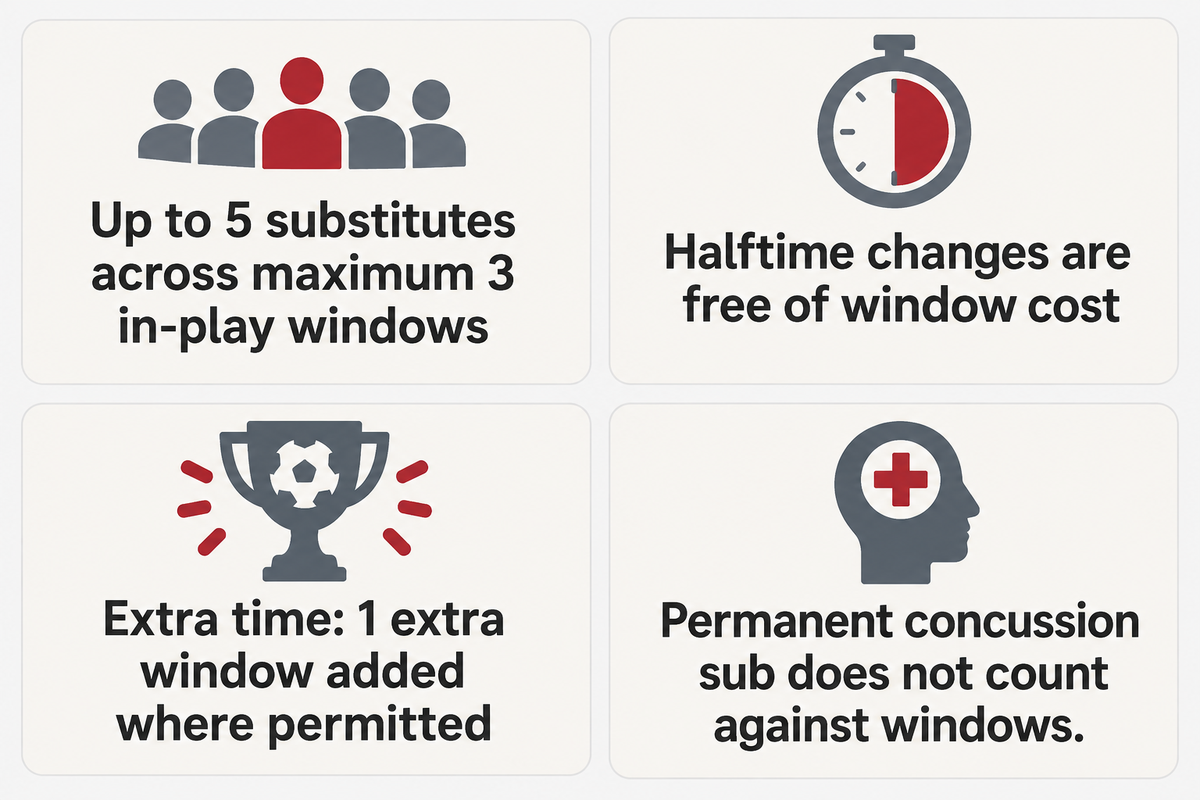
Matchday substitutions in competitions using the five-substitute rule allow up to 5 regular substitute players. Teams use those changes across 3 in-play substitution windows plus halftime.
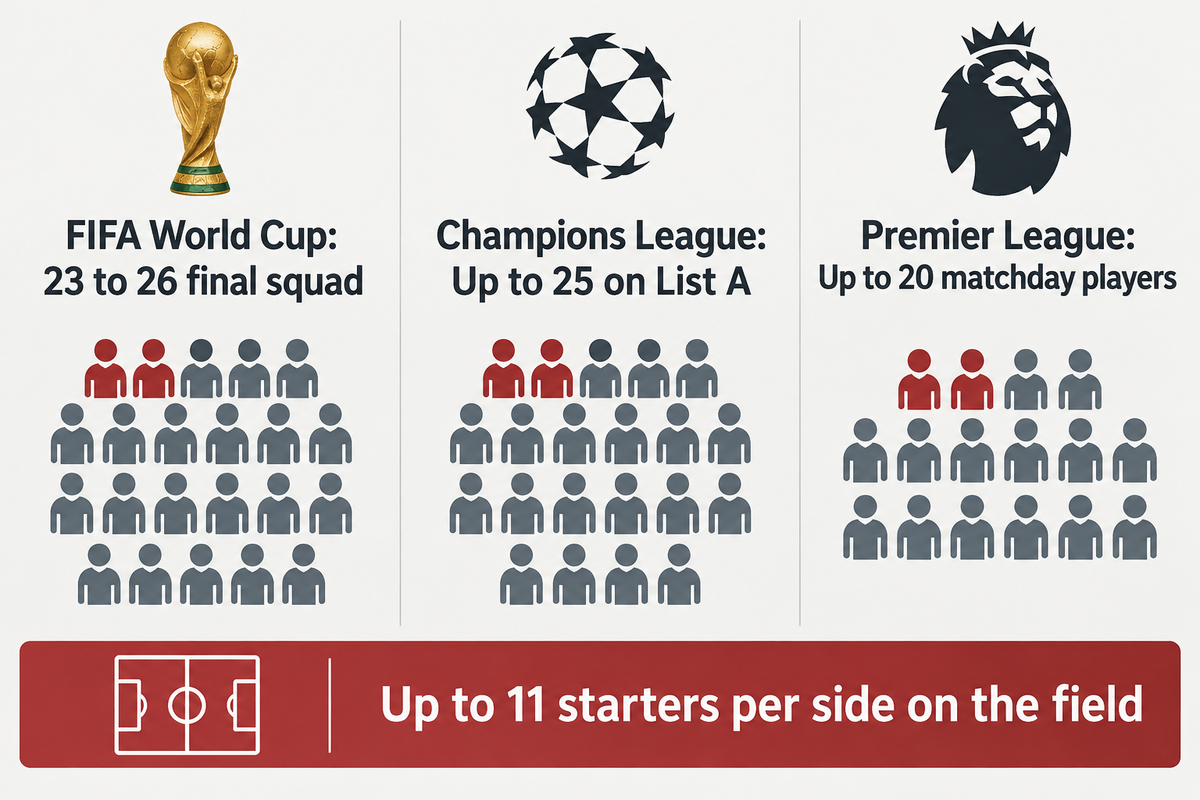
Premier League clubs name up to 20 matchday players from a registered senior squad of up to 25 plus eligible Under-21 players. By comparison, the 2026 World Cup final squad contains 23 to 26 players.
Updated November 2026. Scope: Standard 11v11 association football under the 2025/26 and 2026/27 IFAB Laws of the Game. Coverage also includes FIFA, UEFA, Premier League, MLS, and U.S. Soccer regulations.
How Many Players Are on a Soccer Team in a Standard Soccer Match?
In accordance with IFAB Law 3.1, a standard soccer team can field up to 11 players at one time. That full-strength lineup consists of one goalkeeper and 10 outfield players, creating a total of 22 players on the field of play when both teams are at full strength. A regulation match can’t start or continue with fewer than 7 players on either team.
“A match is played by two teams, each with a maximum of eleven players; one must be the goalkeeper. A match may not start or continue if either team has fewer than seven players.”
Fans asking how many players are on a soccer team encounter three distinct headcounts. At full strength, a single soccer team has 11 players on the field at any given time. Simultaneously, the head coach names a matchday bench, and manages a larger season roster.
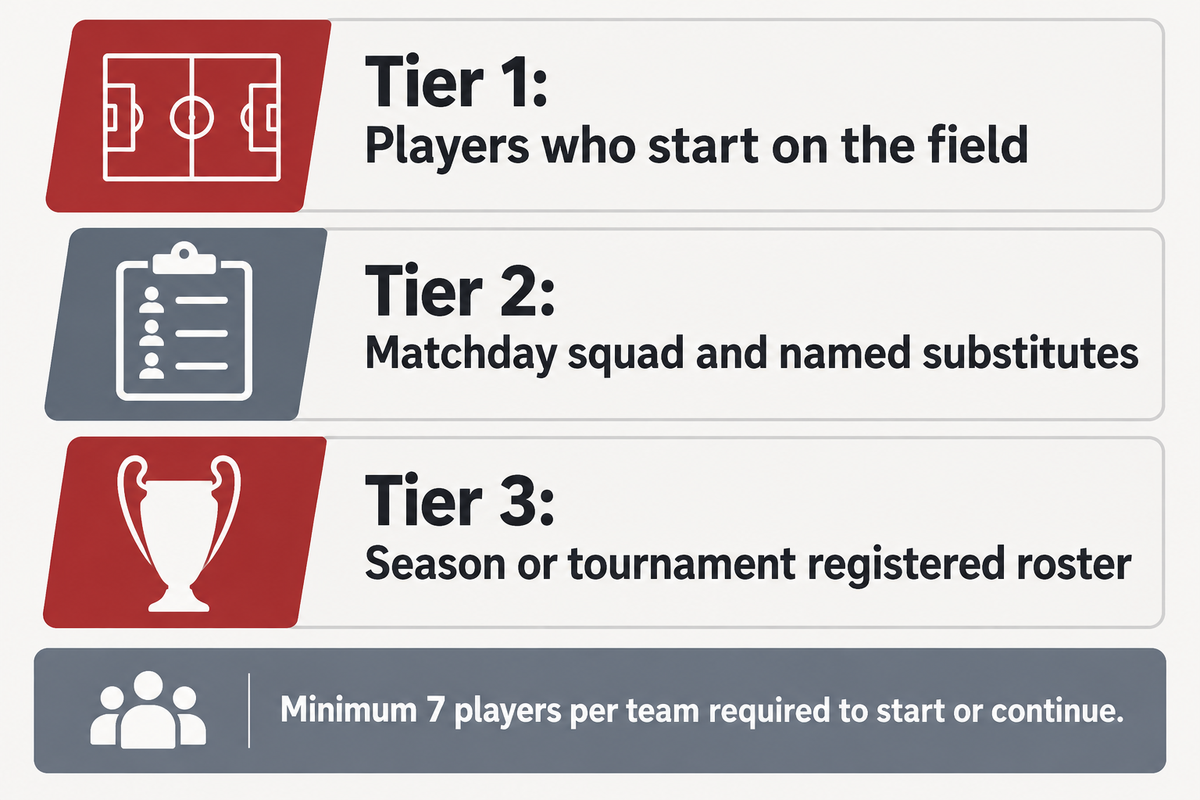
The 3-Tier Soccer Squad Pyramid illustrates these three counts, and can serve viewers and amateur club managers in making similar distinctions.
Tier 1 lists players who start on the field (7 to 11 players per team; 11 at full strength). Each team’s goalkeeper may handle the ball within their own penalty area, where the goalkeeper handling restrictions still apply. Up to ten outfield players cover defense, midfield, and attack.
Tier 2 covers the matchday squad. It incorporates starters with 3 to 15 named substitutes permitted by the competition. Only players available on this pre-match team sheet can take part in the soccer game.
Tier 3 covers the season or tournament registered roster. Separate registration limits and youth player exemptions set by the tournament organizer and League apply to male players or women’s soccer professionals across a campaign.
How many players do you need to play a soccer match?
In standard 11v11 soccer, each team may field up to 11 players (22 total for a full-sided regulation game). Each side needs at least 7 players per team (14 total on the soccer field), including one goalkeeper, to start or continue an official match under IFAB Law 3.1. That 7-player threshold is the minimum number of players allowed on the pitch.
Under the 2026/27 Law 3.1 text, temporary dismissals (sin-bins) don’t count toward dropping below the 7-player floor. The same exemption applies to absences due to the time-limited substitution or off-field treatment and assessment protocols. National football associations may set a higher starting minimum for local competitions, and the 7-player continuation minimum doesn’t apply during penalty shootouts. During normal or extra time, if a permanent dismissal or unreplaceable injury leaves a side with 6 active players able to continue, the referee stops and abandons the match.
How Many Players Are on a Soccer Field vs on the Substitute Bench?
While up to 11 players per team occupy the field at a time, competition rules permit teams to name between 3 and 15 substitutes on the bench. In top-flight domestic and international soccer matches adopting the five-sub rule, each team can use up to 5 regular substitutes across 3 in-play substitution opportunities, plus halftime.
Before 2020, 3 substitutions were the usual normal-time limit in professional competitive matches. Some knockout competitions allowed for an additional substitution in extra time. IFAB Law 3.2 now allows official senior competitions to permit up to 5 substitutions per team, with the exact allowance set by the competition organizer. Law 3.2 also restricts teams to 3 in-play substitution windows during the 90 minutes. That rule prevents coaches from breaking up match flow with five separate stoppages.
Learning how bench size interacts with substitution windows helps you avoid making costly mistakes. See how normal time, halftime, extra time and concussion protocols work in practice by referring to the 5-Sub × 3-Window Substitution Matrix below.
5-Sub × 3-Window Substitution Matrix
5-Sub × 3-Window Substitution Matrix: How IFAB Law 3.2 governs bench sizes, substitution windows, extra time, and concussion replacements
Match Scenario or Phase
Named Bench Cap
Permitted Substitutions
In-Play Window Rule & Exceptions
Standard 90-minute league or cup match (5-sub competitions)
3 to 15 bench players (set by competition)
Up to 5 substitutes
Maximum 3 in-play windows. Multiple changes in one stoppage count as 1 window.
Halftime interval (between 45th and 46th minute)
Same matchday bench
Counts toward the 5-sub cap
Zero in-play windows used. Halftime changes are free of window cost.
Both teams substitute during the same stoppage
Same matchday bench
Counts toward each team’s 5-sub cap
Deducts 1 substitution opportunity from both the attacking team and defending team.
Knockout match entering 30-minute extra time
3 to 15 bench players (set by competition)
Up to 6 substitutes (where competition rules permit)
1 extra window added. Changes before extra time or at extra-time halftime do not use a window.
Permanent concussion substitution protocol
Same matchday bench
1 additional permanent concussion sub
Does not count against the 3 windows. The opposing team gains 1 matching sub and 1 window.
Senior national ‘A’ team friendly match
Up to 15 bench players
Up to 8 subs (or up to 11 by mutual agreement)
Referee must be informed before kick-off if both nations agree to use up to 11 subs.
Can a team make 6 substitutions?
Yes, a team can legally make 6 substitutions in three regulated scenarios. First, in knockout competitions where competition rules permit an extra-time substitute, each side gains a 6th substitution and a 4th in-play window. Unused normal-time subs also carry over into extra time. Second, under the permanent concussion protocol, a team can make an additional concussion substitution even after using the 5 regular substitutions. The opposing team is also allowed an additional substitution.
Third, in senior national ‘A’ team international friendlies, IFAB 2026/27 Law 3.2 allows teams to use up to 8 substitutes by default. Both teams may mutually agree before kick-off to use up to 11 substitutes, provided that the referee is informed before the match. Note that the extra-time 6th substitute is a competition option rather than automatic in every domestic cup. Our how long is a soccer game guide breaks down how 30-minute extra-time periods and halftime intervals affect substitution timing.
Starting 11 vs Matchday Squad vs Full League and World Cup Roster Sizes
Major leagues and tournaments set specific caps for benches and rosters while allowing up to 11 starters per side. Premier League clubs name up to 20 matchday players from a 25-man senior list plus Under-21s, while 2026 FIFA World Cup squads register 23 to 26 players (up to 15 bench substitutes).
Bench headcounts in domestic leagues and headcounts in European leagues differ. Competition organizers set their own matchday team sheet limits within the 3-to-15 substitute range set forth by IFAB. They also implement domestic registration rules to encourage youth and promote squad balance.
In England, the Premier League squad registration rules limit each club to no more than 25 senior players aged 21 and over. No more than 17 of the 25 can be non-Home Grown. A full Premier League squad of 25 requires at least 8 Home Grown players. Each Home Grown player must be registered with an FA- or FAW-affiliated club for three entire seasons or 36 months before their 21st birthday (or the end of the season in which they turn 21).
In European competition, UEFA Champions League Article 31 limits List A to a maximum of 25 players. List A must contain at least 2 goalkeepers. A full 25-player List A requires 8 locally trained players, with no more than 4 of those reserved places filled by association-trained players. Unfilled reserved places decrease the 25-player List A cap accordingly. List B has no numerical cap for young players born on or after January 1st, 2005 for 2026/27. Those List B players must meet qualifying club-registration conditions, including at least 2 uninterrupted years at the club since age 15. On matchday, UEFA allows up to 23 players on the team sheet (11 starters and up to 12 bench substitutes).
Comparison of starting lineups, matchday bench limits, matchday squad caps, and full registered rosters across 9 major competitions
Competition or League
On-Field Starters
Named Bench Subs (Max Used)
Matchday Squad Cap
Registered Roster Cap & Key Quota Rules
FIFA World Cup (2026)
11 (1 GK + 10 outfield)
12 to 15 named (5 used; 6 in ET)
23 to 26 players
23 to 26 final squad (min 3 GKs) from 35 to 55 provisional list (min 4 GKs).
UEFA Champions League
11 (1 GK + 10 outfield)
Up to 12 named (5 used; 6 in ET)
Up to 23 players
Up to 25 on List A (min 2 GKs; 8 locally trained reserved places or cap reduced) plus eligible List B youth players.
English Premier League
11 (1 GK + 10 outfield)
Up to 9 named (5 used in 3 windows)
Up to 20 players
Up to 25 senior players (max 17 non-Home Grown) plus unlimited eligible Under-21 players.
Spanish La Liga
11 (1 GK + 10 outfield)
Up to 12 named (5 used in 3 windows)
Up to 23 players
Up to 25 first-team squad numbers (Nos. 1 to 25; GKs wear 1, 13, or 25) plus B-team call-ups.
Italian Serie A
11 (1 GK + 10 outfield)
Up to 15 named (5 used)
Up to 26 players
Up to 25 senior squad players (4 club-trained and 4 association-trained reserved slots) plus eligible U22s.
German Bundesliga
11 (1 GK + 10 outfield)
Up to 9 named (5 used in 3 windows)
Up to 20 players
No hard senior cap. Clubs must maintain 12 German-eligible players and 8 local trainees.
Major League Soccer (MLS)
11 (1 GK + 10 outfield)
Up to 9 named (5 used in 3 windows)
Up to 20 players
Up to 30 active players on their roster (20 Senior Roster and 10 Supplemental Roster slots).
NWSL (Women’s Soccer)
11 (1 GK + 10 outfield)
Up to 9 named (5 used in 3 windows)
Up to 20 players
22 to 26 active senior roster players under league collective bargaining rules.
FIFA Futsal World Cup
5 on court (1 GK + 4 outfield)
Up to 9 named (unlimited rolling subs)
Up to 14 players
Up to 14 registered tournament players, including at least 2 goalkeepers.
How many players are in a World Cup squad in 2026?
A 2026 FIFA World Cup final squad has 23 to 26 players, with at least 3 goalkeepers, as outlined in official FIFA World Cup 2026 squad regulations. For a full 26-man squad, the 15 non-starters are allowed on the matchday bench.
Before submitting the final 23-to-26-player roster, each coaching staff files a provisional release list of 35 to 55 players with at least 4 goalkeepers. Across all 48 participating national teams at the 2026 FIFA World Cup, a full 26-man selection puts up to 1,248 tournament players on official rosters. Once the final list is locked, a listed player can only be replaced for serious injury or illness up until 24 hours before the team’s opening match.
When Can a Soccer Team Play with Fewer Players After Red Cards or Injuries?
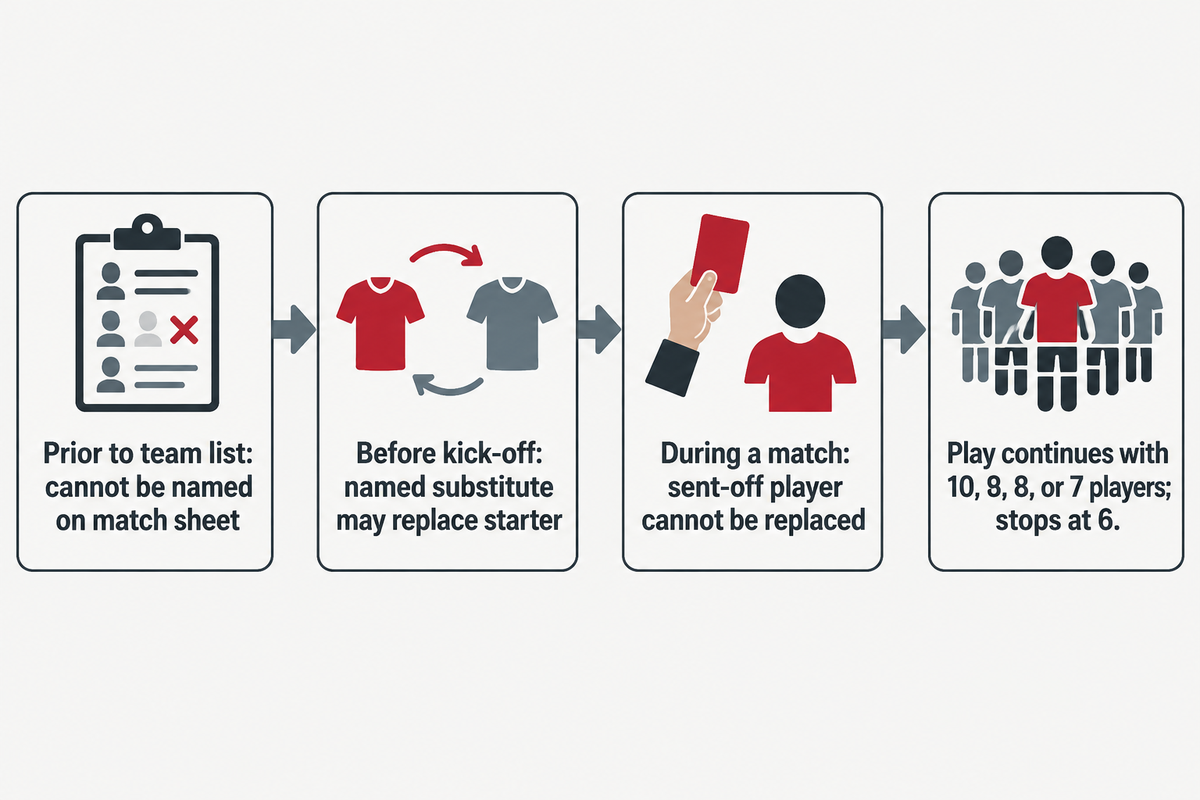
After a kick-off or if a player is forced to leave the match due to an injury and a red card is issued, a soccer team plays with fewer players on the field. Under IFAB Law 3.1, 11v11 play continues with 10, 9, 8, or 7 players, but stops if a side drops to 6 players.
Not every red card reduces a team from 11 players on the field to 10. Under IFAB Law 3.6, timing and player status decide whether the on-field headcount changes:
If a player is sent off prior to the team list being submitted, that player can’t be named on the match sheet in any capacity. The team still names 11 starters and a complete bench.
If a named starter is sent off after the team list is submitted but before the kick-off, a named substitute may replace the dismissed starter in the starting 11. The number of allowed substitutions for the team isn’t reduced. However, the vacant spot on the bench isn’t refilled.
An on-field player who’s sent off during a match can’t be replaced. The team is required to play the remainder of the game with a lower playing strength (i.e. 10 against 11).
After kick-off, dismissing a player reduces the team’s playing strength even if that player is temporarily off the field. A substitute or team official who’s dismissed doesn’t reduce the on-field headcount.
For more information, please refer to our in-depth guides on soccer red card rules and soccer yellow card accumulation to learn how suspensions are applied for accumulation of two cautions in the same game or for a straight dismissal. Here’s an illustrative numerical example that shows the effect of red cards, injuries and penalty shootouts on player counts:
Worked Headcount Sequence: From 11 Starters to Abandonment & Shootout Parity
At kick-off baseline, both Team A and Team B start with 11 active players (22 players total).
After a first active dismissal (11 − 1 = 10), Team A loses a midfielder to a straight red card in the 35th minute.
At the minimum legal floor (11 – 4 = 7), let’s assume Team A suffers 2 more red cards and 1 injured player leaves after all 5 substitutions are made. Team A reaches the minimum legal floor of 7 players.
At the abandonment trigger (7 – 1 = 6), if a dismissal or an injury with no replacement available leaves Team A with fewer than 7 players able to continue, the referee stops the match immediately; the specified temporary off-field protocol periods are exempt. In the 2002 English League match known as the Battle of Bramall Lane, Sheffield United lost 3 players to red cards and 2 to unreplaceable injuries. That drop to 6 players forced abandonment in the 82nd minute.
As per the reduce-to-equate rule in the penalty shootouts (Law 10.3), let’s assume a cup final ends extra time with Team A at 10 players and Team B at 11 players. Under IFAB Law 10.3, Team B has to exclude 1 player (11 – 1 = 10) to equate numbers before penalty kicks start.
Law 10.3 also covers an important exception regarding shootouts. If a team drops to fewer than 7 players during kicks from the penalty mark because of a shootout injury or dismissal, the referee doesn’t abandon the match.
Can a soccer team have more than 11 players on the field?
No, a soccer team can’t legally play with 12 or more players on the field during a match. As per IFAB Laws 3.7 and 3.9, if a substitute enters the pitch without the referee’s permission and interferes with play, the referee stops the match and gives the player a caution. Play resumes with a direct free kick or penalty kick for the opposing team.
What if a team scores a goal while an extra person is on the field of play? If the referee discovers before play is restarted that an extra player, substitute, substituted player, sent-off player, or team official for the scoring side interfered with play, that goal won’t count.
Youth, College, and Small-Sided Soccer Formats: 4v4, 5v5, 7v7, and 9v9 Team Sizes
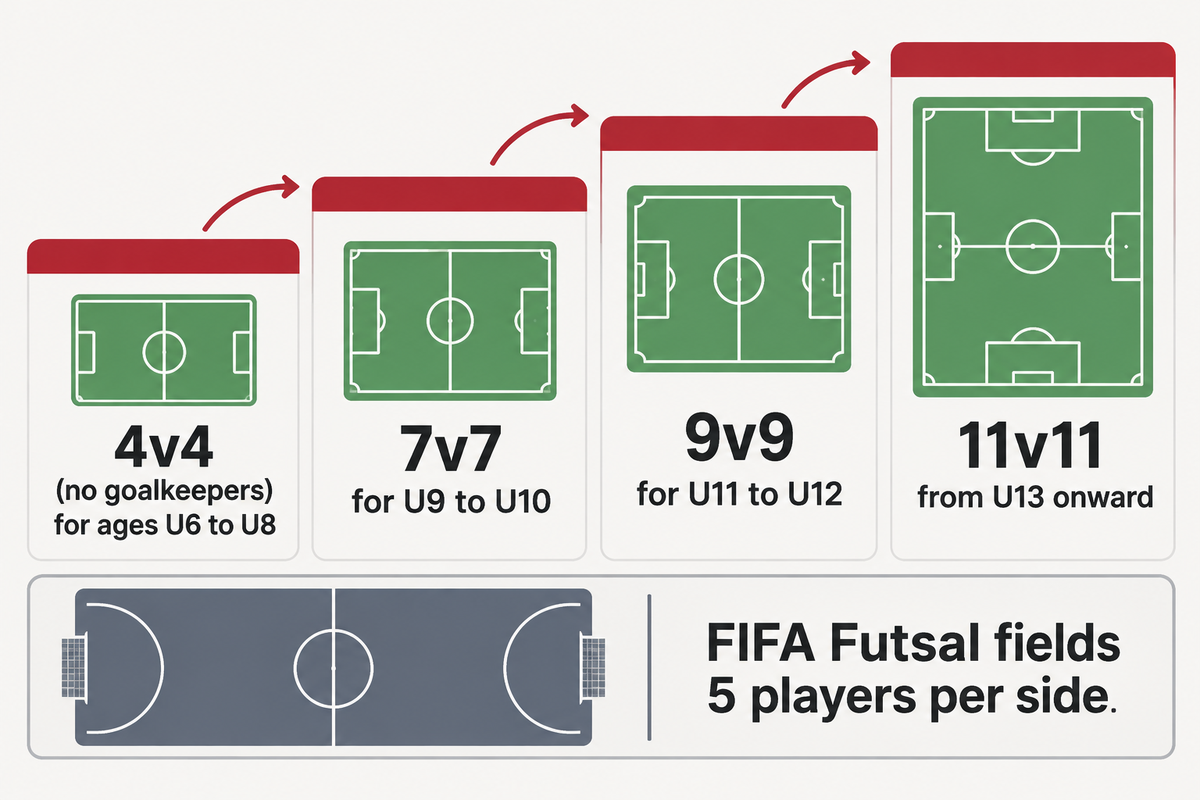
The soccer formats downscale the on-field player count to increase the number of touches on the ball and develop match physicality. In the United States, Youth Small-Sided Game PDI standards recommend 4v4 (no goalkeepers) for ages U6 to U8, 7v7 for U9 to U10, 9v9 for U11 to U12, and 11v11 from U13 onward. FIFA Futsal fields 5 players per side.
Putting eight-year-olds on an adult 11v11 pitch decreases ball contact, and slows the development of skills. The U.S. Soccer Player Development Initiatives (PDI) sets age-group formats to allow younger players to get more touches and passes by limiting the maximum number of players per side. The local leagues and state associations set team roster sizes. Local grassroots leagues may also run smaller 3v3 festivals at U6 and permit unlimited return substitutions under IFAB Law 3.2.
Small-sided adult formats follow their own governing rules. In FIFA Futsal rules, for example, a hard court futsal team fields five players per side (one goalkeeper) and 4 outfield players. With up to 9 substitutes, the matchday squad can contain up to 14 players across two 20-minute stop-clock halves. If a futsal dismissal leaves a team with 4 players against 5, a substitute may enter after 2 minutes of playing time or earlier if the team with 5 players scores, with authorization from the timekeeper or third referee. In 6v6 indoor soccer played inside boarded turf arenas, each team fields 6 players (one goalkeeper and 5 outfield players) with flying bench shifts.
At the collegiate level, men’s and women’s soccer teams in NCAA Division I play 11v11 on the pitch. Starting in the 2025/26 academic year, NCAA Division I schools opting into the House settlement follow a 28-player roster limit under Bylaw 17.2. That rule includes a transition exemption for grandfathered designated student-athletes.
Youth, collegiate, and small-sided soccer formats: on-field players, goalkeeper presence, squad rules, and substitution rules
Age Group or Format
On-Field Format (Total on Pitch)
Goalkeeper Included?
Squad / Roster Cap Rule
Substitution & Re-Entry Rule
U6 to U8 Youth Soccer (U.S. Soccer PDI)
4v4 max (8 players total)
No (0 goalkeepers)
Roster cap set by local league or state association
Unlimited rolling return substitutions at stoppages.
U9 to U10 Youth Soccer (U.S. Soccer PDI)
7v7 max (14 players total)
Yes (1 GK + 6 outfield)
Roster cap set by local league or state association
Unlimited rolling return substitutions; build-out line used.
U11 to U12 Youth Soccer (U.S. Soccer PDI)
9v9 max (18 players total)
Yes (1 GK + 8 outfield)
Roster cap set by local league or state association
Unlimited rolling return substitutions under youth league rules.
U13+ Youth Soccer (U.S. Soccer PDI)
11v11 (22 players total)
Yes (1 GK + 10 outfield)
Matchday sheet and season roster set by competition organizer
Return or limited substitutions determined by competition rules.
U.S. High School (NFHS Rules)
11v11 (22 players total)
Yes (1 GK + 10 outfield)
Varsity roster size set by state athletic association
Return substitutions permitted at approved stoppages.
NCAA Division I College Soccer
11v11 (22 players total)
Yes (1 GK + 10 outfield)
28-player roster cap (opt-in D1 schools under Bylaw 17.2)
Limited re-entry windows per half under NCAA soccer rules.
FIFA Futsal (Indoor Hard Court)
5v5 (10 players on court)
Yes (1 GK + 4 outfield)
Up to 14 players (5 starters + up to 9 bench subs)
Unlimited flying substitutions without stopping the clock.
FIFA Beach Soccer
5v5 (10 players on sand)
Yes (1 GK + 4 outfield)
Up to 12 players (5 starters + up to 7 bench subs)
Unlimited flying substitutions throughout three 12-minute periods.
6v6 Indoor Arena Soccer
6v6 (12 players on turf)
Yes (1 GK + 5 outfield)
Bench size set by arena league organizer
On-the-fly shift changes through the team bench door.
Adult Amateur 7-a-Side / 8-a-Side
7v7 or 8v8 (14 or 16 total)
Yes (1 GK + 6 or 7 outfield)
Squad limit for amateur players set by league organizer
Rolling return substitutions with referee permission.
What Are the 11 Soccer Positions and Shirt Numbers on the Pitch?
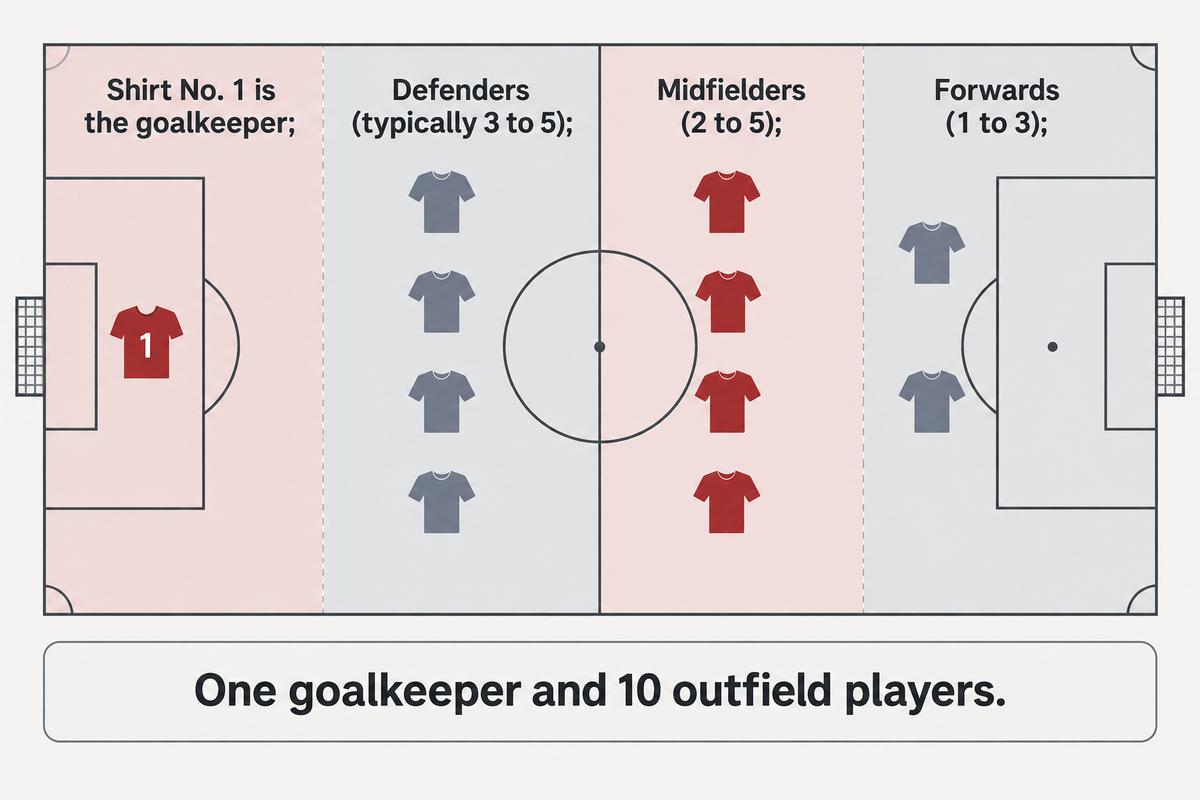
The 11 players on a soccer field divide into one mandatory goalkeeper and 10 outfield players arranged across defense, midfield, and attack. Coaches organize the 10 outfield players into team formations, such as a 4-3-3 or 4-4-2 formation. Traditional shirt numbers 1 through 11 correspond to tactical conventions rather than Law 3 rules.
Does IFAB compel teams to use a certain formation? Under IFAB Law 3.1, the only mandatory positional rule states that one of the players on the field must be the goalkeeper. All outfield role names and 1-to-11 shirt numbers are tactical conventions rather than Law 3 requirements. The goalkeeper can swap places with an outfield teammate during a stoppage in play, provided the referee is notified beforehand (Law 3.4).
In team composition terms, the 10 outfield players work together across three lines: defenders (typically 3 to 5), midfielders (2 to 5), and forwards (1 to 3). Those three lines create goals and stop the opposing team from scoring. Formation numbers never include the goalkeeper. For example, a 4-3-3 lines up 4 defenders, 3 midfielders, and 3 attacking players (4 + 3 + 3 + 1 goalkeeper = 11 starters). The following diagram demonstrates traditional 1-to-11 shirt numbers and their location on the field:
Shirt No. 1 is the goalkeeper. That player is the only team member that’s allowed to handle the ball in the team’s own penalty area.
Shirt Nos. 2 and 3 are the right and left back defenders respectively. Those defenders mark wingers and overlap down the touchline.
Shirt No. 4 and No. 5 are the center-backs. Those defenders obstruct shots and win aerial duels, and help maintain the defensive line used to judge the offside rule in soccer.
Shirt No. 6 is traditionally allocated to the holding/defensive midfielder. This player screens the back line, intercepts passes, and is responsible for setting the tempo from a deeper midfield position.
Shirt No. 8 is allocated to the central box-to-box midfielder. This player is responsible for linking defense to attack across both penalty boxes.
Shirt No. 10 is allocated to the attacking midfielder or playmaker. This player is responsible for creating attacking opportunities and linking the midfield and attack by delivering passes to score goals.
Shirt No. 7 and No. 11 are allocated to the right and left wingers respectively. These players beat full backs, deliver dangerous crosses, and cut inside to shoot on goal.
A center-forward, or striker, shirt No. 9, is the primary goalscorer on the team and is responsible for directing the attack against the opposing center-backs.
What is a sweeper in soccer?
A sweeper (libero), which is a central defender, is positioned behind the center-backs and the goalkeeper. This player relies on experience to read attacking passes, intercepts loose passes, and breaks up the opposition’s attack to launch a counter-attack.
Historically, sweepers wore shirt No. 5 or No. 6 in 5-3-2 defensive systems made famous by Franz Beckenbauer and Franco Baresi. Most clubs have a flat four-man or three-man defensive system to trap the opposition offside. This shift in defensive systems moved the sweeper to a ball playing “sweeper-keeper” who comes out of his box to intercept passes.
How Many Numbered Jerseys and Goalkeeper Kits Should a Soccer Team Order?
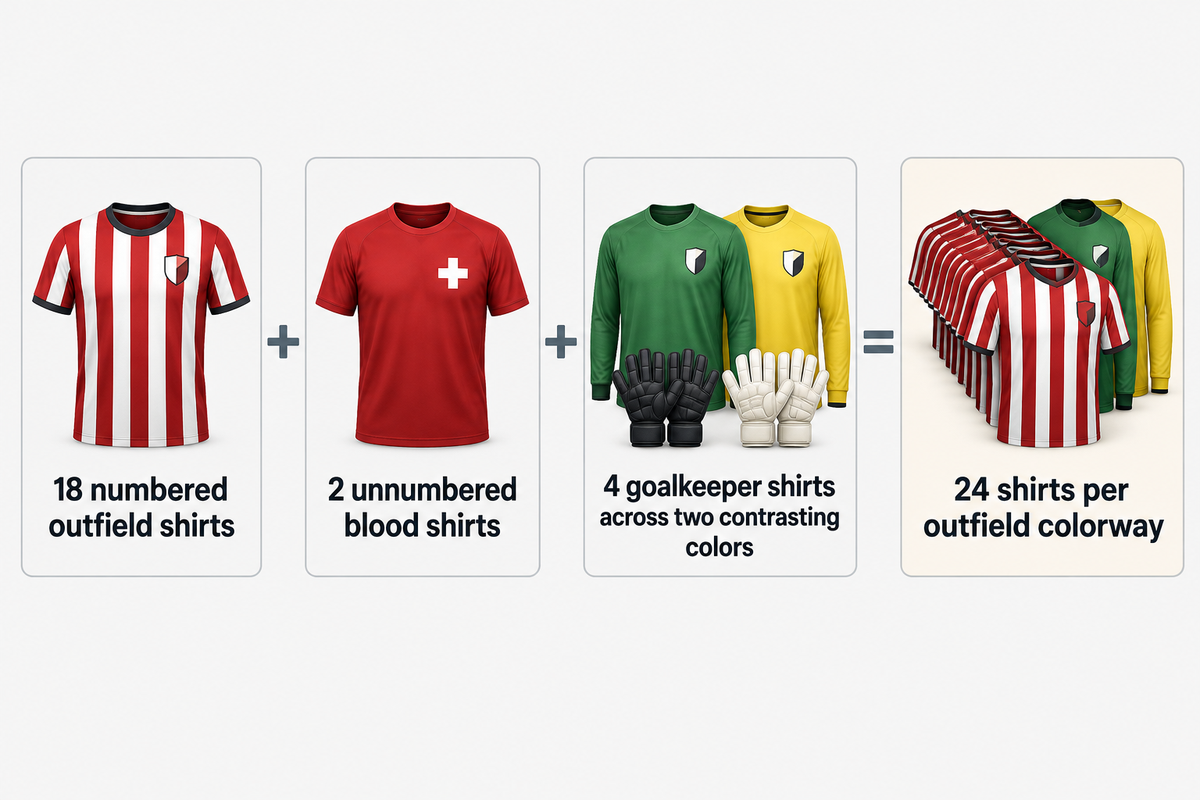
For a full 18-player adult matchday squad with 2 named goalkeepers, our club kit planning model orders 24 shirts per outfield colorway: 18 numbered outfield shirts, 2 unnumbered blood shirts, and 4 goalkeeper shirts across two contrasting colors. Ordering 11 shirts leaves bench substitutes and injury replacements uncovered.
According to IFAB Law 4.2 and Law 4.3, a player is required to wear five items: a sleeved shirt, shorts, socks, shin guards and the appropriate footwear. Both teams are required to wear colors that distinguish them from each other and the match officials. Law 4.3 also requires goalkeepers to wear colors that are distinct from all other players and the match officials. While Law 4 does not prescribe a numeric kit order quantity, competition rules require a player with a blood-stained shirt to change before re-entering.
Amateur club secretaries and school athletic directors can plan matchday kit buffers for 18-to-23-player squads using this practical Squad Kit Order Planning Formula:
Squad Kit Order Planning Formula (Practical Club Recommendation):
• Outfield Jerseys per Colorway = (Matchday Squad Cap − Named Goalkeepers) + 2 Size-Buffer Outfield Shirts + 2 Spare Shirts (for blood-stained or torn shirt replacements).
– Goalkeeper Shirts = Named Goalkeepers x 2 Colorways with each goalkeeper’s number available in both colorways. The matchday color selection must differentiate the goalkeeper from all other players and match officials.
– Worked Example (18-Player Adult Matchday Squad with 2 Named Goalkeepers): The outfield allocation comprises 18 numbered shirts using Nos. 2 to 12 and 14 to 20 (including 2 size-buffer shirts) as well as 2 unnumbered blood shirts, totaling 20 outfield shirts. Adding 4 goalkeeper shirts (Nos. 1 and 13 in two contrasting goalkeeper colors) to those 20 outfield shirts yields 24 shirts in total .
Use the Matchday Squad to Kit Order Calculator Table below to determine a complete jersey order based on your competition format and squad cap.
Matchday Squad-to-Kit Order Calculator Table: Practical jersey ordering quantities by format and matchday sheet limit
Format & Matchday Squad Cap
Numbered Outfield Jerseys (with +2 Size Buffer)
Goalkeeper Kits (Named GKs × 2 Colorways)
Spare / Blood Replacement Shirts
Total Jerseys per Outfield Color Set
Youth 7v7 (12-player squad, 1 GK)
13 outfield shirts (Nos. 2 to 14)
2 GK kits (No. 1 in 2 colors)
1 spare shirt
16 total shirts (13 + 2 + 1)
Youth 9v9 (16-player squad, 2 GKs)
16 outfield shirts (Nos. 2 to 12, 14 to 18)
4 GK kits (Nos. 1 & 13 in 2 colors)
2 spare shirts
22 total shirts (16 + 4 + 2)
Adult Amateur 11v11 (18-man sheet, 2 GKs)
18 outfield shirts (Nos. 2 to 12, 14 to 20)
4 GK kits (Nos. 1 & 13 in 2 colors)
2 spare shirts
24 total shirts (18 + 4 + 2)
League 11v11 (20-man matchday sheet, 2 GKs)
20 outfield shirts (Nos. 2 to 12, 14 to 22)
4 GK kits (Nos. 1 & 13 in 2 colors)
2 spare shirts
26 total shirts (20 + 4 + 2)
Cup / Tournament 11v11 (23-man sheet, 3 GKs)
22 outfield shirts (Nos. 2 to 11, 14 to 22, 24 to 26)
6 GK kits (Nos. 1, 12 & 13 in 2 colors)
2 spare shirts
30 total shirts (22 + 6 + 2)
Where to Find Authentic and Retro Matchday Soccer Shirts by Squad Number
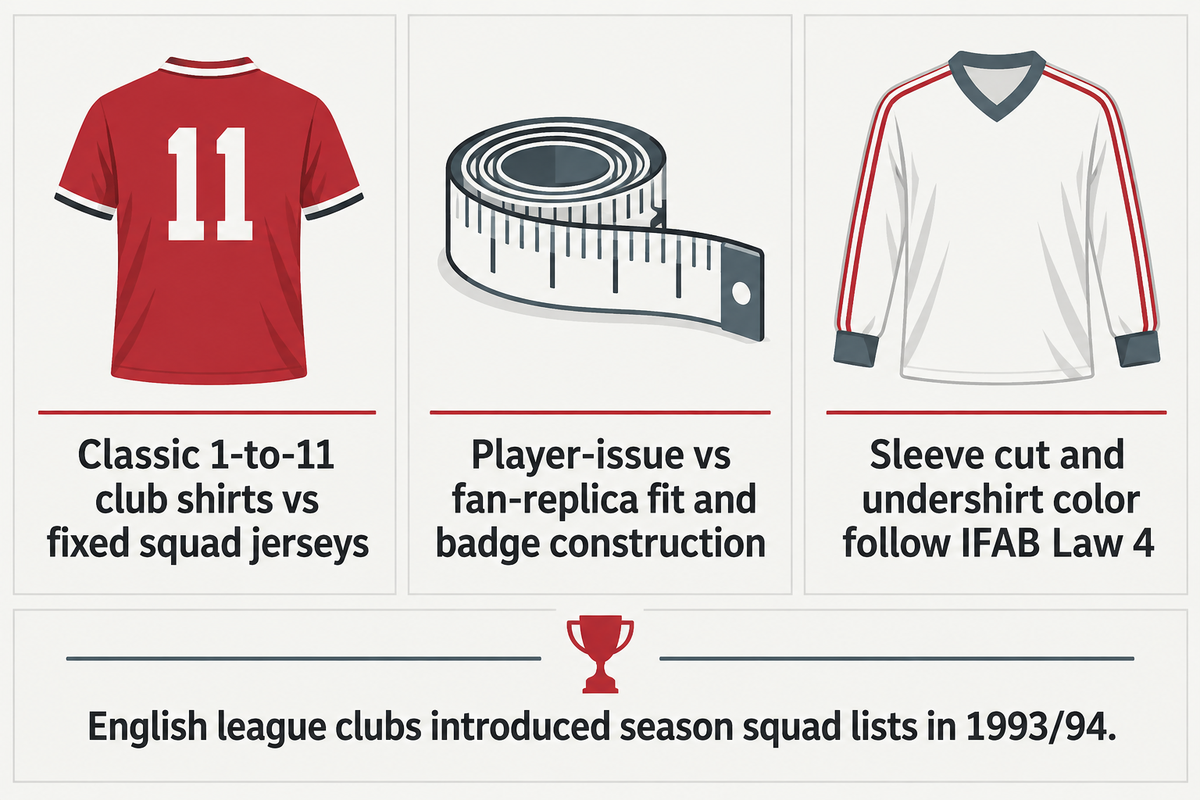
Collectors and club buyers encounter both match-assigned 1-to-11 shirts and fixed squad-number jerseys in the market. World Cup teams used fixed tournament squad numbers before English league clubs introduced season squad lists in 1993/94, and modern club shirt numbers can exceed 26. Club league shirts may use league fonts, while World Cup shirts use national-team namesets.
In the history of football, the evolution of bench rules and the introduction of legal substitutions in the 1970 FIFA World Cup final tournament were contemporaneous. Many European domestic leagues used match-assigned numbers 1 through 11 for starters (with higher numbers for substitutes) until fixed season squad lists were introduced in the 1990s. World Cup teams used fixed tournament squad numbers before English league clubs introduced season squad lists in 1993/94, and modern club shirt numbers can exceed 26. Later, the FIFA World Cup tournaments increased the size of national squad lists from 23 to 26 starting in the 2022 tournaments.
When browsing vintage retro soccer jerseys or outfitting a local 11-a-side squad, check three kit details before selecting sizes and printings:
Era-accurate numbering differs between classic 1-to-11 club shirts from the 1970s and 1980s and modern fixed squad jerseys. Vintage shirts often used felt or flock back numbers without player names, whereas modern jerseys tie iconic numbers to specific legends across transfers, as shown in our Cristiano Ronaldo No. 7 jersey timeline.
Fit and badge construction differ between player-issue and fan-replica shirts. Buyers should consult a brand’s size chart to determine best fit.
What Is Changing in 2025/26 Soccer Squad Rules and Substitution Protocols?
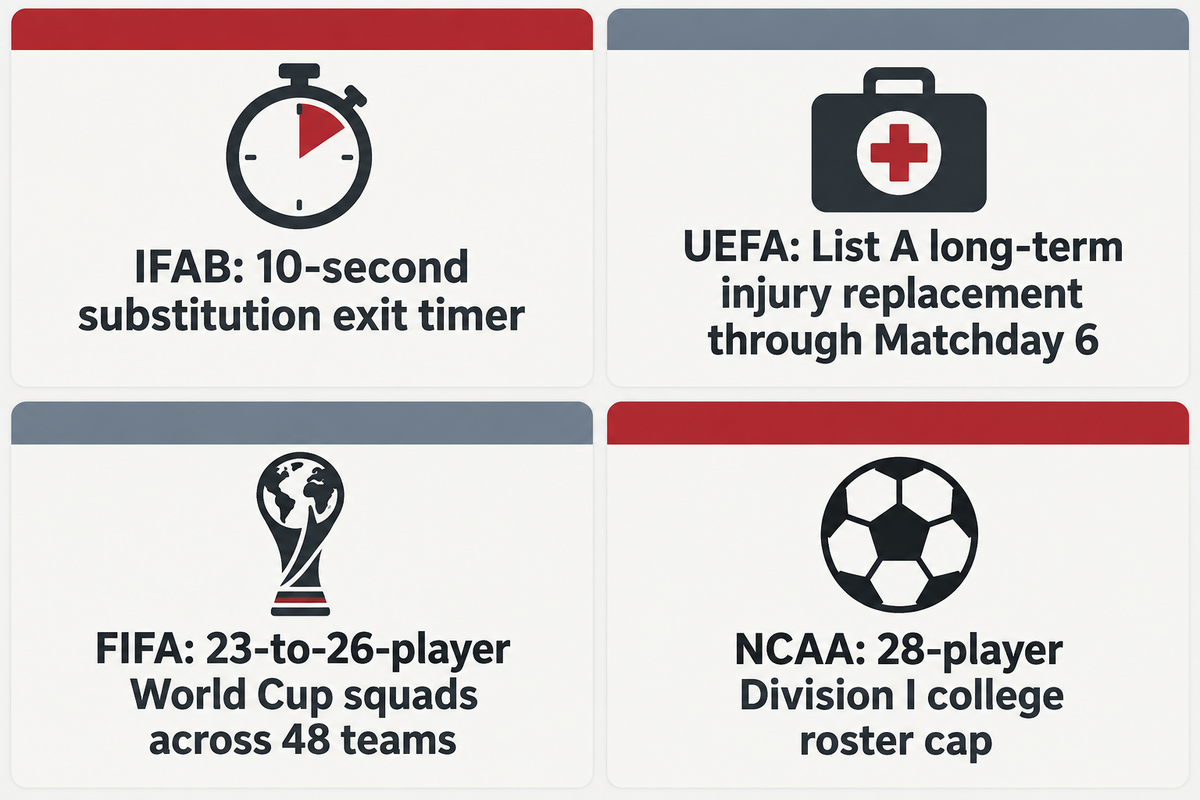
Four rule updates between 2025/26 and 2026/27 shape soccer team sizes and matchday sheets: FIFA’s 23-to-26-player World Cup squads across 48 teams, IFAB’s 10-second substitution exit timer, UEFA’s List A long-term injury replacement rule through Matchday 6, and the NCAA’s 28-player Division I college roster cap.
Expanding international and club calendars, including the 36-team Champions League league phase and the 48-team 2026 World Cup, have cemented larger matchday benches. Bench sizes continue to grow. Referees, coaches and fans are reminded of four rule changes as outlined below:
As defined in IFAB’s 2026/27 Law 3 changes, a substituted player must leave the field within 10 seconds. If the player takes more than 10 seconds, the incoming substitute can’t enter until the first stoppage after one minute of play has elapsed. The same update codifies up to 8 used substitutes (or up to 11 by mutual agreement if the referee is informed in advance) in senior ‘A’ international friendlies.
Under UEFA Champions League player registration rules, clubs may temporarily replace one outfield player on List A through Matchday 6 in the event of a certified long-term injury or illness. During the season, clubs can also register a temporary replacement goalkeeper.
For the 2026 FIFA World Cup, retaining the 23-to-26-player final squad range across 48 competing nations puts up to 1,248 registered players at the tournament. Up to 15 non-starting squad members are eligible for the matchday bench.
In NCAA Division I college soccer, opt-in programs are now limited to a 28-player roster (Bylaw 17.2). This replaces uncapped walk-on rosters, but grandfathered designated student-athletes are exempt.
Frequently Asked Questions
Are there 11 or 12 players on a soccer team?
There are a maximum of 11 players on a soccer team on the field at one time, never 12.
Fans sometimes hear the phrase “the 12th man” during broadcasts. That expression is a nickname for the home crowd cheering from the stands rather than an active player on the grass. While Canadian football fields 12 players per side, association football strictly caps on-field lineups at 11 players (1 goalkeeper and 10 outfield players) under IFAB Law 3.1.
When fans ask how many players on a soccer team take the field, a full-strength regulation team fields 11 players at one time.
The 11-player standard grew out of 19th-century English school and club conventions and was formally written into the Laws of the Game in 1897.
When the Football Association published its original Laws of the Game in 1863, it didn’t fix a team size. In fact, the first FA demonstration match at Battersea Park in January 1864 featured 14 players per side. Through the late 1860s and the first official international match in 1872, 11-a-side became standard practice before being explicitly codified in the 1897 Laws.
What happens if a goalkeeper gets a red card and all 5 substitutions are used?
An outfield player already on the pitch must put on a contrasting goalkeeper shirt and take over in goal, while the team continues with 10 players.
Under IFAB Law 3.1 and Law 3.4, a team must always have a designated goalkeeper on the field. Any active outfield player may swap positions with the keeper during a stoppage after informing the referee. In a 2019 Champions League match against Atalanta, Manchester City lost substitute keeper Claudio Bravo to an 81st-minute red card. Right-back Kyle Walker put on the gloves and made a free-kick save to secure a 1 to 1 draw.
How many players are on a soccer team vs an American football team?
Both sports put up to 11 players per team on the field at one time (22 total), but their substitution rules and active roster sizes are completely different.
In a professional soccer match, the starters play both offense and defense continuously. In competitions using the five-substitute rule, a coach may normally use up to 5 regular substitutes in normal time, plus a 6th in extra time or an additional concussion substitute where competition rules permit. The Premier League matchday squad comprises up to 20 players, while the UEFA Champions League matchday squad comprises up to 23. By contrast, an NFL American football team dresses 48 active players on game day from a 53-man roster. NFL teams also swap entire 11-man offensive, defensive, and special-teams units between plays.
How many referees are on a soccer field?
Four match officials oversee a standard senior soccer match: 1 center referee on the pitch, 2 touchline assistant referees, and 1 fourth official between the benches.
Top professional matches also assign a Video Assistant Referee (VAR) crew in a video operation room, whereas grassroots youth games often use a single center referee.
Can a substituted player go back into a soccer game?
No, in senior professional soccer, a substituted player cannot re-enter the match once they leave the pitch.
However, IFAB Law 3.2 explicitly permits return (rolling) substitutions in youth, veterans, disability, and grassroots recreational soccer when authorized by the competition’s national football association, confederation, or FIFA. U.S. high school (NFHS) and NCAA college soccer also allow return substitutions under their respective competition rules.
Key Takeaway
A full-strength 11v11 soccer lineup has 11 players per side: 1 goalkeeper and 10 outfield players (22 players total). A team may start or continue with fewer players down to the 7-player minimum in standard 11v11 matches, with exceptions for temporary dismissals, one-minute protocol absences, and penalty shootouts. Check your competition handbook for bench limits (3 to 15 substitutes), permitted substitution windows, and goalkeeper and spare shirt requirements.
Editorial Transparency
Reviewed by the SoccerKit editorial team. All player headcounts, substitution windows, and roster quotas in this guide were verified in November 2026 against the 2025/26 and 2026/27 IFAB Laws of the Game, FIFA World Cup 2026 regulations, UEFA Champions League regulations, Premier League squad rules, and U.S. Soccer PDI guidelines. Domestic cups, youth leagues, and amateur associations may adopt local modifications to bench limits and return substitutions. Confirm your competition’s current handbook before submitting a matchday team sheet.
I write about football shirts in use and in club history. My articles compare training and match-day jerseys and revisit memorable Mohamed Salah Liverpool shirts, helping readers connect fit and purpose with the players and moments that made a kit familiar.