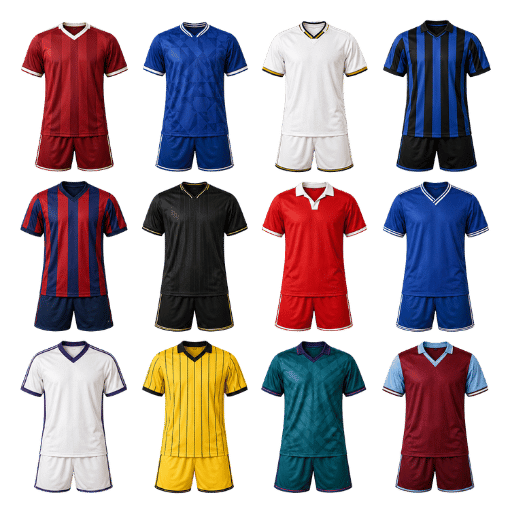
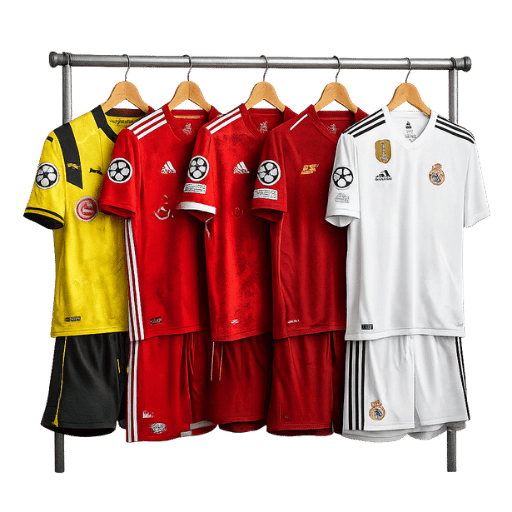
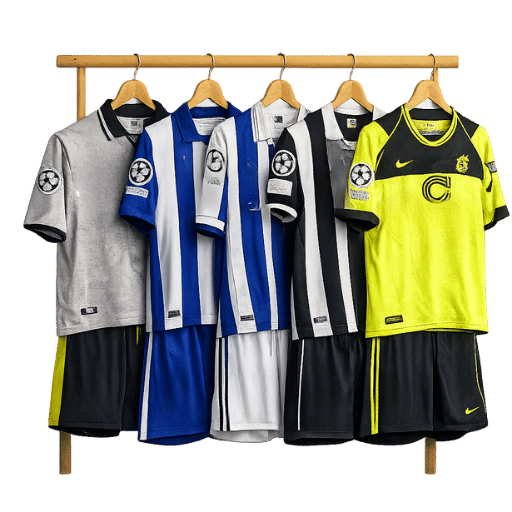
Still searching for your perfect jersey? Explore our best-selling products—we're confident you'll find a style that's just right for you in our diverse collection.
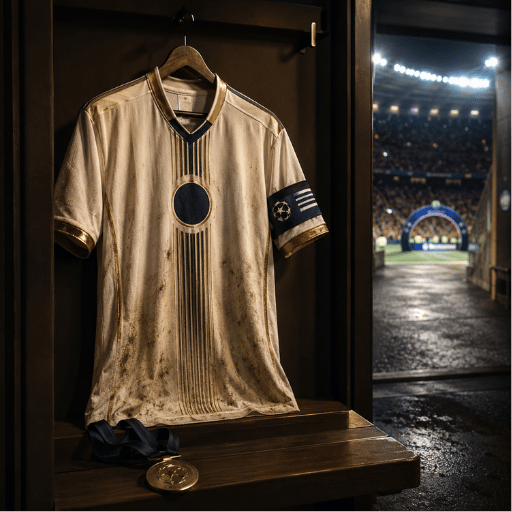
This is our ranking of the iconic Champions League final jerseys ranked here not on trophies but on the kits that still stop you in the aisle of a vintage shop. From Real Madrid’s foundational all-white to Porto’s underdog stripes, we scored 12 European Cup and Champions League final shirts on design, the moment they carry, scarcity, cultural reach and how wearable they still are today.
The short answer. The most iconic Champions League final jersey is Real Madrid’s all-white kit of 1956–60, worn through five straight European Cup wins. Iconic status tracks design and the moment a shirt is tied to, not trophy count, which is why a one-off Marseille 1993 or Borussia Dortmund 1997 outranks many better-decorated kits.
Key takeaways
Iconic doesn’t mean most successful, design, scarcity and the moment matter more than the trophy count.
A genuine “final jersey” is a different object from the season kit: it carries match-specific final embroidery and the UEFA sleeve patch.
The “uglier kit always wins the final” line is folklore, not a record-backed pattern.
Provenance, not age, drives value: match-worn shirts can run from a few hundred pounds into the millions.
What Makes a Champions League Final Kit Iconic? The 5-Point Icon Score Framework
Before arguing about the order, it helps to agree on what “iconic” means. Most lists never say. We use a transparent rubric we call The Final-Shirt Icon Score: five criteria, each marked out of 10, for a total out of 50. A final kit become iconic when it scores high on five things at once, design, the moment it’s tied to, scarcity, cultural reach and how wearable it still is today.
The Final-Shirt Icon Score: the five criteria we use to rank iconic Champions League final jerseys (each scored 0–10, total /50).
Criterion
What it measures
Design (0–10)
Colourway, template, crest and sponsor balance — does it still look right decades on?
The Moment (0–10)
The final it is bound to — comeback, treble, an era-defining win.
Scarcity (0–10)
How hard the genuine match-issue or original version is to find now.
Cultural Reach (0–10)
Recognition beyond the club’s own fans — does a neutral know it?
Wearability (0–10)
Would you wear the retro version on the street today?
What is the most iconic football jersey?
If you widen the question past the Champions League, the honest answer is that no single shirt wins outright, it depends on which of the five criteria you weight. Brazil’s 1970 yellow scores highest on cultural reach, while Real Madrid’s all-white scores on design and longevity. Within European finals specifically, the kits that come closest to a perfect score are the ones that pair a timeless template with a landmark night, which is exactly what our ranking below reward. The point of a scoring rubric is that you can disagree with us criterion by criterion, rather than just trading favourites. We built the Final-Shirt Icon Score at Classic Football Shirts because most “best kit” lists never say what “best” means, and the real problem with ranking by trophies is that it rewards success rather than design. In practice, judging across nearly 70 years of finals means a beautiful one-off can rightly out-score a forgettable shirt that happened to win, because longevity and influence outlast a single result.
The Ranking at a Glance: 12 Iconic Champions League Final Kits, Scored
Here’s the full ranking. Read the Icon Score as an opinion with its working shown, not a law of physics, the value is that every number is broken down by the same five criteria. One honest caveat before you treat any ranking as a shopping list: a kit’s place here reflects the original design and its moment, not the quality of a specific reissue. The most expensive mistake we see at Classic Football Shirts is a buyer paying a final-shirt price for a weak reproduction, because the word “iconic” attaches to the design rather than the individual shirt in front of you. In practice, a kit revered for 30 years still has to be checked shirt by shirt, since the same design can be a bargain or a rip-off depending on the version.
12 iconic Champions League and European Cup final kits, grouped by tier and scored out of 50 on the Final-Shirt Icon Score (Real Madrid 1956–60 tops the list at 48/50).
Rank
Kit (club & final)
Tier
Maker
Icon Score
1
Real Madrid, all-white — 1956–60 European Cups
All-time icon
—
48/50
2
AC Milan, red-and-black stripes — 1989 & 1990
All-time icon
Kappa
46/50
3
Ajax, broad red band — 1971–73
All-time icon
—
45/50
4
Celtic, green-and-white hoops — 1967
All-time icon
—
44/50
5
Manchester United, home red — 1999
Modern classic
Umbro
43/50
6
Marseille, white — 1993 (first CL final)
Modern classic
Adidas
42/50
7
Borussia Dortmund, yellow — 1997
Modern classic
Nike
41/50
8
Real Madrid, white — 2002 (Zidane volley)
Modern classic
Adidas
40/50
9
Inter Milan, blue-and-black — 2010 (treble)
Cult favourite
Nike
39/50
10
Barcelona, blaugrana — 2011 (Wembley)
Cult favourite
Nike
38/50
11
Liverpool, all-red — 1977 to 1984
Cult favourite
Umbro
37/50
12
Porto, blue-and-white stripes — 2004
Cult favourite
—
35/50
The All-Time Icons (#1–#4)
These four are the kits a neutral recognises on sight, and for collectors they’re also the hardest to buy safely. The risk is scarcity: genuine examples are 40 to 70 years old, so a shirt sold as original is wrong more often than it’s right, and the mistake of trusting a listing photo is an expensive one. The reason these top the ranking is structural, design, the moment and cultural reach all peak together. In practice, Classic Football Shirts treats anything from this group as guilty until proven genuine, because the demand has run hot for decades while the real shirts only get rarer.
#1 Real Madrid, all-white (1956–60) — 48/50
No European kit carries more weight. Real Madrid won the first five European Cups in a row from 1956 to 1960, and they did it in plain white with the club crest and nothing else competing for your eye. The blankness is the point: it ages out of fashion cycles entirely. Decades and a dozen template change later, the look is unchanged, which is why a neutral can still picture Alfredo Di Stéfano in it. It’s the founding image of European club football and the benchmark every shirt on this list is measured against.
“There has been no debate: Real Madrid wear all white. They were, and remain, Los Blancos.”
#2 AC Milan, red-and-black stripes (1989 & 1990) — 46/50
The rossoneri stripes are iconic on their own, but the 1989 and 1990 back-to-back European Cup winners gave them the moment to match. This was the Arrigo Sacchi side built around the Dutch trio of Ruud Gullit, Marco van Basten and Frank Rijkaard, in front of a defence marshalled by Franco Baresi and Paolo Maldini. The Kappa-made shirt’s bold vertical bars read instantly at any distance, which is exactly what a great striped kit should do. Original match-issue versions from this side are among the most sought-after club shirts in the collector market.
#3 Ajax, broad red band (1971–73) — 45/50
Ajax’s white shirt with the single broad red band down the centre is total football made visible. Worn through three straight European Cups from 1971 to 1973, it framed Johan Cruyff at his peak and influenced kit design far beyond the Netherlands. The genius is the restraint: one bold stripe instead of a busy template, so the shirt look modern even now. It’s the design that proves “iconic” and “minimal” are often the same thing.
#4 Celtic, green-and-white hoops (1967) — 44/50
When Celtic beat Inter Milan in Lisbon in 1967 they became the first British club to win the European Cup, with a side famously all born within a short distance of the ground. The green-and-white hoops are one of football’s most recognisable patterns, and the Lisbon win is the moment that turned a domestic kit into a European icon. Scarcity pushes the score up: genuine 1967 shirts are rare and carry the kind of provenance that defines this list’s top tier.
For collectors, the risk with these all-time icons is the opposite of the modern kits: the genuine articles are scarce, and a shirt claimed to be 50 years old is wrong far more often than it’s right. The reason is simple economics, demand has outrun supply for decades, so reproductions fill the gap. In practice, Classic Football Shirts treats anything from this era as guilty until proven genuine, because a convincing fake of a 1967 or 1971 shirt is cheaper to make than the real thing is to find.
Modern Classics (#5–#8)
#5 Manchester United, home red (1999) — 43/50
The treble shirt earns its place on the moment alone. United’s injury-time comeback to beat Bayern Munich in the 1999 final at Camp Nou is one of the competition’s defining nights, and the Umbro home red with the Sharp sponsor is bound to it permanently. The detail collectors care about is telling: the actual final shirts were embroidered “Camp Nou Champions League Final,” a reminder that a real final jersey is built for one match, not a season. A clean original of this one is a centrepiece for any United collector.
#6 Marseille, white (1993) — 42/50
Marseille’s win over AC Milan in 1993 made them the first French club to lift the trophy and the winners of the first final under the rebranded Champions League. The Adidas white kit is understated, but the history it carries isn’t, it’s literally the first Champions League final shirt. For a collector building a competition timeline, this is the chapter one piece, and its place in the story keep it relevant well beyond its looks.
#7 Borussia Dortmund, yellow (1997) — 41/50
Dortmund’s 1997 win over Juventus is one of the great underdog finals, and the wall of Nike yellow is unmistakable on the eye. It’s a kit that score on design and cultural reach without the club being a serial winner, proof again that the moment, not the medal count, drives iconicity. The bold single colour makes it one of the most wearable retros on this list.
Which club has the best Champions League kit?
By our Icon Score, Real Madrid edges it, partly for the 1956–60 white and partly because the 2002 final shirt scores again on a different criterion entirely, the moment of Zinedine Zidane’s volley against Bayer Leverkusen at Hampden Park. But “best” splits by what you value. AC Milan win on pure design with the stripes; Ajax win on influence; Dortmund and Marseille win on the underdog moment. If you want one club whose kit you could wear anywhere and have a neutral recognise it, Real Madrid’s white is the safest answer, which is exactly why it tops the ranking.
#8 Real Madrid, white (2002) — 40/50
The same white, a different era, and one of the greatest goals ever scored in a final. The 2002 win over Bayer Leverkusen at Hampden is remembered for Zidane’s left-foot volley, and the Adidas shirt rides that moment. It scores lower than the 1956–60 original only because it’s less scarce and less foundational, but as a wearable modern white it’s hard to beat.
Modern final kits carry a different risk: they were mass-produced, so the trap is overpaying for an ordinary retail shirt dressed up as something special. Because the production runs were large, a standard 1999 or 2011 shirt is common, while the genuine match-issue version with final detailing is the scarce one. In practice, we tell buyers at Classic Football Shirts to separate “the design I love” from “the specific shirt I’m paying for”, because for a design loved for 25 years the gap between the two can be the wrong version bought at the right price.
Cult Favourites, Honourable Mentions & the “Uglier Kit” Myth (#9–#12)
#9 Inter Milan, blue-and-black (2010) — 39/50
Ask collectors for an underrated icon and Inter’s 2010 shirt comes up fast. It’s tied to the historic treble under José Mourinho, and the nerazzurri stripes carry a quiet menace that the win only sharpened. It’s a kit that has aged well precisely because it never chased a trend.
#10 Barcelona, blaugrana (2011) — 38/50
Pep Guardiola’s Barcelona dismantling Manchester United at Wembley in 2011 is one of the great final performances, and the Nike blaugrana, worn with the Unicef lettering Barcelona carried for years instead of a paid sponsor, is bound to it. The shirt score on the moment and on cultural reach; that side made the kit famous worldwide.
#11 Liverpool, all-red (1977 to 1984) — 37/50
Liverpool’s plain all-red is the uniform of their European glory years, worn across four European Cup wins between 1977 and 1984. Like Real Madrid’s white, the strength is the simplicity: no clutter, just the colour and the crest under the floodlights. It scores on heritage and wearability rather than novelty.
#12 Porto, blue-and-white stripes (2004) — 35/50
Porto’s 2004 win, again under Mourinho, is the modern underdog story, and the blue-and-white stripes are a clean, classic look that has aged better than many flashier kits from the era. It rounds out the list as a reminder that a smaller club can still produce a final shirt worth owning.
The risk, and the common mistake, with cult favourites is sentiment: because a shirt is beloved on the forums doesn’t mean the version you’re buying is genuine. At Classic Football Shirts we’ve handled plenty of fakes of the Inter 2010 and Barcelona 2011 shirts in the 15 years since they were worn, and in practice the cult shirts attract counterfeiters precisely because demand runs hot while the originals are getting harder to find.
Honourable mentions. A few near-misses that just missed the cut, each a worthy collector’s piece: Aston Villa 1982, PSV Eindhoven 1988, Red Star Belgrade 1991, Liverpool 2005 (the Istanbul comeback), and Chelsea 2012.
⚠️The “uglier kit wins the final” myth
You’ll hear that the uglier shirt, or the away kit, always wins the final. It’s a fun line, but it’s folklore rather than a record-backed pattern. Finals across the competition’s history have been won in home, away and change kits, and “ugly” is doing a lot of subjective work in that sentence. Enjoy the superstition; don’t build a collection around it.
Final Shirt vs Season Kit: What Actually Makes It a “Final Jersey”?
A Champions League final jersey differs from the standard season kit when it carries match-specific final embroidery, the opponent, date and venue stitched on the chest, plus the UEFA Champions League sleeve patch, and for player-issue versions a slim match-fit spec. That’s the distinction most ranking lists miss, and it’s the one that matter most for value.
The 1999 Manchester United example makes it concrete: the shirts worn that night were embroidered “Camp Nou Champions League Final,” text that never appears on the ordinary league version. UEFA itself now leans into this, releasing a limited-edition official final jersey for each final with the match details and starball patch built in. So when a listing says “final shirt,” it can mean three different things, the season kit that happened to be worn in the final, the official limited-edition final release, or a genuine player match-issue with the final embroidery. Knowing which one you’re buying is the difference between a £60 replica and a serious collector’s piece.
This distinction is where buyers lose the most money. The mistake is paying a final-shirt price for a standard season kit, because a listing can say “final” while showing a shirt with none of the match detailing. The reason the gap matters is structural: the season kit was produced in the tens of thousands, while genuine final or match-issue shirts were made for one night. In practice, Classic Football Shirts treats the final embroidery and the starball patch as the deciding evidence, and a shirt that has been on open sale for 20 years is almost certainly the common version, not the rare one.
How to Spot an Authentic Final Shirt: The Match-Issue Tell
Counterfeiting is a real and policed market, the UK Intellectual Property Office has reported officers seizing over £500,000 of counterfeit football shirts in the run-up to a single tournament, and fakes routinely sell for around £20 against roughly £80 for the genuine article. The scale is not trivial: a 2025 EUIPO and OECD study valued global trade in counterfeit goods at around USD 467 billion, with clothing and footwear among the most-faked categories. Before you pay a final-shirt premium, run what we call The Match-Issue Tell, a three-point check.
✔Final embroidery. Check the placement and stitch quality of any “final” lettering and the date/venue detail. On a genuine match-issue piece it’s cleanly embroidered and correctly positioned; on a fake it’s often printed, blurry or slightly off-centre.
✔Spec and size tag plus article code. Authentic shirts carry the maker’s internal size and article/style code on the wash tag. Cross-check that code against the era and maker, mismatched fonts, missing codes or a tag that looks too new on an “old” shirt are red flags.
✔Sleeve patch construction. The UEFA Champions League starball patch should be applied to the era’s standard, heat-applied or embroidered as appropriate, not a glued-on print with frayed edges.
📐 Collector’s Note
As a rule of thumb, authentic and player-issue shirts use lighter performance fabric with heat-pressed or finely embroidered crests, while fan replicas use heavier polyester and simpler badges. Neither is “wrong” to own, but you should pay the match-issue premium only when the final embroidery, tag and patch all line up. If a seller can’t show the wash tag and a clear shot of the final detailing, treat it as a replica and price it accordingly. When in doubt, buy from a source that let you verify the shirt before you commit, and read our guide on player version vs replica shirts and where to buy replica jerseys safely.
Collecting Iconic Final Shirts: Value & Where to Buy
Once you know the difference between a replica and a match-issue, the buying decision is really about how much originality and scarcity you want to pay for. Provenance, not age, drives value: standard retro shirts start at modest prices, while landmark match-worn examples have sold into the millions, Pelé’s 1958 World Cup final shirt went to auction with a multi-million-dollar estimate, and recent match-worn Champions League final shirts have drawn strong premiums on the resale market.
How to choose: the four ways to own an iconic Champions League final kit, by scarcity and budget (figures are indicative ranges, not fixed prices).
Type
What you get
Best for
Match-worn
A shirt actually worn in the match, with the highest provenance and price.
Serious collectors and investment pieces.
Match-issue
Prepared to the same spec with final embroidery, but not necessarily worn.
Collectors who want the detail without the worn premium.
Authentic retail
The genuine player-spec shirt sold to the public, lighter fabric, heat-pressed crest.
Wearers who want the real thing day to day.
Official retro re-issue / replica
A reproduction of a classic design at the most accessible price.
Fans on a budget and everyday wear.
✔ Authentic / match-issue advantages
Highest provenance and resale value
Correct final embroidery and spec
Holds value if cared for
⚠ Limitations
Higher price and more fakes to sift through
Lighter fabric is less hard-wearing
Genuine vintage examples are scarce
If you’re starting out, a well-chosen retro or authentic version of one of these iconic designs is the smart entry point, you get the look and the story without the auction-house risk. Browse our range of authentic soccer jerseys, explore vintage and retro soccer jerseys, or compare replica soccer jerseys if you’re buying for everyday wear.
The Outlook: Limited-Edition Official Final Jerseys & Match-Issue Scarcity
The most important shift for collectors isn’t a price chart, it’s that UEFA now treats the final shirt as a deliberately scarce, limited-edition product in its own right. Official final jerseys for recent finals, from Munich in 2025 to Budapest for the 2025/26 final, are released as one-off pieces with the match detailing and starball patch built in, rather than as ordinary season kits. That changes the buyer’s calculus: the match-specific shirt is becoming an ownable category separate from the club’s normal range, and the genuine versions are produced in deliberately limited numbers.
Alongside that, demand for retro and vintage shirts has stayed structurally high, and match-worn final shirts continue to draw rising premiums when they surface. Read those two facts together as a directional signal rather than a forecast: scarcity is being engineered at the top of the market while interest broadens at the bottom. If you’re planning a 2026 purchase, the practical move is to target match-issue or final-embroidered pieces and official limited editions early in the cycle, and to authenticate before you buy, the gap between a genuine final shirt and a convincing fake only gets more valuable to close.
For buyers, the practical risk is waiting too long. Because these official final jerseys are deliberately limited, the genuine versions can sell out within 3 days of a final, and the resale price climbs from there. The reason is the same scarcity logic that drives the rest of this list. In practice, Classic Football Shirts sees the strongest demand in the year after a memorable final, so the safe move is to buy early and authenticate before the hype, because chasing one a year later usually means paying a premium for the wrong version.
Frequently Asked Questions
Q: Are Champions League final jerseys worth collecting?
View Answer
Yes, and they are one of the more rewarding corners of shirt collecting because each one is tied to a specific, well-documented night. Value depends heavily on provenance: a match-worn or match-issue final shirt with genuine final embroidery sits far above a standard replica. Iconic designs such as AC Milan’s stripes or Real Madrid’s white also hold interest because they are recognised well beyond the clubs’ own fans, which keeps demand broad.
Q: What is the difference between a final shirt and a normal season kit?
View Answer
A genuine final shirt carries match-specific detailing the season kit does not: final embroidery with the opponent, date and venue, the UEFA Champions League sleeve patch, and on player-issue versions a tighter match-fit cut. The ordinary season kit is the same base design but without that final-night detailing. Manchester United’s 1999 shirts, embroidered “Camp Nou Champions League Final,” are the classic example of the difference.
Q: Which Champions League final kit is the most valuable?
View Answer
There is no single fixed answer, because value is set by provenance rather than by the design alone. Match-worn shirts from landmark finals, especially those tied to a famous player or moment, command the highest prices and can reach well into six figures or beyond at auction. A standard retro of the same design might cost a fraction of that, so the same kit can span an enormous price range depending on whether it was worn, issued or simply sold to fans.
Q: How can you tell if a retro Champions League shirt is authentic?
View Answer
Check the crest or badge application, the wash tag with its maker article code, and any final embroidery against the era and maker. Fakes usually fail on at least one of those three.
Q: Did the “uglier kit wins the final” superstition actually hold up?
View Answer
Not really. It is a fun piece of folklore that survives because people remember the finals that fit it and forget the many that do not. Across the competition’s history, finals have been won in home kits, away kits and one-off change kits alike, and “ugly” is entirely subjective. There is no reliable record-backed pattern linking a kit’s looks to the result, so treat it as a bit of pre-match fun rather than a guide to which shirt to buy.
Q: What was the first Champions League final winning kit?
View Answer
Marseille’s white shirt from their 1993 win over AC Milan — the first final after the European Cup was rebranded as the Champions League.
Why We Ranked These
Classic Football Shirts compiled this ranking, and we handle authentic, vintage and match-worn kits every day, including the match-issue and final-embroidered shirts discussed above. We scored each kit with the same five-criterion Final-Shirt Icon Score rather than ranking by trophies, and we’ve kept every price reference as a range, because provenance, not nostalgia, sets what a shirt is actually worth. Reviewed by the Classic Football Shirts technical team.