Still searching for your perfect jersey? Explore our best-selling products—we're confident you'll find a style that's just right for you in our diverse collection.
A youth goalkeeper jersey sizing guide is a simple method for turning a young keeper’s chest, height and age into the right shirt size, and it matters because a keeper’s shirt isn’t sized like the outfield kit your child already owns. This youth goalkeeper jersey sizing guide covers measuring a young goalie, a reconciled size-by-age chart, brand fit quirks, and how much room to leave for growth, so the jersey that arrives allows full reach and movement without being outgrown in a month.
Quick Answer
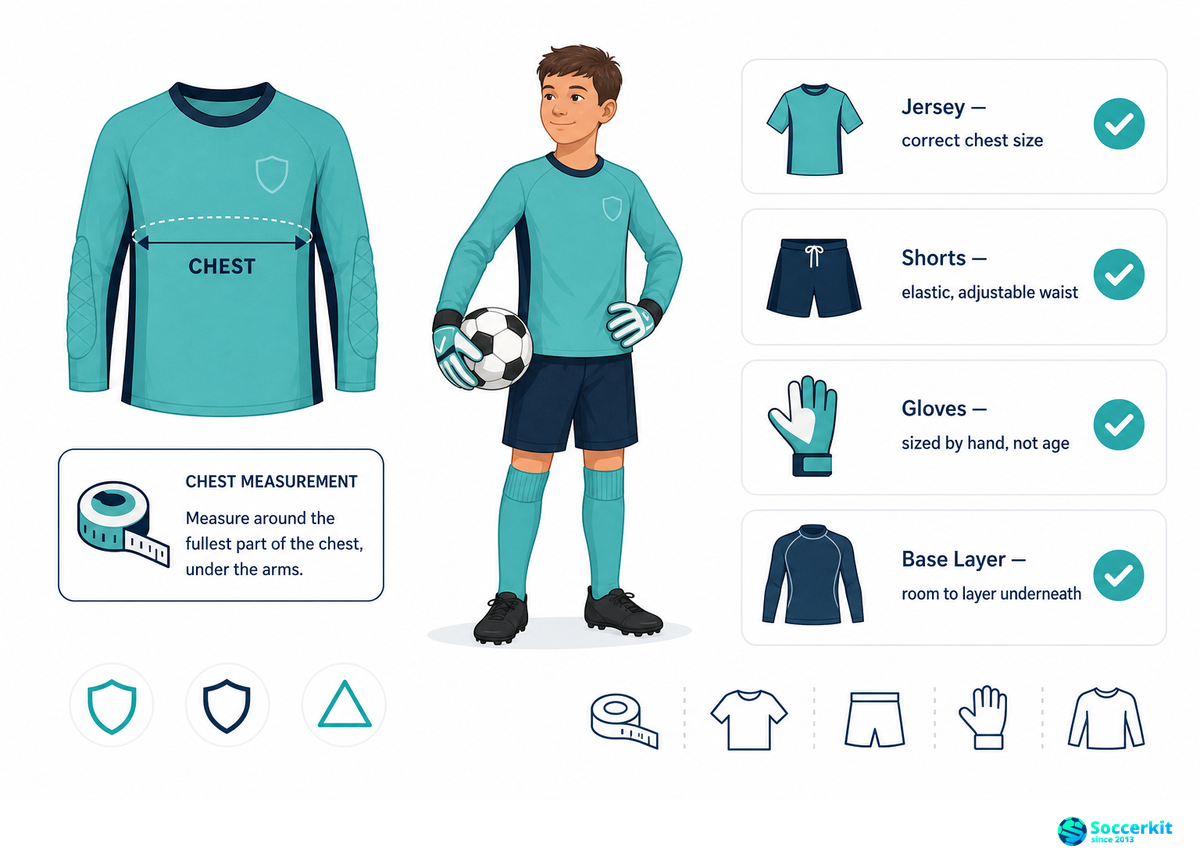
Measure the child’s chest circumference (around the largest part, while keeping the arms down and relaxed) then check the measurement against a chart for a youth size; for example, typically, Youth Small will fit a 25-27” chest (ages 6-7), Youth Medium will fit a 27-29” chest (ages 8-10) and Youth Large will fit a 29-31” chest (ages 11-12). Consider one size larger for goalies under the age of ten, or if your young goalie will wear a padded undershirt, although it’s usually advisable to purchase the accurate size from age 13 so as to avoid catching it during a dive.
Why Goalkeeper Jerseys Fit Differently From Outfield Kits
Because a soccer goalkeeper’s job differs from an outfield player’s, the jersey is sized differently too: a keeper’s shirt is cut more generously in the chest and shoulders and often has longer sleeves, so a young keeper can reach, dive and land without the fabric pulling tight. Size it like an outfield shirt and you start with the wrong fit. (This guide covers soccer sizing only, not hockey goalie jerseys.)
Experts in the field say clearly that both too tight and too loose an item will hamper mobility and could expose a young player on a dive. Two aspects of the design are largely responsible for this differentiation from outfield jerseys:
✔Mobility cut: a relaxed fit through the body with slightly longer sleeves gives the arms free rein to reach and parry. Keepers want that relaxed, slightly loose fit, not the snug outfield cut.
✔Protection layer: often some of the best youth goalie jerseys have padding at the elbows, and are worn over a padded undershirt, which will need a little room in the shirt.
Parents rarely consider another dimension: under Law 4 of the IFAB Laws of the Game, the goalkeeper must wear colours that are clearly distinguishable from the other players and the officials, which is why keeper kits come in bright, often contrasting colours. Why does this matter for ordering? Because the keeper wears the one jersey on the pitch designed to stand out, and when you order for real match play with a padded undershirt underneath, Law 4 requires that undershirt to match the dominant colour of the shirt’s sleeves.
How to Measure Your Young Keeper
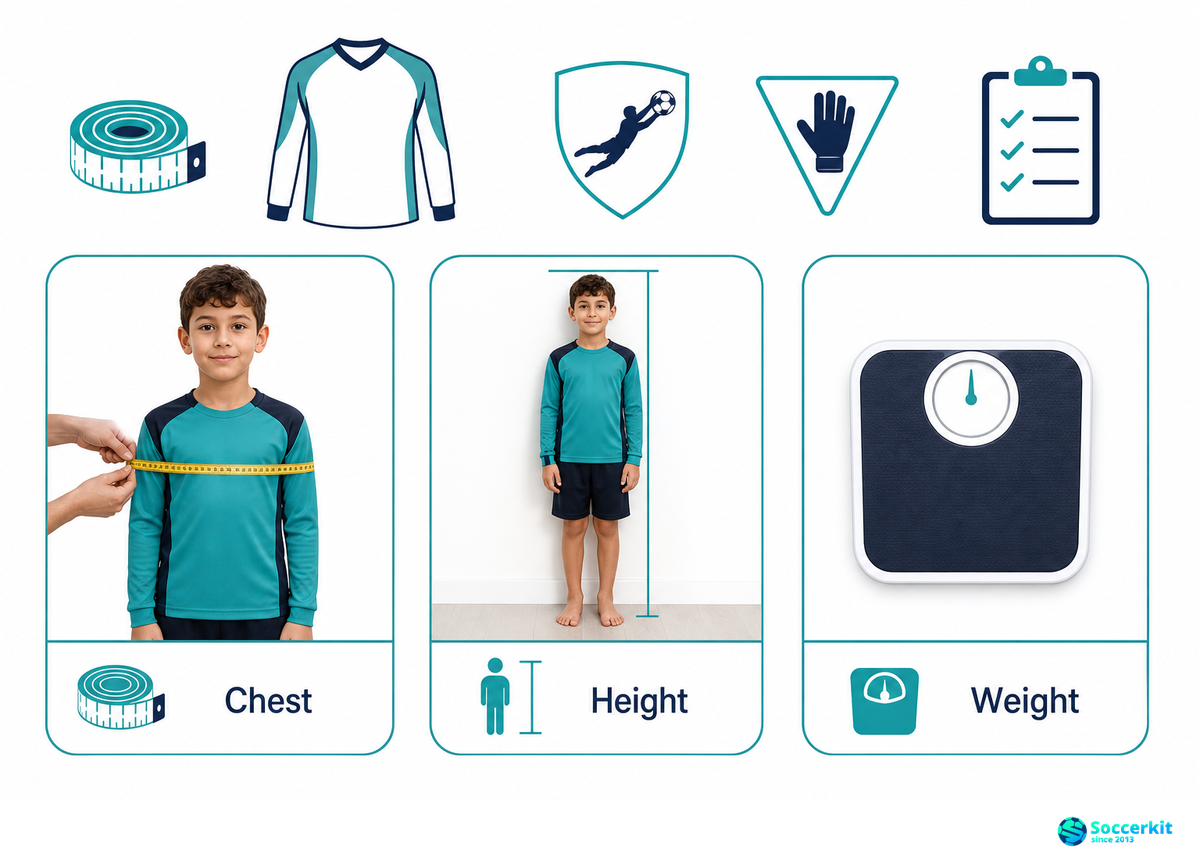
The most reliable way to size a youth goalie shirt is to take a couple of simple measurements at home and compare them to a chart. There’s no shortcut; guesswork from age alone is the primary reason for returns. Because height-for-age and weight-for-age vary widely from child to child (the same spread you see across the CDC clinical growth charts), a tape measure beats a birthday every time. All you need is a soft tape measure and two minutes.
The three measurements that matter
Measurement
How to take it
Why it matters
Chest
Around the fullest part at the armpits, arms relaxed, tape parallel to the floor.
The single most important number for a jersey; sizes are built around it.
Height
Barefoot against a wall, heel to top of head.
Confirms sleeve and body length so the shirt is not too short or long.
Weight
Standard bathroom scale.
Breaks the tie when a child sits between two sizes on chest alone.
💡Pro Tip
No measuring tape in the house? Instead, take a jersey your child currently wears that fits him well, lay it flat, measure from seam to seam across the chest and double that measurement; that number is the chest circumference to match against the sizing chart.
Youth Goalkeeper Jersey Size Chart by Age, The Youth Keeper Size Blueprint
This is how to work from your child’s chest measurement to get their Youth Keeper Size starting point. We refer to this as the Youth Keeper Size Blueprint as it draws from a goalkeeper jersey chart, a youth soccer jersey chart, and two house-brand youth jersey charts, combining them into one table with a grow-room column, which you rarely find on an individual retailer’s size chart.
Age
Youth size class
Chest (in)
Height (in)
Suggested sleeve
Grow-room
3–4
Toddler / 2–3T
21–23
38–41
Long
Size up 1
4–5
Youth XS
23–25
41–44
Long
Size up 1
6–7
Youth Small
25–27
44–50
Long or short
Size up 1
8–9
Youth Medium
27–28
50–54
Either
Size up 1
9–10
Youth Medium
28–29
54–56
Either
Half-size up
11–12
Youth Large
29–31
55–58
Either
True to size
12–13
Youth Large
31–32
58–61
Either
True to size
13–14
Youth XL
31–33
58–63
Player choice
True to size
15–16
Youth XL / Adult XS
33–35
63–67
Player choice
Move to adult cut
Chest sizes compared against: goalkeeper jersey size chart (Youth S 24-26″, M 26-28″, L 30-32″), youth soccer chart and house brand kids’ jersey chart. House brands and the Adidas youth chart vary by an inch in the chest measurement for the same age group. Those height bands track the stature-for-age ranges in the CDC clinical growth charts, which is why a chest measurement always beats a birthday. Always treat this as a starting point and compare it to the product page you’re viewing.
⚠️Important
The ages in this chart are an indicator of size, not a rigid rule. A slender 10-year-old and a stocky 8-year-old can easily land on the same size. Always go with the chest measurement when it disagrees with age.
The Keeper Fit Triangle: Chest, Sleeve, and Layering Room
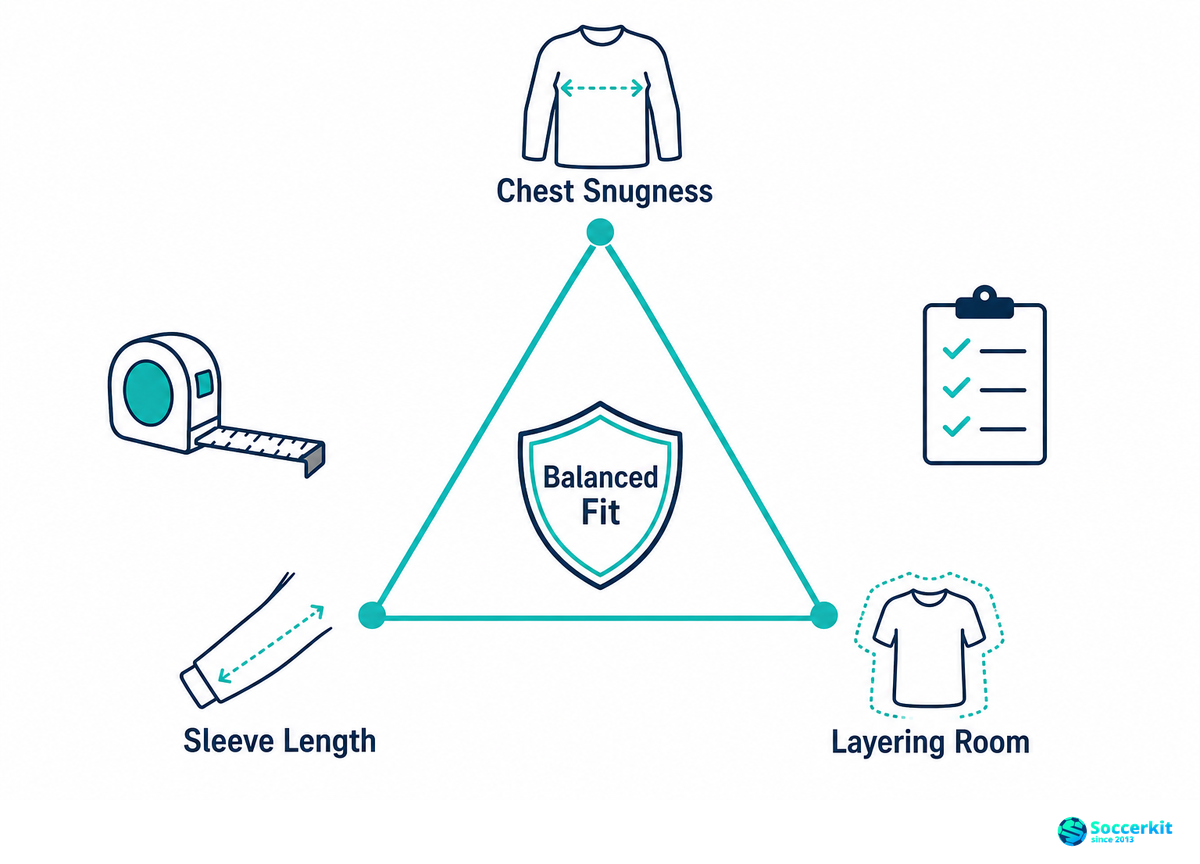
Choosing the right fit for a keeper requires keeping three elements balanced at once, and we call this the Keeper Fit Triangle. For a jersey to fit well, it has to hold up on all three corners at the same time. This matters because a keeper who nails chest width but loses 1 inch of sleeve reach is still exposed on a dive; a shirt that scores on two corners and fails the third is the wrong size. When buying, run the arms-overhead test against each corner and confirm the sleeve reaches the wrist before you commit.
The Keeper Fit Triangle
Chest fit: snug, not tight. Your child should be able to extend both arms overhead and reach to catch a high ball without the hem of the shirt rising to their ribs.
Sleeve fit: reaching the wrist. Long sleeves will help protect the forearm during dives on hard ground and artificial turf. Short sleeves are fine for a casual shirt or hot weather.
Layering: room underneath. Leave space for a base layer, a warm undershirt or a padded undershirt (which, for match play, Law 4 requires to match the sleeve colour) without the shirt straining across the back.
Do
Don’t
Check the arms-overhead test in the fitting room or first wear.
Judge fit standing still with arms down — keepers rarely do.
Leave a little room for a base layer in winter.
Buy so big the shirt flaps and catches on a dive.
Padded or Plain? Long Sleeve or Short?
Two keeper-specific choices affect how you pick a size: padding and sleeve length. Neither is only cosmetic; both shape the fit and match-day performance of the shirt. Getting either one wrong is a common reason a keeper shirt ends up tight across the shoulders or so loose it interferes with diving.
Padding. The rise of the padded goalkeeper jersey has changed sizing: lightweight elbow padding is now built in, and many young keepers also wear a dedicated padded undershirt on hard ground surfaces. Law 4 of the IFAB Laws of the Game explicitly permits the use of soft, lightweight padded arm protection for goalkeepers. Padding affects size selection because a padded undershirt adds roughly 0.5 to 1 inch of chest circumference. So rather than adding a whole size or two for a padded undershirt, just add the Layering allowance from the Fit Triangle, usually a half to a full size, on top of the size your chest measurement points to. For example, a 9-year-old with a 28-inch chest is a Youth Medium true to size; add a 1-inch padded undershirt and the effective chest is nearer 29 inches, which nudges toward a Youth Large. When in doubt, cross-check your adjusted size against the specific product’s size chart rather than relying on an estimate.
Sleeve length. Long sleeves are the traditional keeper choice because they shield the forearms and elbows when diving onto turf; short sleeves suit hot weather and younger players who mostly train. A first competitive keeper is safest in a long sleeve plus a thin base layer. When buying, read the size chart’s sleeve column: a Youth Medium keeper sleeve typically runs 20-22 inches, and a sleeve that stops above the wrist bone leaves the forearm exposed on a landing. Affordable padded long-sleeve youth sets now exist for ages 6-14, often in the $25-$45 range, so protection no longer means paying a premium.
Brand Sizing Differences for Young Keepers
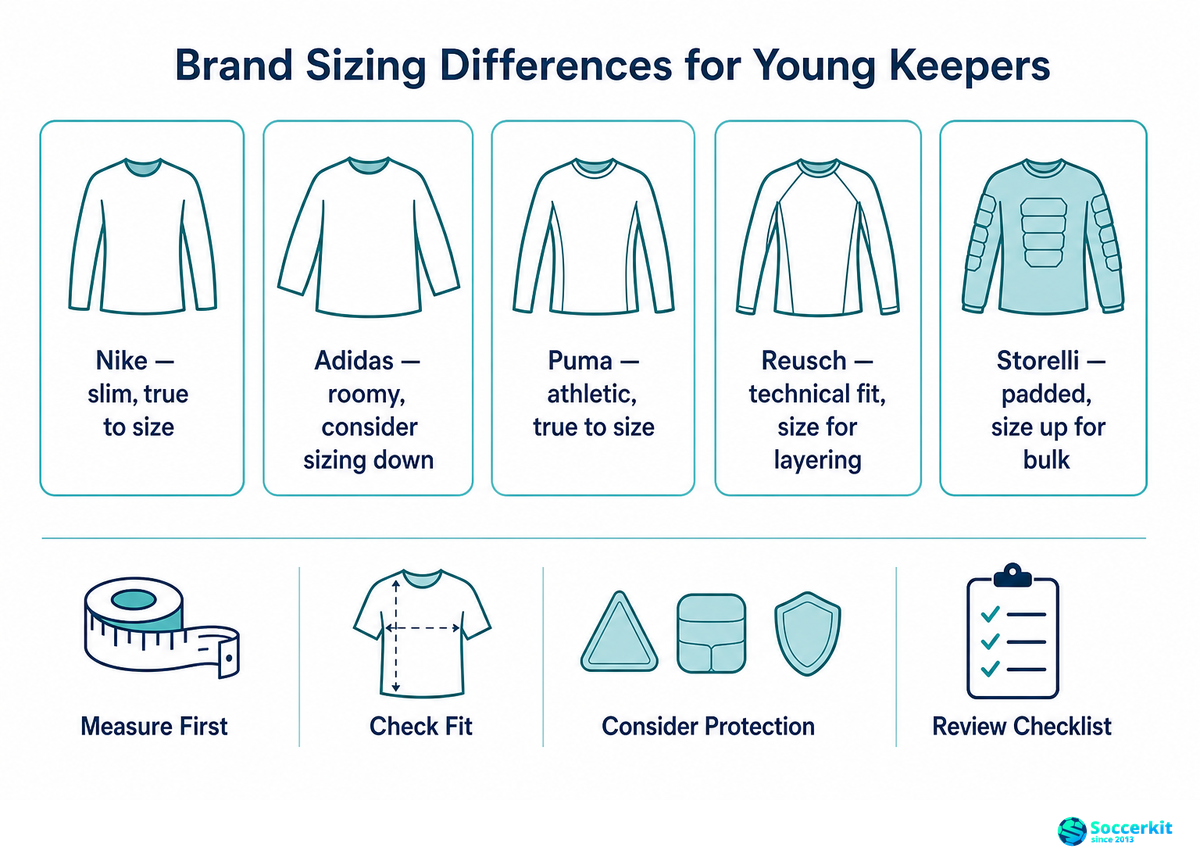
The varying fit of major brands will often mean that a particular chest size for a young player may well run as a Small in one brand, but a Medium in another. Here’s the rundown for some of the more popular youth keeper brands based on their official size chart information and parent reviews:
Brand
Youth fit
Runs
Size-up advice
Nike
Slim, athletic
Slightly small
Size up if between sizes or layering
Adidas
Roomier, generous
True to size
Order the chart size
Puma
Athletic
True to size
Order the chart size
Reusch
Keeper-cut, long sleeve
True to slightly small
Size up for a growing keeper
Storelli
Built around padding
True, with padding room
Order chart size; designed for a base layer
Kelme
Youth-cut padded sets
True to size
Order chart size (ages 6–14)
Joma
Slim European cut
Runs small
Size up one for a 25–27" chest tween
Uhlsport
Keeper-specialist, padded
True to size
Order chart size; built for a padded undershirt
“A keeper jersey that is too tight or too loose can hinder movement or leave a young player exposed on a dive. Fit for the save first, the look second.”
Goalkeeper kit fitting guidance
As far as specific team styles are concerned, the reality is that many authentic major pro club goalkeeper tops simply aren’t manufactured in youth sizes, and many parents report having to purchase an adult XSmall and tie it in the back with a hair tie to make it fit their child. If your child really wants to rock the kit of their favourite professional team, then a replica in a youth cut or an official club-branded youth keeper jersey is your best bet. You can browse youth options in our kids jerseys collection, including goalkeeper styles such as the Manchester United 2025/26 goalkeeper jersey.
Sizing for Growth: The One-Season Grow-Room Window
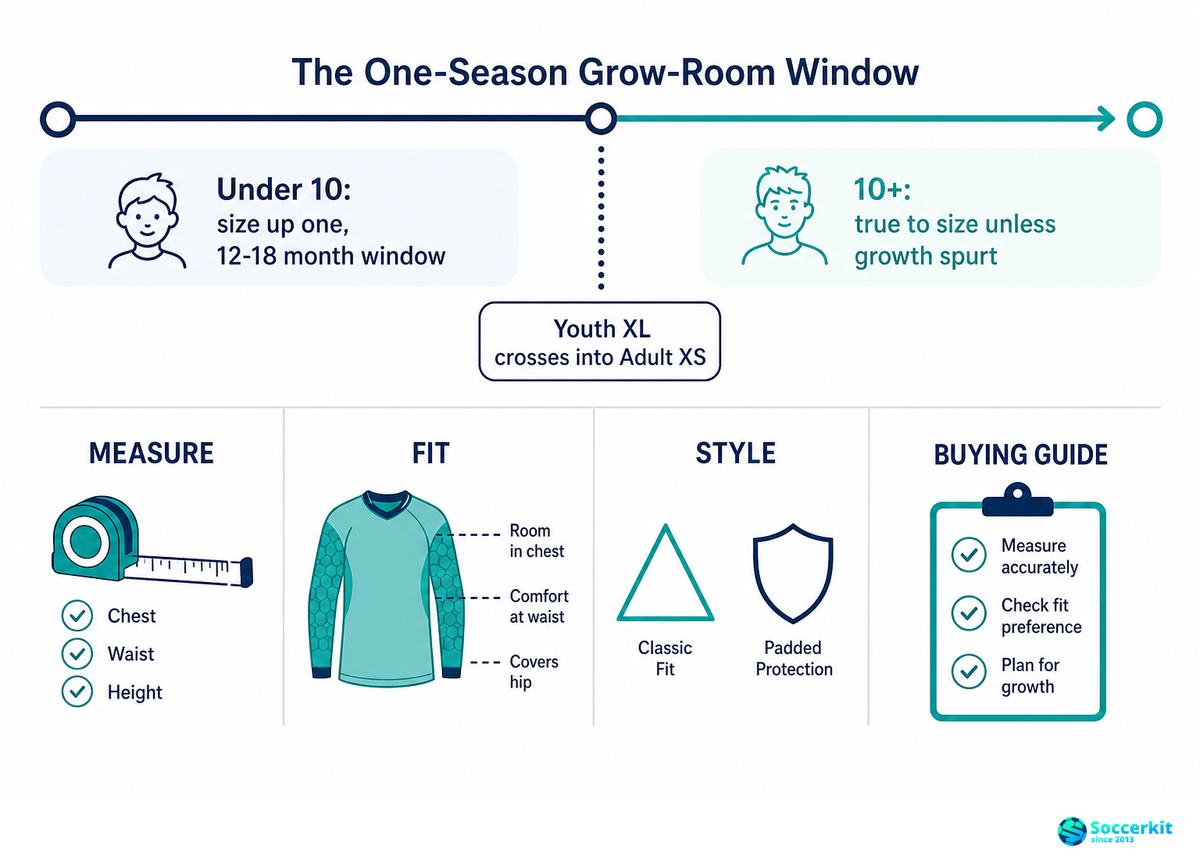
How much to size up depends almost entirely on your child’s age, and there’s a turning point around age 10. We call the sweet spot the One-Season Grow-Room Window: the shirt is big enough to last through a growing season, but not so big it drags on the ground. Age 10 becomes the dividing line because of growth rate. Children between 6 and 10 typically gain about two inches in height per year (in line with the stature-for-age curves in the CDC pediatric growth charts and the WHO growth reference for 5–19 year-olds), so sizing up one step buys roughly 12-18 months of wear before the chest catches up. An older keeper whose growth has slowed needs the jersey to fit well now, rather than risk a floppy, over-sized shirt that gets in the way in the goalmouth.
✔Under 10 (high growth rate): sizing up by one buys roughly 12-18 months of growth in shirt wear. Children of this age typically gain about 2-2.5 inches in height per year, so a snug true-to-size shirt is often outgrown by the middle of the season.
✔Age 10 and up: buy true to size unless your child is in the midst of a significant growth spurt, since an over-sized keeper top can easily get snagged and drag along the floor inside the goalmouth.
✔Advanced or older keepers: buy true to size to maximize your child’s range of movement in the goalmouth; this protects better overall than squeezing out one more year’s worth of growth.
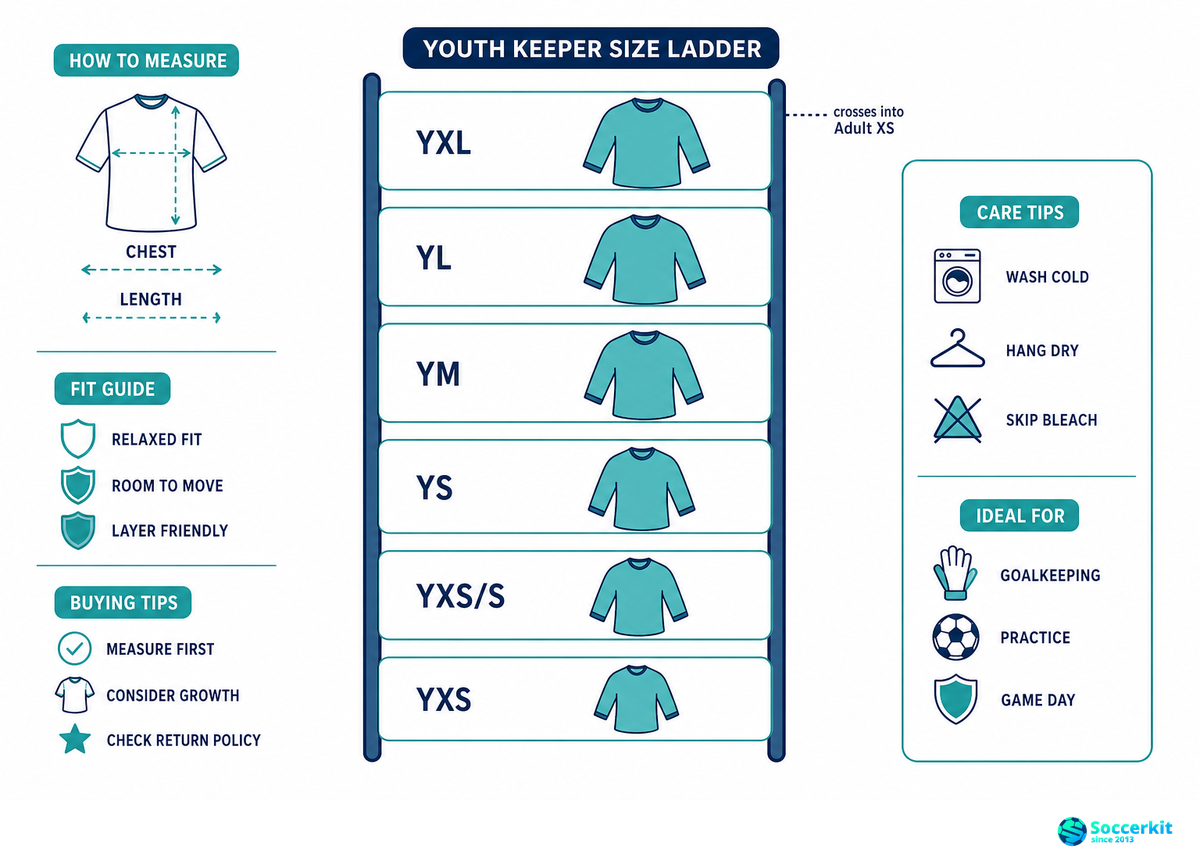
But what about the move to adult sizes? A Youth XL sits close to an Adult XS in the chest, but the longer body and broader shoulders on an adult shirt can swamp a teen keeper. Stick to youth sizing until the player comfortably fills a Youth XL, then move up to an adult small rather than an adult extra-small, so the shoulder line stays clean. This is also where the tired advice to always size up for padding breaks down: keeper jerseys already fit snug, so the size bump is usually about the adult cut, not the pads. Do both and you end up two sizes too big.
Building the Complete Youth Keeper Kit for 2025-26
Since a youth goalkeeper shirt is part of a wider kit, the same sizing logic applies to the rest of the pieces. When shopping for a first-choice keeper who trains on hard ground, size each component to its own measurement, because sizing a glove or a padded short off the jersey number is a common fit problem. That set usually includes:
✔Goalkeeper shorts or padded trousers, sized by the waist (about a 22–24 inch waist for most 8–10s), with hard-surface play calling for padded hips.
✔Goalkeeper gloves, sized to the hand: measure palm width (around 3–3.5 inches at ages 8–10) and round up to the next glove size, since a junior keeper’s glove size and jersey size rarely match.
✔A base layer or padded goalkeeper undershirt, ideally in a moisture-wicking, breathable fabric, which for match play must be colour-coded to match the jersey sleeve (under Law 4).
Timing and Trends for 2025-26. Two factors are significant this season. First, youth goalkeeping wear peaks in August and September when leagues return, so ordering early gives you access to a broader range of sizes. Search interest for “youth goalkeeper jerseys” roughly triples from late July through the September kick-off. Second, an affordable range of youth padded goalkeeper sets for ages 6-14 is now widely stocked, so a correctly fitted, protected kit need not be costly. Our guide to the most durable kids’ jerseys for active play pairs well with this one, and if you’re weighing where to order, see the best places to buy kids’ jerseys online.
Ready to kit out your young keeper?
You can shop youth goalkeeper jerseys and full children’s kits sized from toddler right through to Youth XL. Not sure between two sizes? Download and print our Blueprint sizing chart, or send our football specialists a WhatsApp message for a quick check.
Q: What size goalkeeper jersey should I get for my child?
Start with the chest, not the age. Measure around the fullest part of the chest with arms relaxed, then match it to a youth size — roughly Youth Small at 25–27″, Youth Medium at 27–29″, and Youth Large at 29–31″. Size up one step for keepers under 10 or if a padded undershirt will be worn, and buy true to size for older or more serious keepers so the shirt does not snag on dives.
Since goalkeeper tops can be roomier than outfield tops and not all brands size in the same way, check sizing against product pages on retailer sites, and on the first wear, put on the jersey and reach up. If the hem of the shirt goes to the ribs as you lift your arms up to catch, you need to order the next size up, so the jersey can follow the motion of the save rather than impede it.
Q: What size youth soccer jersey for a 10 year old?
A typical 10-year-old fits a Youth Medium, which suits a chest of about 27–29 inches and a height around 54–56 inches. Since 10 is right on the growth cusp, buy true to size if your child is average or tall for their age, and only size up if a clear growth spurt is underway or you are layering a base garment underneath.
If the player’s chest measures above 29 inches, move up to a Youth Large rather than stretching a Youth Medium. At age 10 most children sit right on the growth cusp, so buy true to size when your child is average or tall for their age, and only size up when a clear growth spurt is underway or you plan to layer a padded undershirt underneath. Confirm the chart size against the specific product page before ordering, since keeper cuts and brands can vary by up to an inch at the same age.
Q: What size is a youth XL jersey in adult size?
A Youth XL sits very close to an Adult XS in the chest, generally around a 33–35 inch chest. The catch is cut: adult jerseys are longer in the body and wider in the shoulders, so an Adult XS can look and feel baggy on a teen keeper even when the chest number matches. Stay in youth sizing until your child fills a Youth XL, then step to an adult small.
Match play favours a youth cut, because an adult XS still carries an adult-length body and wider shoulders that can swamp a teen keeper even when the chest number lines up. Youth XL generally maps to a 33-35 inch chest, close to an Adult XS on paper, yet the two feel very different in goal. Keep your child in youth sizing until they comfortably fill a Youth XL, then step up to an adult small rather than an adult XS for a cleaner shoulder line.
Q: How do you know your goalkeeper size?
Measure the chest, height and weight, then match the chest to a size chart — that is the reliable method for a keeper. A quick shortcut is to compare against a shirt that already fits well.
Then do the reach-up test again; the size is correct if no part of the hem rises to the ribcage when reaching to make a save.
Q: Should I size up a youth goalkeeper jersey for growth?
Under 10, yes — one size up buys 12 to 18 months of wear. At 10 and older, no; buy true to size unless a growth spurt is underway, because a loose keeper shirt drags on dives.
Do not size up for grow-room on top of sizing up for padding; that combination gets you to two sizes too large, and a baggy keeper jersey is a real problem for a young player throwing themselves at a low ball near the far post. Make one deliberate size decision at a time for an honest fit.
Q: Can a child wear an adult small goalkeeper jersey?
A larger teen can, but the adult cut runs longer and wider in the shoulders, so it fits best once a child is already near the top of youth sizing. Most young keepers match a Youth XL better than an Adult Small.
If a pro club only offers its keeper kit in adult sizes, most of our customers wear an adult small tucked or tied at the hem until the child grows into it.
About This Sizing Guide
These size bands bring together a goalkeeper chart, a general youth chart, and our own brand and kids’ charts, where age ranges can swing by an inch or more across brands. We carry youth GK tops from toddler up through Youth XL, so the grow-room recommendations here reflect what we’ve observed land well, not a single brand’s chart.
I write about football jersey fit and when different shirt styles make sense. My articles cover youth goalkeeper sizing and long-sleeve jerseys, helping players and families think through comfort, movement, weather, and the role of the shirt before they buy.