Still searching for your perfect jersey? Explore our best-selling products—we're confident you'll find a style that's just right for you in our diverse collection.
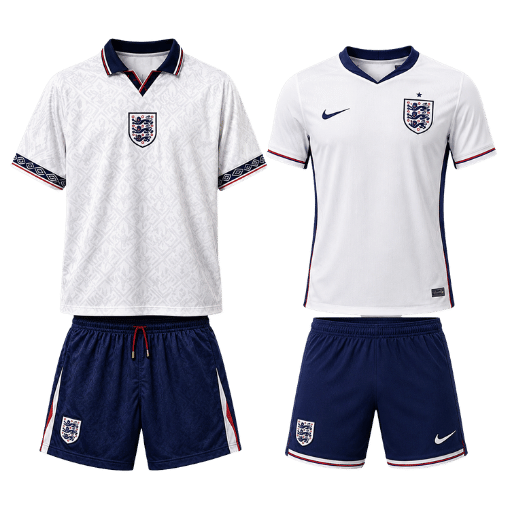
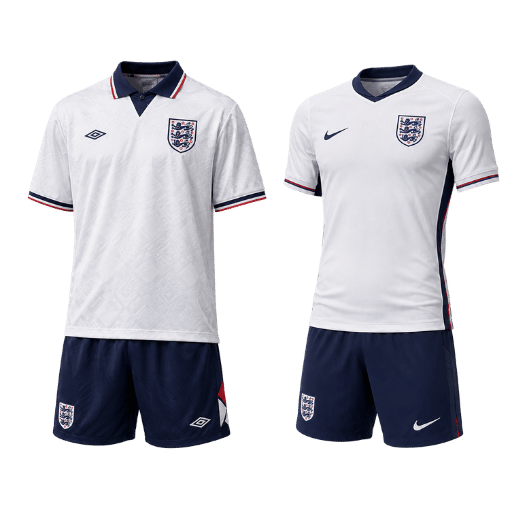
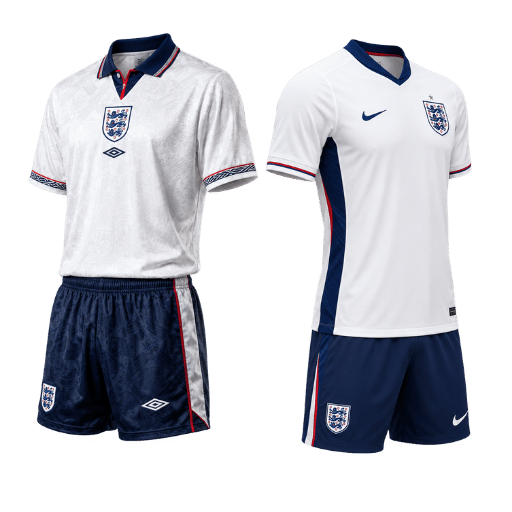
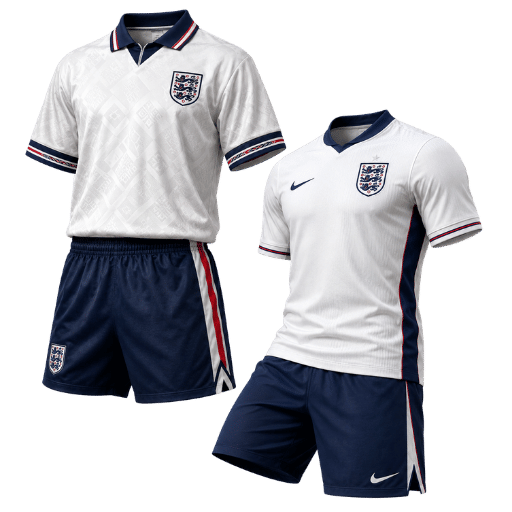
An England Euro 96 jersey vs 2024 jersey comparison is a side-by-side look at two of the most talked-about England shirts ever made: the white Umbro home shirt from the summer football came home, and Nike’s 2024 shirt that started a national argument about the St George’s Cross. One is a 1990s icon worn at a home tournament; the other is a modern, controversy-stamped collectible. Below we compare their design, makers, fabric, stories, price and authenticity, and give you a simple framework for deciding which England shirt is worth buying.
Short version: the Euro 96 shirt wins on nostalgia and tournament history, while the 2024 shirt is the more talked-about modern kit thanks to the redesigned flag on its collar. Which one is “better” depends on whether you’re buying a piece of football culture or a wearable modern shirt, so we’ve built the comparison around exactly that decision.
Kit At a Glance
England Euro 96 (Umbro)
White home shirt / grey “indigo” away
UEFA Euro 1996, England as hosts
Semi-final: lost 6–5 on penalties to Germany
Maker: Umbro (British)
England 2024 (Nike)
White home shirt, slim Dri-FIT cut
UEFA Euro 2024, runners-up (lost final 2–1 to Spain)
Redesigned St George’s Cross on the collar
Maker: Nike (global)
England Euro 96 vs 2024 Shirt, At a Glance
Fastest way to settle an England Euro 96 jersey vs 2024 jersey comparison? A straight spec-for-spec table. Both are white home shirts worn by England at a European Championship, but almost everything else, maker, cut, fabric, crest detail and price, is different. In practice, the most common mistake buyers make is judging the two on look alone, because the real gaps between shirts made 28 years apart only show up side by side, and getting it wrong is an expensive risk. Here’s the full breakdown.
England Euro 96 shirt vs 2024 shirt: the 96-vs-24 At a Glance comparison across 11 key details.
Detail
Euro 96 Shirt
2024 Shirt
Manufacturer
Umbro (British)
Nike (USA)
Tournament
UEFA Euro 1996 (hosts)
UEFA Euro 2024 (runners-up)
Best result in it
Semi-final (lost on penalties)
Final (lost 2–1 to Spain)
Home colour
White + turquoise/pale-blue trim
White + navy trim
Away/change colour
Grey “indigo blue”
Purple/blue
Crest position
Centred (first time ever)
Left chest
Collar
Polo-style
Ribbed crew, gradient cross inside
Fabric
100% polyester (heavier)
Recycled Dri-FIT (lighter)
Fit
Relaxed / boxy
Slim / engineered
Signature talking point
Gazza’s “dentist’s chair”
St George’s Cross redesign
Typical 2026 price
~£23 common, up to £300 rare original
£84.99 stadium / ~£124.99 authentic
Prices as of June 2026; original-shirt values move with condition, size and rarity.
Design & Aesthetics, Umbro Minimalism vs Nike’s Modern Cut
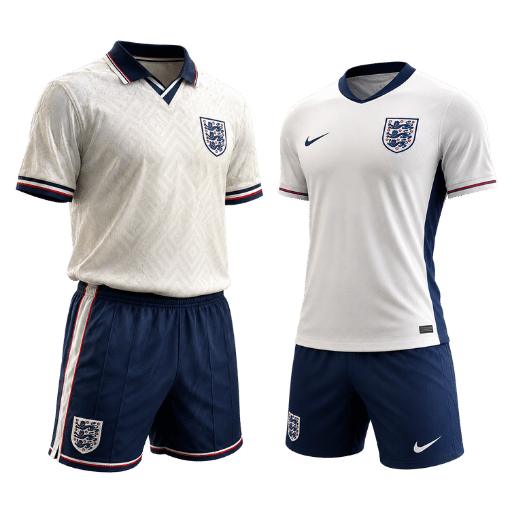
Euro 96’s home shirt is a study in restrained 1990s design. For the first time ever, Umbro moved the Three Lions crest to the centre of the chest, sat beneath a text-based logo and a clean polo collar, with a subtle injection of turquoise running through the white. It looks deliberately simple, and that simplicity is exactly why it has aged so well.
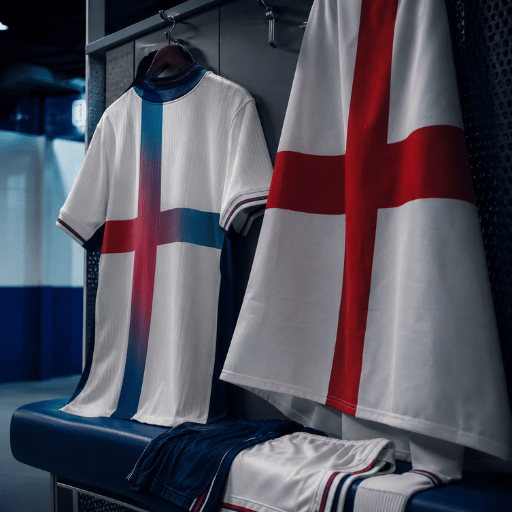
Nike’s 2024 shirt takes the opposite instinct: a slimmer, engineered crew-neck in bright white with navy trim and the crest on the left chest. Its design is clean enough, but the talking point hides on the collar, where Nike replaced the traditional red-on-white St George’s Cross with a navy-to-purple gradient. That single change, marketed as a “playful update,” became the most discussed England kit detail in years (more on that below).
There’s a second design twist worth knowing. Take the Euro 96 away shirt, a grey colourway Umbro marketed as “indigo blue” — was the first time England’s change kit moved away from traditional red. It was divisive at launch, yet today many collectors rate it above the home shirt. As one kit historian put it, it’s “arguably the most recognisable of the tournament, despite only being worn once.” A common mistake, in practice, is assuming the white home shirt is automatically the prize, because the risk with England kits is that the change shirt, not the home one, often becomes the more wanted design 28 years later.
📐 Collector’s Note
On a genuine 1996 Umbro home shirt, the embroidered Three Lions crest sits dead-centre and the Umbro wordmark is text-based, not the diamond-only logo used on earlier kits. A centred crest with a clean polo collar is the quickest visual tell that you’re looking at the Euro 96 design rather than a later 1997–99 England shirt.
Manufacturer & Era, Umbro 1996 vs Nike 2024
Who makes an England shirt matters more than most buyers realise. Umbro, a British company founded in Manchester, supplied England kits for decades and made every shirt of the 1990s golden era for the England national team. Nike took over the England national team contract in 2013, ending the Umbro relationship and moving the national team onto the same global template system used by dozens of other countries.
Why does that matter for buyers? Because the maker is a large part of what gives a shirt its collector identity. An Umbro-era England shirt carries a heritage premium: it represents a specific, un-repeatable period of English football design before global templates took over. A Nike shirt, by contrast, is a modern product made in huge numbers, its value comes less from rarity and more from the story attached to a specific edition. So when you compare these two shirts, you’re really comparing a British heritage maker at its creative peak against a global brand at scale. This matters in practice because an Umbro England shirt has been out of production for nearly 13 years, and the reason originals command a premium is that scarcity, a structural gap buyers in the resale market feel directly, and a risk if you mistake a later 1997–99 shirt for a true Euro 96 one.
Fabric, Fit & Construction, Boxy Polyester vs Engineered Dri-FIT
Worn side by side, these two shirts feel completely different. Euro 96’s shirt is 100% polyester in the heavier, relaxed cut of its era, a longer body, roomier sleeves and that slightly stiff hand-feel vintage collectors know well. Nike’s 2024 shirt uses a lighter, recycled Dri-FIT knit engineered for a slim, body-mapped fit with a dropped hem. If you’re used to modern slim shirts, a 1990s shirt in your usual size will feel noticeably looser and longer.
📐 Construction Note
If you want the relaxed 90s look, buy a Euro 96 shirt in your true size. If you want it to sit like a modern fit, size down once. Official Score Draw reissues of the 96 kit follow vintage sizing, so treat their “L” as a roomy modern “XL”. For the 2024 Nike shirt, the slim stadium cut runs close to the body, size up once if you prefer room.
A common sizing mistake, in practice, is buying your usual modern size in a 1990s shirt, because 90s cuts ran longer and roomier, get it wrong and a 28-year-old shirt fits like a tent. One honest caveat: exact fabric weights vary between production runs, and the “right” choice is personal. Point is, these are simply two different garments, one built for 1996 terrace culture, one for 2024 performance marketing.
The Stories Behind the Shirts, Gazza ’96 vs the 2024 Final
A shirt is only as collectible as the memories attached to it, and here the two couldn’t be more different. Euro 96’s shirt is bound up with the summer “football’s coming home” — the Baddiel, Skinner and Lightning Seeds anthem, Paul Gascoigne’s “dentist’s chair” celebration against Scotland, and Alan Shearer finishing as the tournament’s top scorer. It ended in heartbreak: a 1–1 semi-final against Germany at Wembley, lost 6–5 on penalties, with Gareth Southgate’s spot-kick saved before Andreas Möller scored the winner, according to UEFA Euro 1996 records. For collectors, the reason this shirt holds value 28 years on is emotional, not technical, because an authenticated original still anchors a specific summer, which in practice is why a good example rarely struggles to sell.
“England’s away kit in Euro 96 is arguably the most recognisable of the tournament, despite only being worn just once. Its colour, marketed as ‘indigo blue’ but commonly described as grey, was the first time England had moved from their traditional red as first-choice change colour, and it was designed as a shirt that could be worn by supporters with jeans.”
Gavin Hope, Football Kit Geek
Nike’s 2024 shirt carries a very modern kind of story. England reached the Euro 2024 final and lost 2–1 to Spain, but the shirt is remembered less for the football and more for the flag row on its collar, a controversy that, ironically, made it one of the most photographed England kits ever. That’s the shirt’s lasting hook, so it deserves its own section.
The St George’s Cross Controversy, Explained
Why was the 2024 England shirt controversial?
The 2024 England home shirt was controversial because Nike changed the St George’s Cross. Instead of the traditional red-on-white flag, the cross printed on the back of the collar was rendered as a navy-to-purple gradient, a detail Nike described as a “playful update.” Many fans saw it as altering the national flag, and the backlash reached Westminster: then-Prime Minister Rishi Sunak said Nike “shouldn’t mess with” the flag, while Labour leader Keir Starmer also urged changes.
Here’s the part most people miss, and it’s what we call the Flag-Gate Effect. Despite the outcry and call for a boycott, Nike and the Football Association refused to recall or change the shirt, and it sold strongly anyway. All that noise generated enormous attention, and a kit that might have been forgotten became a defining modern England shirt. That story didn’t end there: the FA later announced it would overhaul its kit-approval process so future England kits face tougher internal checks.
That intensity isn’t new, either. Research on national flags traces the St George’s Cross’s rise as the dominant English football symbol, displacing the Union Flag, to the mid-1990s, and documents how fans gradually “reclaimed” it from earlier far-right associations (Platoff, Old Flags, New Meanings). That history is exactly why redrawing the flag on a national shirt touches a nerve. A risk for buyers, in practice, is mistaking this controversial collar for a fault or a fake, because the gradient is correct and deliberate, the reason it exists is Nike’s redesign, not an error. For collectors, that combination, a one-off design, a national argument, and a process change that makes a repeat unlikely, is exactly what turns an ordinary shirt into a future talking-point piece.
Price & Collectible Value, What Each Shirt Costs in 2026
How much is an original Euro 96 England shirt worth?
An original 1996 Umbro England shirt is worth anywhere from about £23 for a common, well-worn home shirt to around £300 for a rare, excellent-condition or player-relevant example, with vintage England shirts reported selling for up to £300 on the resale market. Condition, size and originality drive most of that spread. Here’s how the four main buying options compare.
England Euro 96 vs 2024 shirt price bands in 2026, from original vintage to modern authentic.
Option
Typical 2026 price
Best for
Original Umbro 96 (good condition)
~£80–£300
Purists, investment, display
Original Umbro 96 (well-worn/common)
~£23–£60
Wearers on a budget
Official Score Draw reissue
~£50
New-condition retro look
2024 Nike stadium replica
£84.99
Everyday modern fans
2024 Nike authentic/match
~£124.99
Collectors of the Flag-Gate edition
⚠️ Prices as of June 2026 and may not reflect current market; resale values move with demand, condition and tournament cycles.
In practice, the most expensive mistake buyers make is overpaying for a common shirt because a listing call it “rare” — a risk worth a 30-second check against recent sold prices. Beyond the stadium and authentic versions, a genuine player issue or match shirt from the matchday squad can cost more again. So the pattern is clear: a good original Umbro 96 shirt generally out-values a modern 2024 stadium replica, with reissues sitting in between. But the 2024 authentic shirt is the wildcard, as the “Flag-Gate edition,” it may hold value better than a typical modern kit precisely because of its controversy.
Spotting Authentic vs Reissue vs Fake
Are reissue Euro 96 shirts authentic?
Yes, an official reissue is a genuine, licensed product, not a fake. Brands such as Score Draw make officially licensed reproductions of classic England kits, and reputable sellers label them clearly as reissues rather than passing them off as original 1996 stock. What to avoid is the third category: an unlicensed copy with fake Umbro branding, which is a counterfeit. Telling original, official reissue and fake apart is the single most useful skill when buying.
Unlike a club shirt, an England shirt carries no sponsor, so the maker’s logo and the badge become your main authentication points. These checks work for both the 1996 original and the 2024 Nike shirt.
✔Crest & embroidery: sharp, dense stitching with the rose and lions correctly shaped; blurry or thin embroidery is a red flag.
✔Tags: an original 96 shirt has an era-correct Umbro tag and letter sizing (S/M/L); modern reissues carry current brand tags.
✔Fabric & age: a genuine vintage shirt shows honest signs of age, slight fading, minor print cracking. “Too perfect for its age” is suspicious.
✔2024 Nike checks: look for the holographic swing tag and correct collar gradient; a flat red-on-white collar on a “2024” shirt is wrong.
✔Price & seller: if an “original” is far below market and offered in every size at once from an unknown seller, treat it as a fake.
Fakes slip through, in practice, because buyers skip the tags, a counterfeit’s biggest risk of exposure is the era-correct label that an authenticated shirt is checked against. When in doubt, cross-reference the design against a trusted archive and buy from a specialist who authenticates stock before listing. Our own player-version vs replica jersey guide goes deeper on the tags and badge details that separate the tiers, and the guide to buying replica soccer jerseys safely covers seller red flags.
Which Should You Buy? The Collector’s Triangle
Most buyers get stuck because they compare the two shirts on the wrong axis. Instead of asking “which is better,” score each shirt on three things, what we call the Collector’s Triangle: Story (the memories and meaning), Scarcity (how hard it’s to get a genuine one) and Wearability (how it looks and fits day to day). Euro 96’s shirt wins on Story and Scarcity; the 2024 shirt wins on Wearability and has a surprisingly strong Story of its own.
The Collector’s Triangle: which England shirt to buy in 2026 by buyer type.
Why does this comparison even matter in 2026? Because retro and modern England shirts are both climbing in demand, but for different reasons. That demand is cultural, not just commercial: 1990s nostalgia has crossed over into mainstream fashion, with vintage football shirts now worn casually as “blokecore” and terrace-style streetwear rather than only on matchday. Academic work on sport marketing backs this up, research into retro branding in sport finds that fans will pay to feel nostalgic for eras, and the Euro 96 shirt sits right at the centre of that pull. In practice, the reason both shirts keep climbing is a structural squeeze: demand outpaces genuine supply, and because good originals are finite, the risk for buyers is that prices rise faster than wages every tournament summer.
Nike’s 2024 shirt rides a different wave: notoriety. That St George’s Cross row keeps it in the conversation, and the FA’s kit-approval overhaul makes a repeat of that design unlikely, which gives the 2024 shirt a one-off, “you-had-to-be-there” quality that modern kits rarely earn. For context, the wider football-shirt market is forecast to keep growing at roughly 5% a year through the mid-2030s, but that headline figure is just background; the real action is in which specific shirts capture cultural memory. Both of these do.
Practically, for buyers: if you want a genuine Euro 96 original, demand is only rising, so the best-condition examples will keep getting harder to find, buy before the next tournament summer, not during it. If you want the 2024 shirt, the authentic version is the one to hold. For more on how England’s design language has shifted across the decades, see our Germany World Cup jersey evolution guide and our roundup of the most iconic 1990s soccer jersey designs.
England Euro 96 vs 2024 Shirt, FAQ
Q: Who made the England Euro 96 shirt and the 2024 shirt?
View Answer
Umbro made the Euro 96 England shirt; the British brand supplied England kits throughout the 1990s. Nike made the 2024 shirt, taking over the England contract in 2013. You will also see official Score Draw reissues: licensed reproductions made today, not original Umbro stock.
Q: Why was the 2024 England shirt controversial?
View Answer
Nike changed the St George’s Cross on the collar from the traditional red-on-white to a navy-to-purple gradient, calling it a “playful update.” Many fans felt it altered the national flag, and the backlash reached Westminster and senior politicians. Nike and the FA refused to recall the shirt, it sold strongly anyway, and the FA later said it would overhaul how future England kits are approved. Ironically, the controversy made the shirt more memorable, not less.
Q: Is the Euro 96 England shirt worth buying in 2026?
View Answer
For most fans, yes. A common original sits around £23–£60, a top-condition original can reach roughly £300, and an official Score Draw reissue is about £50 if you want the look in new condition. With 1990s nostalgia driving the retro-shirt boom, good originals are getting harder to find, so buying a genuine example now is a reasonable call — just authenticate it first.
Q: What’s the difference in fit between the 1996 and 2024 shirts?
View Answer
Fit is the biggest practical difference here. The 1996 Umbro shirt has a relaxed, boxy 1990s cut with a longer body and roomy sleeves, designed to be worn loose. The 2024 Nike shirt is a slim, engineered Dri-FIT fit that sits much closer to the body. If you want a modern look in an original 96 shirt, size down once; if the 2024 cut feels too tight, size up one for a more relaxed drape.
Q: Which England shirt is rarer?
View Answer
A genuine original 1996 Umbro shirt in good condition is far rarer than the mass-produced 2024 Nike shirt, since decades of wear and washing have thinned the surviving stock. Among modern shirts, the authentic 2024 “Flag-Gate” player edition is the scarcer option.
Q: Was the Euro 96 grey away shirt really that popular?
View Answer
Yes. The grey (officially “indigo”) Umbro away shirt is now one of the most loved England kits ever made, despite being worn only once, in the Euro 96 semi-final defeat to Germany. That single-outing rarity is exactly what drives its strong collector demand today.
How We Compare Kits
Every verdict in this England Euro 96 vs 2024 comparison draws on tournament records, the 2024 St George’s Cross reporting, collector authentication practice and resale pricing we track across the vintage-shirt trade. Prices are dated to June 2026 and move with condition and demand; we authenticate originals before listing and label all reissues clearly. Reviewed by the Classic Football Shirts team.
I write about football jersey fit and when different shirt styles make sense. My articles cover youth goalkeeper sizing and long-sleeve jerseys, helping players and families think through comfort, movement, weather, and the role of the shirt before they buy.