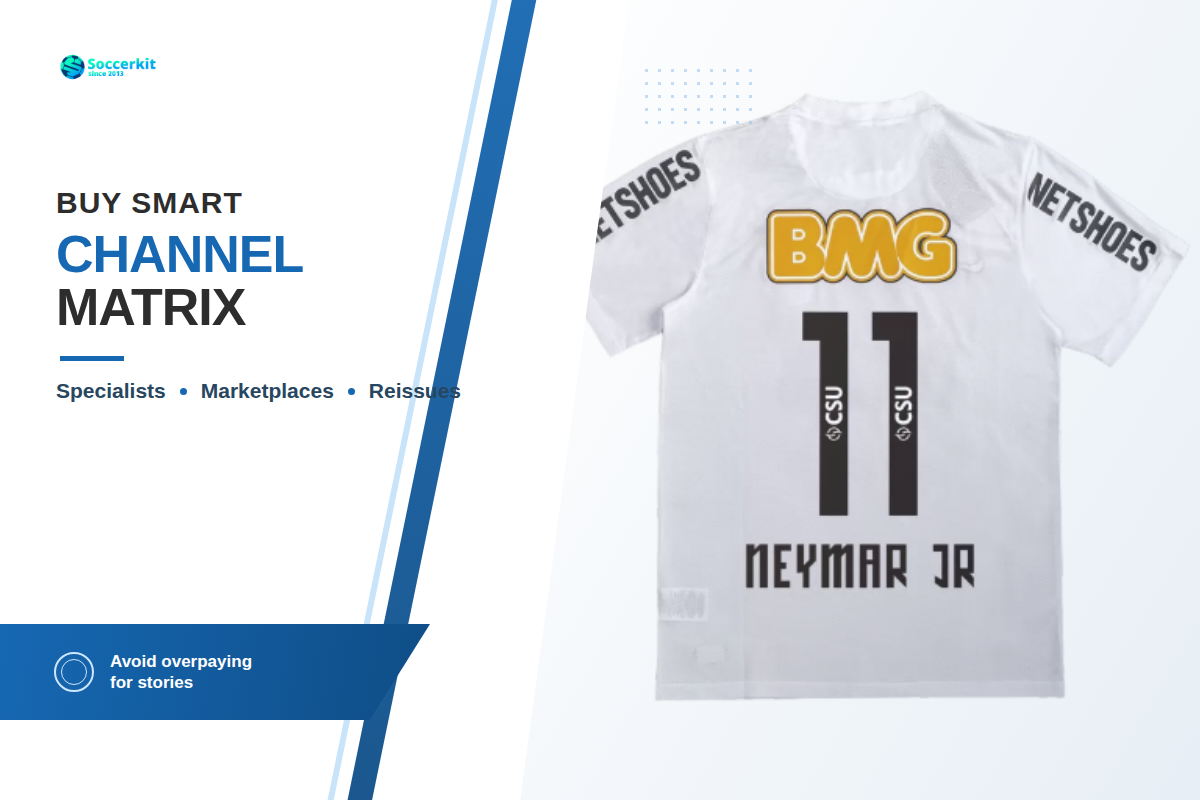
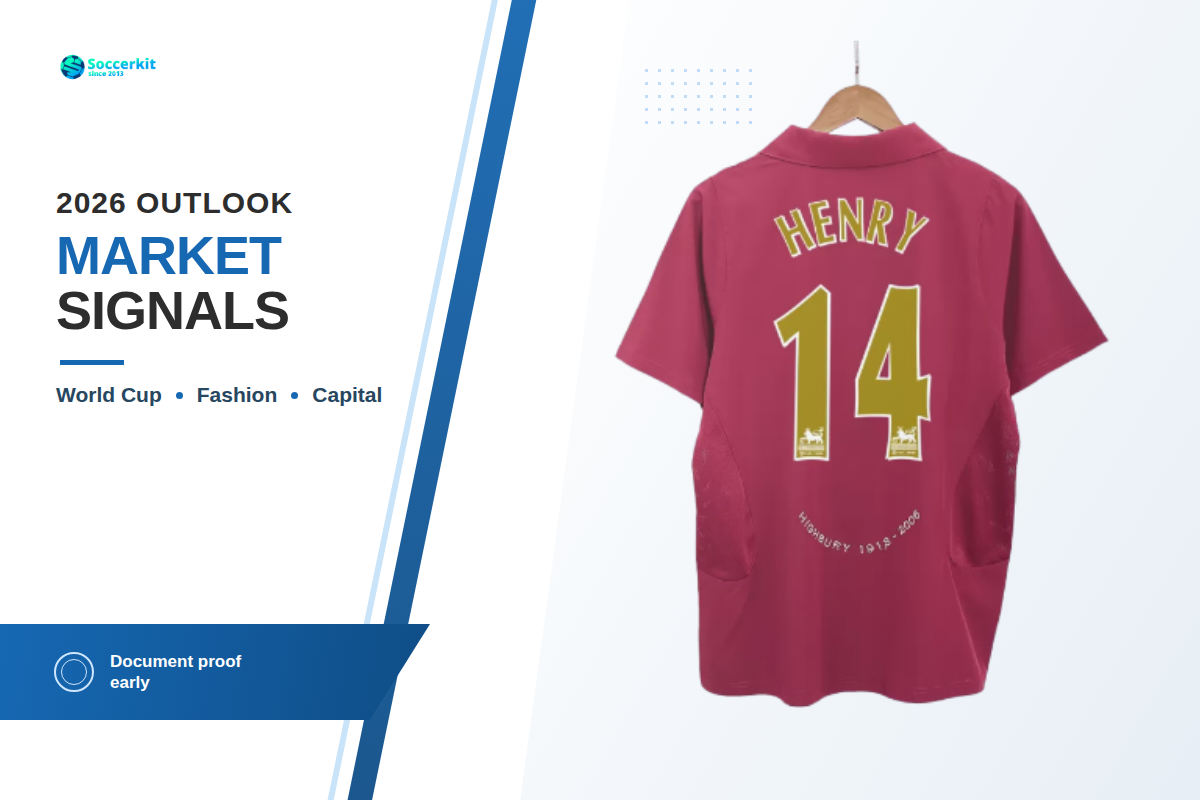
Still searching for your perfect jersey? Explore our best-selling products—we're confident you'll find a style that's just right for you in our diverse collection.
Updated June 2026 · Reviewed by the Classic Football Shirts team.
The best era for retro soccer jerseys investment is the late 1980s through the 1990s, the window where iconic design, thin original supply and peak nostalgia overlap. But the decade on the label is only half the story: a random 1994 replica off a market stall won’t grow in value, while an authenticated shirt tied to a specific player, a tournament moment and a short print run can multiply many times over. When U.S. private equity firm The Chernin Group put $38.5 million into Classic Football Shirts in 2024, it was a bet on that distinction becoming the whole market’s logic.
This guide scores every decade on a single index, breaks down what actually drives a vintage football shirt‘s value, and gives you a buying framework so you put money where the data points, not where nostalgia pulls.
Quick Take
Strongest investment era
Late 1980s – 1990s originals (thin supply + peak design)
What actually drives value
Player × moment × scarcity × provenance — not age alone
Record sale
Maradona 1986 “Hand of God” match-worn: £7,142,500
Market direction (2026)
Pre-owned growing >100% year over year; institutional money entering
Biggest risk
Fakes — authentication is the core capital-protection step
Do Retro Soccer Jerseys Actually Hold Their Value?
Retro soccer jerseys hold their value selectively, and that caveat matters more than any decade ranking. A minority of shirts appreciate strongly; most modern replicas never do. Value concentrates in classic football shirt stock where a famous player, a tournament moment and genuine scarcity overlap on the same piece.
Soccer jerseys can be a good investment, but only as a concentrated, illiquid and condition-sensitive asset. A current-season shirt bought at retail today will almost never grow in value within a few years unless it carries a legend’s nameset or becomes genuinely rare. There’s no certainty, only better odds for the right shirt.
A useful sanity check comes from collectors on r/SoccerJerseys and from specialist retailer nss-sports, who stresses that “no certainty” applies to any ordinary jersey. Treat a jersey as a passion asset first and an investment second. In practice, the rule is simple: buy what you would be happy to own even if it never gained a penny.
Before you compare eras, learn to score a single shirt. After handling the volume of stock that moves through the vintage market, five forces explain almost every price, and they’re weighted, not equal.
Five forces set a retro football shirt’s value, with the rough weight each carries.
Force
Weight
What it means
Player & moment
30%
A shirt tied to Diego Maradona, a World Cup goal or a title-winning night.
Tournament weight
20%
World Cup and major-final kits out-pull mid-table league shirts.
Supply scarcity
20%
Short original print runs, away/third kits, pre-mass-market eras.
Brand-era design
15%
An adidas or Umbro template collectors actually want to wear.
Condition & provenance
15%
Grade and proof of authenticity — the multiplier on everything above.
Run a real shirt through the forces and the logic clicks. Score a 1990 Napoli home: player and moment (Maradona’s Scudetto side) max out, tournament weight is league rather than World Cup, scarcity is high on genuine originals, the design is a Serie A classic, and a mint example with proof outranks a faded one. Four of five forces fire, which is exactly why that shirt sits near the top of the market while a 2014 mid-table away kit, strong on nothing, stays a wearing piece.
What the weighting reveals: the top two forces (player and tournament) are fixed the day the shirt is made, while the bottom two (condition and provenance) are the ones you control as a buyer. You can’t make that 2014 away shirt historic, but you can refuse to overpay for a poor-condition example and you can insist on authentication. In practice, the most expensive mistake is paying a player-and-moment price for a shirt that only scores on design, a misread that can cost 40–50% of resale the day you try to sell, because the buyer pool for “nice-looking but anonymous” is shallow. No force survives a fake, either: a counterfeit that imitates any of the five is worth nothing, which is why U.S. authorities track sports counterfeiting as a multi-million-dollar problem in the 2025 Notorious Markets review.
Era by Era: Which Decade Is the Best Retro Jersey Investment?
Here’s the synthesis the listicles skip, every era scored on the four forces a buyer can read before purchase, resolved to an investment grade. Scores run 1 (weak) to 5 (strong). Each price band is an indicative range for common authentic originals in good condition, not rare grails or match-worn pieces.
The Era Investment Index: retro soccer jersey decades scored 1–5, with the 1990s the best all-round investment era.
Era
Design
Scarcity
Cultural pull
Liquidity
Indicative original
Grade
1970s
5
5
4
2
£150–600+
A
Early 1980s
4
5
4
3
£120–450
A−
Late 1980s
5
5
5
3
£120–500
A
Early 1990s
5
4
5
4
£100–400
A
Mid 1990s
5
4
5
5
£80–300
A+
Late 1990s
5
3
5
5
£70–250
A−
Early 2000s
4
3
4
4
£55–200
B+
Late 2000s
3
2
3
4
£45–150
B
2010s
3
2
3
4
£30–120
B−
Current / speculative
3
1
2
5
£40–90 retail
C
Scores are the Classic Football Shirts team’s read of the market; price bands are indicative for common authentic originals in good condition and move with demand.
What decade produced the best retro football shirts?
On raw design and scarcity, the 1970s and 1980s win, with thinner survival and bolder one-off templates. But for investment, which balances upside against the ability to actually buy and sell, the mid-to-late 1990s grades highest, the only window where iconic design, real scarcity, peak cultural pull and strong liquidity all score 4 or 5 at once.
A 1970s shirt can out-appreciate, but supply is so thin and prices so high that most buyers are priced out. In practice, chasing the rarest 1970s example is a liquidity risk: you might wait months to find a buyer, and a rushed sale can lose 20–30% against a patient one. The 1990s is where serious money and accessible entry points overlap; the most iconic 1990s designs are still findable in original form.
The 90s Premium: Why the Golden Era Commands the Highest Prices
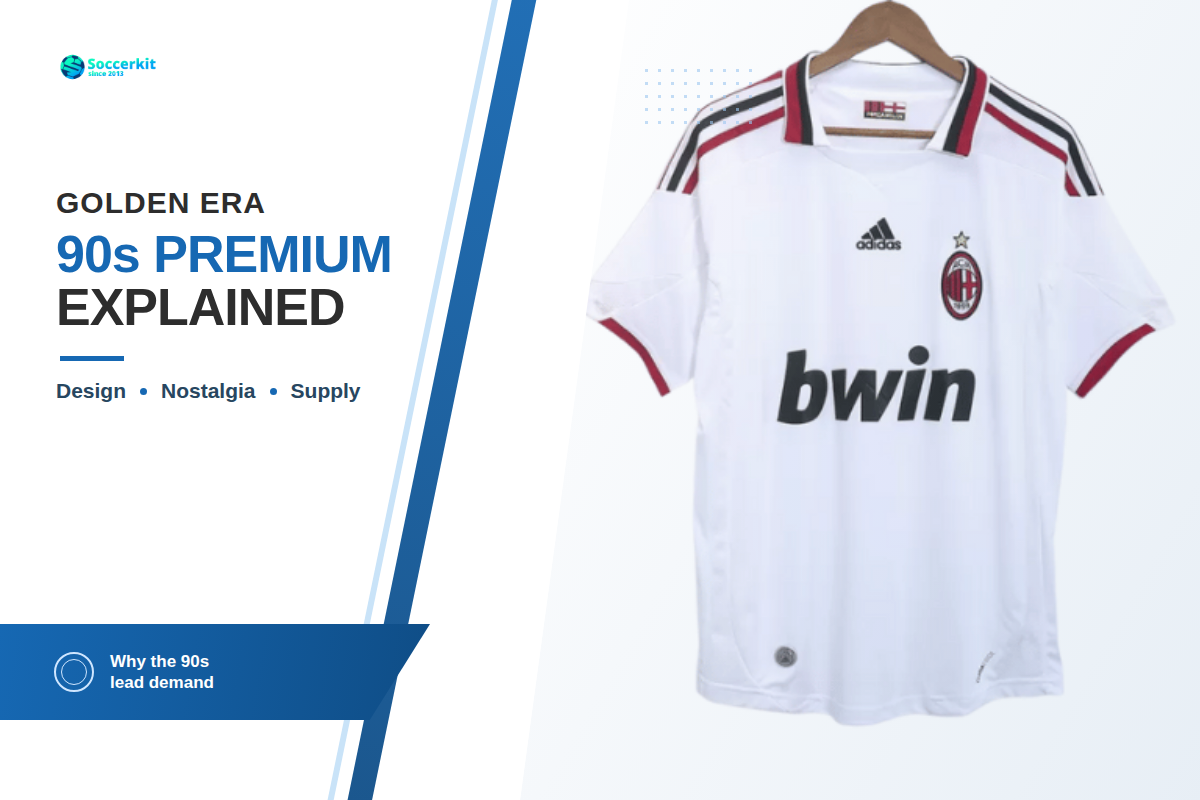
Three forces converge on the 1990s, and that convergence, not the decade itself, is the 90s Premium. First, finite original stock: shirts were made in far smaller runs than today’s global retail drops, and three decades of wear has thinned the survivors. Second, peak template design: brands took real risks, the splatter-print goalkeeper kits, the bold Milan-and-Serie-A graphics, the 1994 Brazil era palettes. Third, the nostalgia demographic: the fans who grew up watching Diego Maradona‘s 1986 Argentina side or Italia ’90 are now at peak spending power.
Italian football supplies the concrete evidence. AC Milan‘s early-90s teams and the Napoli of the Maradona Scudetto years anchor the era, Napoli waited 33 years between their 1989/90 title and 2023, and that scarcity keeps the 1990 kit in demand. Each Italian club here, Milan, Napoli, Juventus and Fiorentina, pairs the prestige of a Serie A title with thin original supply, which is why they hold their value across cycles. Shirts from the 1990, 1994 and 1998 World Cup campaigns form the spine of most serious collections, and in practice they’re the easiest 1990s pieces to resell when you need liquidity.
If you want concrete targets, the most-quoted names among shirt collectors tell the story of the decade’s unique designs. The Nigeria 1994 shirt is a national-team icon of bold pattern; the Ajax kits carry the weight of the club’s Champions League heritage; the 1994 World Cup and 1998 World Cup home shirts of Brazil and Argentina anchor any vintage-kits collection, just as the best shirts from the 1980s anchor the decade before. These rare vintage originals are the core of European football’s collecting scene. These are the pieces whose value over time has tracked upward, the ones that surface in football-history features and, occasionally, sell for thousands at auction. Even the mid-table oddities have a market: lurid away kits from the early premier league era now sell to a generation that never saw them played, a sign of how wide the market for vintage shirts has grown.
“I see soccer shirts as the sneaker culture of 10 years ago. They tell a story: your tastes, style, background. They can be worn or collected.”
A 90s shirt’s investment case strengthens sharply when two or more forces stack: a world cup tournament and a named legend and an away/third kit run. A plain home-league shirt with none of those is a wearing piece, not an appreciating asset, price it accordingly.
Blue-Chip vs Speculative: The Two-Speed Shirt Market
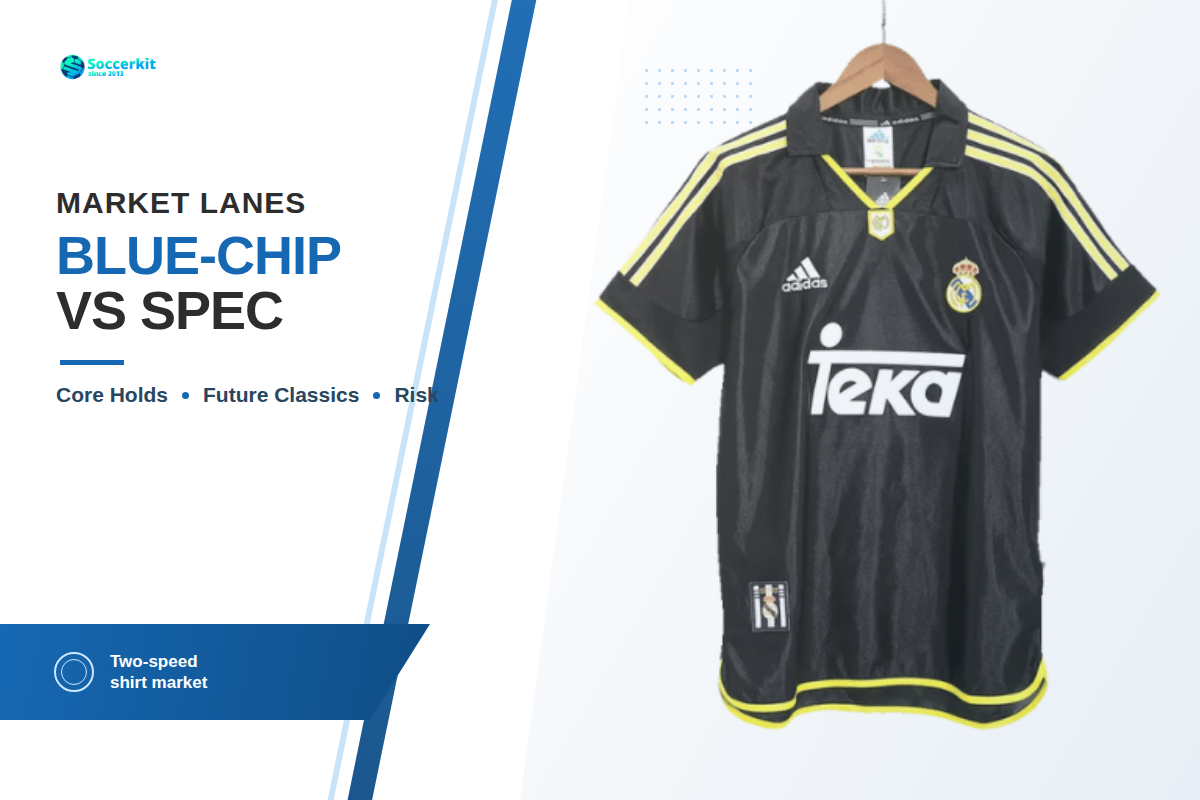
Every shirt sits in one of two lanes, and confusing them is the most expensive mistake new buyers make. Blue-chip shirts, World Cup-winner originals, iconic-club kits from Brazil’s 1970 side, barcelona, liverpool or manchester united title teams, move slowly, stay liquid and rarely crash. In practice a buyer building a core holding starts here: a retro Barcelona jersey, an AC Milan retro jersey or a Manchester United retro jersey from a title-winning soccer league season are the application of the same blue-chip logic across different clubs, whether your taste runs to Italian, Spanish or English football. Speculative shirts are bets on a current or recent kit becoming a future classic. Some land; most stay flat.
✔ Blue-chip (slow lane)
World Cup-winner and major-final originals
Iconic-club kits with a named legend
Low downside, deep buyer pool, easy to resell
Higher entry price, slower gains
⚠ Speculative (fast lane)
Current “future classic” and limited drops
Cheap entry, high variance
Needs a moment (title, transfer, retirement) to pop
Most stay flat, treat as a small punt
One signal that scrambles the lanes: provenance can beat age entirely. For example, Cole Palmer’s 2024/25 Premier League match-worn shirt fetched around €41,000 at auction and can out-value almost any vintage retail shirt. That’s the clue to the next section: the single biggest lever on price isn’t the year on the label, it’s proof of who wore it.
Provenance and Authentication: What Separates a £50 Shirt From a £5,000 One
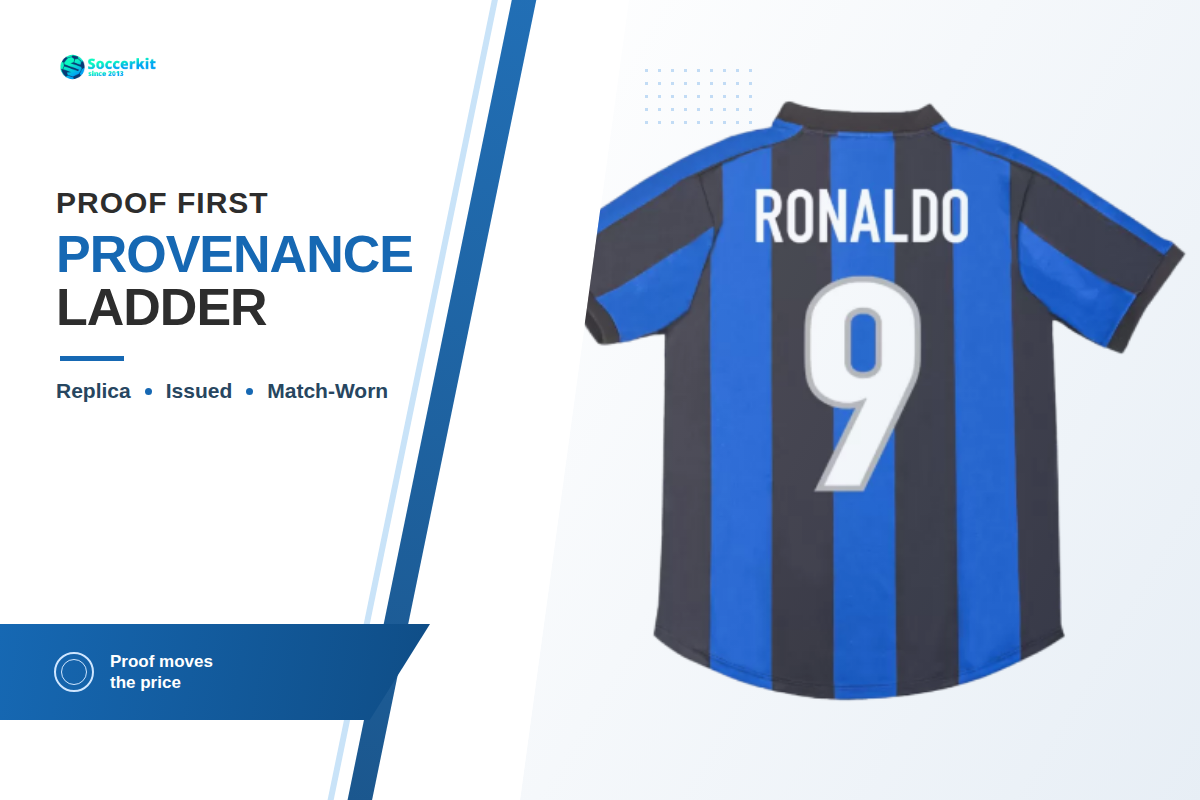
Provenance is the multiplier on every other force, and the spread it creates is enormous. That same 1986 Argentina design sells as a retro/retail piece for tens of pounds, yet the actual shirt Diego Maradona wore, his match-worn “Hand of God” jersey, set the Guinness World Record at £7,142,500. That’s provenance plus the moment, not the design, doing the work. Here’s the ladder every listing sits on:
Provenance ladder: how proof of who wore a shirt drives value from tens of pounds to millions.
Tier
What it is
Indicative level
Replica
Mass retail, cheaper fabric and print
Entry / wearing only
Authentic (player-spec) retail
Player-grade build sold to the public
Modest premium
Match-issued
Prepared for a player, not confirmed worn
Strong premium
Match-worn
Actually worn in a game (often unwashed)
High premium
Match-worn, iconic moment
Worn in a defining game (a goal, a final)
Record territory
How do you value classic, match-worn shirts?
Photo-matching is the gold standard for valuing a match-worn shirt: pairing the exact shirt to game photography of a player wearing it, the way programmes like MeiGray do in U.S. sports. Short of that, value rests on a chain of proof, a letter of authenticity, the seller’s reputation, and physical tells in the tags, sponsor construction and player-spec sizing.
If you can’t build that chain, you’re buying a story, not a match-worn shirt, and the difference between a player version and a replica is exactly where most overpaying happens.
This is the structural shift worth acting on now: as institutional capital and the fashion crossover professionalise the market, the premium is migrating from nostalgia toward provable provenance. Buyers who document and authenticate today are positioning for a market that increasingly pays for proof.
Condition, Storage and the Resale Multiplier
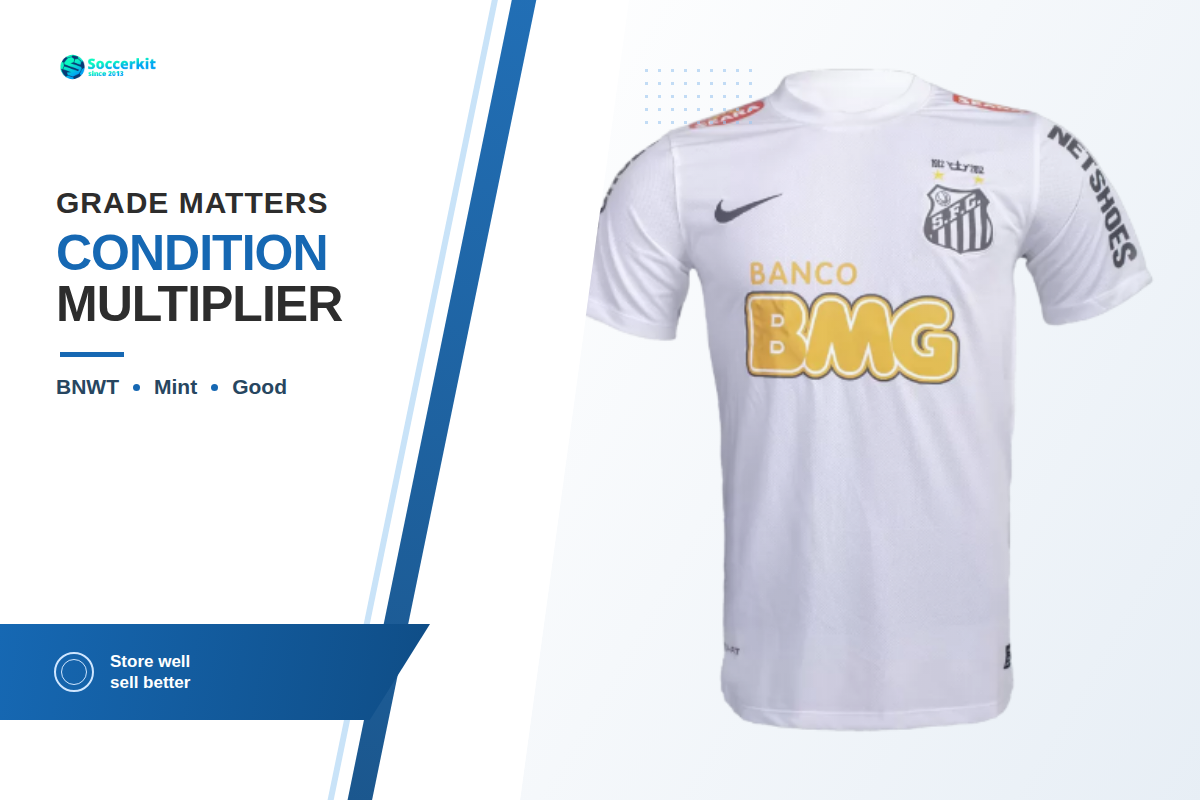
Condition is the one value force entirely in your hands after purchase, and it moves price by multiples. In practice, specialist sellers grade on a consistent scale: BNWT (brand new with tags) at the top, then Mint (10), Excellent (9/8), Very Good (7/6), Good (5) and Fair (4/3). Grading is partly subjective, but the price effect isn’t. Condition only counts on a genuine shirt, though: a fake graded “mint” is still worth nothing, which is why Border Force counterfeit seizures matter to collectors as much as to brands.
📍 Collector’s Note — the condition multiplier
Take one common authentic original, say a 1990 home shirt that brings roughly £250 in mint condition. That same shirt in good, clearly-worn condition (pulls, bobbling, faded print) might bring £90–120. That’s a 2–3× spread driven by grade alone, on an identical design. Bottom line: for investment, buy the best condition you can afford, because the multiplier compounds with every other value force.
✔ Store flat or on padded hangers, heavy home shirt and away shirt fabrics distort on thin wire.
✔ Keep out of direct UV light; sun-fade is irreversible and visible to graders.
✔ Never hot-wash a vintage shirt, it cracks printing and shrinks fabric, dropping a grade instantly.
✔ Keep the tags. For a wearing piece it’s cosmetic; for a shirt collection held as investment, BNWT is a different price tier.
Where and How to Buy Without Overpaying
Channel choice is a trade-off between price and protection. Open marketplaces (eBay, Vinted, Depop) are cheapest but carry the most fake and misgrade risk, collectors regularly report getting burned. Specialist retailers charge a premium, a shirt that’s £30 on eBay can be £80 at a specialist, but you pay for authentication, grading and recourse. For investment-grade buying, that premium is usually worth it; for a wearing piece, it may not be.
Serendipity cuts both ways. When U.S. coach Gregg Berhalter wandered into a Classic Football Shirts pop-up in New York in 2022, he walked out with a mint USA 1994–95 home jersey that the shop priced near $400, a tournament shirt, in top condition, from a verified seller. That’s the buy done right. Its mistake version is the same shirt bought blind on a marketplace for $120, ungraded and unauthenticated, that turns out to be a modern signed-look reproduction worth nothing to a serious collector.
The buy-decision matrix
Goal = wear it: buy an official reissue or authentic retail. Reissues make iconic designs affordable and wearable, a legitimate sub-market, just not an investment.
Goal = hold value: buy an authentic original in the best condition you can afford, from a channel that authenticates.
Goal = top-end investment: buy match-issued or match-worn with documented provenance, and verify before you pay.
Buying shirts well comes down to one habit: separate the two jobs cleanly, because shirt collecting and football culture reward different things, reissues are for wearing, originals are for holding. Confusing them, paying original prices for a reissue, or wearing an investment-grade original, is how value leaks. If you’re still deciding which sellers to trust, our guide to the best places to buy and the home-vs-away dynamics of a classic kit like Italy 2006 are good next reads.
Market Outlook: Where Retro Jersey Investment Is Heading in 2026
Professionalisation is the defining shift, and it changes what you should buy. The market is no longer a hobbyist corner: institutional capital has arrived, the $38.5 million Chernin investment, U.S. retail expansion, and a sport-meets-fashion crossover documented by the BBC. As that money matures the market, it rewards what it can verify, which means the premium is migrating from soft nostalgia to hard, documented provenance. For a buyer, the action is concrete: prioritise authentication and keep paperwork now, before the market fully prices proof in.
In practice, the risk for buyers is straightforward: in a market growing more than 100% year over year, prices on common shirts can run ahead of fundamentals, and the discipline that protects you is authentication, not hype. Buying the boom while ignoring the shirt is the failure mode. You can already see the shift in the queues. Classic Football Shirts co-founder Gary Bierton describes a line down Melrose Avenue at the Los Angeles pop-up, a far cry from the single exhibition rail the company ran at Rockefeller Center for the 2018 World Cup. That foot traffic is the demand curve made physical, and it’s pulling a younger buyer toward the same blue-chip names: a Real Madrid retro jersey, a Manchester United 1990s home, a verified match-worn jersey with paperwork.
One near-term catalyst is firmly dated: the 2026 World Cup across the United States, Canada and Mexico, the first U.S.-hosted tournament since USA ’94, is pulling a new, younger, team-agnostic buyer base into the market and reviving demand for 1994-era kits. As background, global new-shirt sales already run beyond $6 billion a year; the pre-owned slice is the fast-growing part. Treat market-size figures as context, not a guarantee, the durable edge for a buyer is still the same shirt-by-shirt discipline this guide lays out, and the buyer who authenticates and documents now is the one positioned for it.
Frequently Asked Questions
Q: Do soccer jerseys go up in value?
View Answer
Some do, most do not. Mass-produced modern replicas rarely appreciate. Value concentrates in authentic originals tied to a named player, a major tournament moment, a thin print run, or genuine match-worn provenance — and condition multiplies the result. Overall, the pre-owned market is growing fast (more than 100% year over year), but that lifts a minority of shirts, not every jersey in a drawer.
Q: Which retro football shirts are most valuable?
View Answer
At the very top sit match-worn shirts from defining moments: Diego Maradona’s 1986 “Hand of God” shirt holds the record at £7,142,500, and Pelé’s 1970 World Cup final shirt has reached roughly £150,000–220,000. For ordinary collectors, the most valuable accessible shirts are late-1980s and 1990s World Cup and iconic-club originals (Argentina 1986, AC Milan, Napoli 1990) in strong condition.
Q: Do throwback jerseys hold their value?
View Answer
Authentic vintage originals from strong eras tend to hold and slowly appreciate, especially in mint or BNWT condition. Official reissues hold their wearing value but should not be bought as investments — they exist precisely to make rare designs affordable again. Shirts that lose value fastest are common modern replicas bought at full retail in the hope of a quick return.
Q: Are reissued (remake) retro shirts a good investment?
View Answer
Generally no, not as an appreciating asset — but they are not worthless either. An official reissue lets you wear an iconic design at a fraction of the original’s price, and it holds that wearing value well. Just keep the jobs separate: reissues are for enjoying the design, authentic originals are for holding value.
Q: How do I start a retro football shirt collection on a budget?
View Answer
Start with late-1990s and 2000s authentic originals in good condition — they carry real design pull at accessible prices, and buy only what you can authenticate.
Q: What are the most popular vintage soccer jerseys?
View Answer
World Cup classics and iconic-club kits — Argentina 1986, Brazil 1970, AC Milan, Manchester United and Barcelona shirts of the 1990s lead demand.
About This Analysis
Classic Football Shirts has bought, authenticated and sold vintage and match-worn kits since 2006. The era score and value framework here reflect that market vantage point; the auction records, market figures and counterfeit data are drawn from the independent sources cited throughout. A football shirt is never a guaranteed investment; this guide is about improving your odds, not promising returns.
I write about football jersey fit and when different shirt styles make sense. My articles cover youth goalkeeper sizing and long-sleeve jerseys, helping players and families think through comfort, movement, weather, and the role of the shirt before they buy.