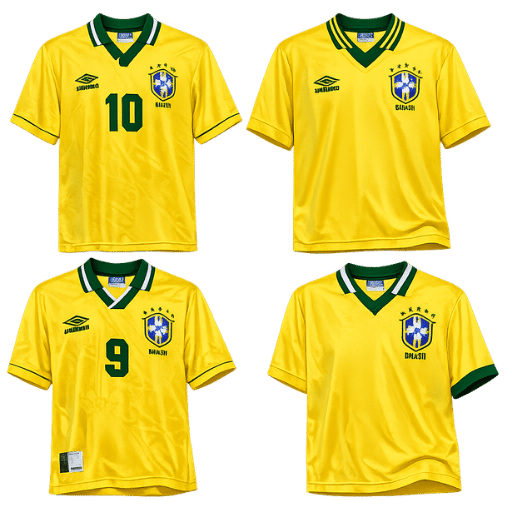
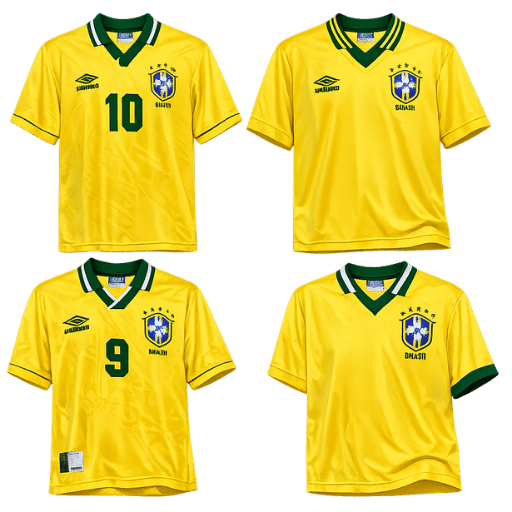
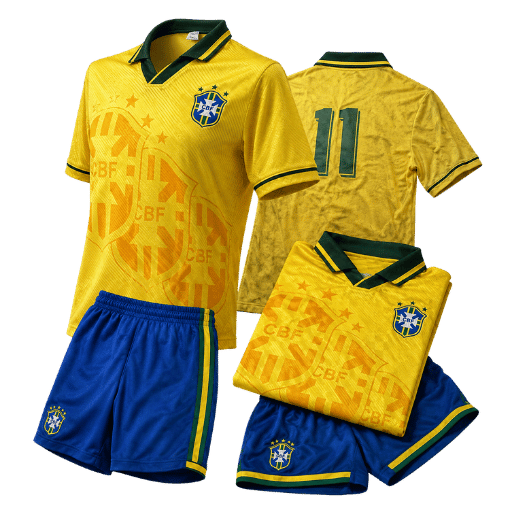
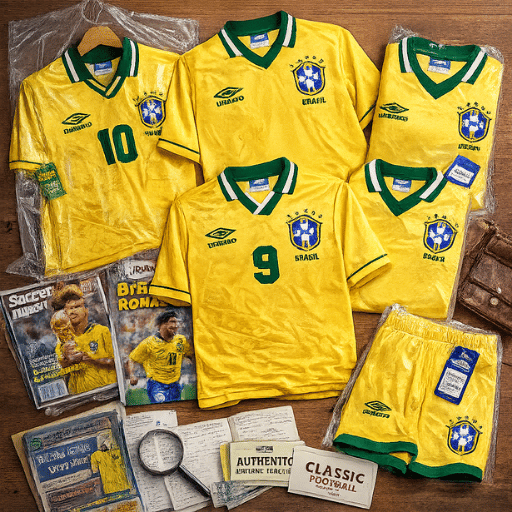
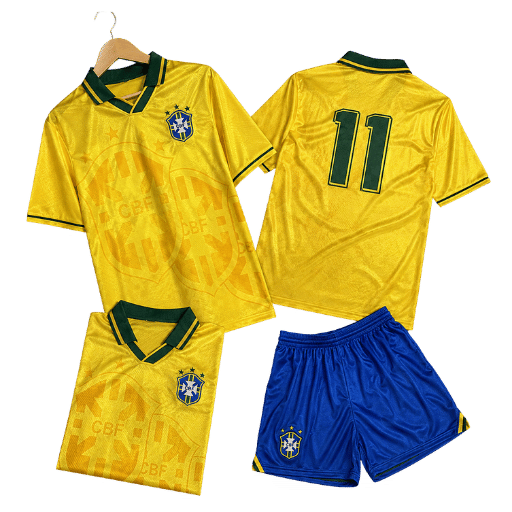
Still searching for your perfect jersey? Explore our best-selling products—we're confident you'll find a style that's just right for you in our diverse collection.
The retro 1994 Brazil jersey belongs to those shirts that carries way more narrative than most collectors presume before embarking on it. Brazil held aloft the World Cup trophy in Pasadena in canary yellow Umbro shirt—and Ronaldo, then 17, sat on the squad bench and never played a single minute. 30 years later, that shirt is one of the most popular vintage jerseys for sale on the collector market. This guide explores its design, its history, its authentication, its values in ²0²5—and the career-creating paradox at the heart of the Ronaldo era.
Why the 1994 Brazil Umbro Jersey Is the Most Iconic Football Shirt of the 1990s
Twenty four years is a long time to wait. In-between the 1970 and the 1994 World Cups, Brazil appeared in five tournaments, and won zero of them. The 1982 team – Zico, Sayco, Falco – remains the gold standard for the finest football team never to have lifted the trophy. Enter: the 1994 US team, of which the team’s official brand Umbro’s canary yellow kit was representative of everything that happened.
The time-period makes this shirt unique in that sense. UK kit manufacturer Umbro had the contract with Brazil for the years 1993 to 1997. Within that time frame, Brazil succeeded in winning one World Cup, in Pasadena, on 17 July 1994. Nike took the CBF kit deal in 1997 and it has not given it up since. That means the 1993-97 Umbro period is the only happening time frame in modern football history when Brazil wore an un-Nike kit to FIFA World Cup success. Nothing similar to this shirt from other time frames exists, and it never will again.
KEY STATISTICS — USA 1994 WORLD CUP
3,587,538 — Game total attendance for the 1994 tournament, an unbroken World Cup attendance record
68,991 — Game average attendance for the 1994 tournament, the all-time record for a World Cup
4th trophy – the four Worlds that Brazil has won:1958 (Sweden), 1962 (Chile), 1970 (Mexico), 1994 (USA)
Amongst shirt obsessives, the undoubted stranglehold that Umbro had with the one-tournament-theoretically-weakest-ever-does-not-means-better-or-worse kits is… X to one. The 1994 Umbro home shirt is never (at least, not yet) as highly prized as the 1970 Topper, but it is always comfortably second on the desire list, ranking ahead of the 2002 Nike and well above the 1998 Nike offerings. Surprising perhaps to those untrained is the fact that buyers and players of shirts prefer this to the 2 years younger R9 France 1998 kit. That is simply because the older shirt is by a brand who no longer supplies Brazil’s kit, is associated with the second World Cup title in a patchy history, and – crucially – is from a slightly older period of a series of willing post-War World Cup winners in comparison to the 1998 Nike shirt, which is considered by the amateur fan market to be “more accessible”- translating directly to “bargain prices” amongst the serious collectors.
The vintage retro football jersey market has a term for what drives value: unrepeatable moments in unrepeatable garments. You can buy a 2025 Nike Brazil shirt today. A genuine 1994 Umbro one — the yellow jersey of the Seleção’s fourth World Cup victory — is a different matter entirely.
Deconstructing the Umbro Design: Every Stitch of the 1993–97 Brazil Home Shirt
The 93-97 design was an obvious progression from the previous years. Umbro replaced the heavier textures of the Topper polyester with a lighter synthetic fabric. The new slim cut fit (aided by the synthetic blends) made the shirt more responsive for a game of football, even in the 8/26 California sunshine of the Rose Bowl. Indeed, one collector analysis from 2026 labelled it as “the most sophisticated Brazil shirt yet.”
Trim: Green ribbed collar, green cuffs, green side trim bands
Collar: Round-neck with green-and-yellow inlay ribbing pattern
Umbro branding: Large diamond graphic applied to left side of chest (embossed on authentic shirts)
Back numbers: Green squad numbers on yellow – heat-applied on retail versions
CBF crest: Raised (embossed) shield on left side of chest, pre and post 1994 World Cup win
Country of manufacture: Several – UK, Portuguese and US retail versions exist as genuine authentic shirts
The Umbro diamond may be something to which purists pay a great deal of attention and complain about. It appears – at times (more often on the pre-Win shirts) – much larger than the CBF shield on this otherwise dignified & subdued shirt. Whether that reads as bold or heavy-handed is a matter of one’s own personal opinion. For authentication though, it is one of the more dependable markers: a buyer can check especially for shape, size & embroidery consistency in the early moments of a transaction.
What Is the Difference Between the Pre-Win and Post-Win 1994 Brazil Jersey?
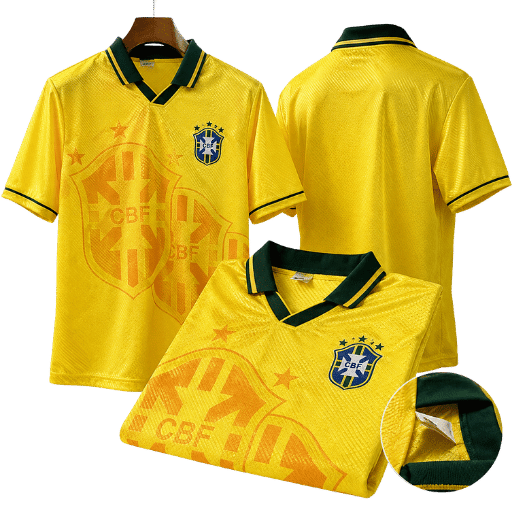
What seems a subtle difference can be a confident basis of knowledge: one that ships and sellers of lesser expertise some times fail to understand and explain fully. The pre-Win version of 93-97 has three stacked CBF shields in the crest: one for each of the three previous World Cup final wins (1958, 1962 and 1970). When Brazil retained their 1994 title on Sunday 17 July of that year, it became necessary to add a further award – incorporating four more shields to the crest and four new gold stars to the band above it.
Both versions of 93-97 are genuine Umbro originals and come from the same contract period. The post-win shirt (from August 1994 onwards) accounts for 90 percent of retail presentation in the subsequent three years, and is what many collectors would term a ‘regular’ 1994 World Cup shirt. The pre-Win shirts are considerably more difficult to come by (though far less well-researched by bidders) yet their difference is apparently incompatible for the untrained eye. Names and numbers are one of the key evidentiary points here.
Collector tip: Count the shields on the chest crest: three for the early (1993-Mid July 1994) or four (Nov 1994-97) for the later. Four extra gold starters are added for a new world cup win. This is most widely accepted as the benchmark for searchers when they see dealers/auctions selling ‘normal’ 1994 Brazil kits.
The Ronaldo Paradox: World Champion at 17 Without Playing a Single Minute
It’s this fact that will pause the conversation for the average football supporter. The penalty box master craftsman – R9, potentially the finest pure striker of the ball of all-time – is a 1994 World Cup winner. He possesses the medal.
It is hanging around some where. He traveled to the US, he was part of the Brazilian training camp while Romario and Bebeto did the goalscoring, and he failed to register even one competitive appearance throughout their seven games in that tournament.
This is not a footnote. It is, rather, the founding contradiction of one of sport’s most dazzling, unique, and inexplicable careers-and it offers a different kind of meaning for anyone collecting this particular shirt. In all ways but number, Umbro jersey’s 1994 version is a garment from the era that held Ronaldo prior to Ronaldo having a designation as what “Ronaldo” actually is; and its contradiction renders it a fascinating, unrepeatable historical moment.
Did Ronaldo Play for Brazil in 1994?
No. Ronaldo Nazario was picked for Brazil’s 22-man World Cup squad by manager Carlos Alberto Parreira and, aged 17, was one of the youngest to be chosen in a Brazilian World Cup travelling party. Parreira didn’t use him in any of Brazil’s seven games, and Ronaldo observed the 0-0 World Cup final against Italy from the substitutes’ bench, with Taffarel making the winning save in the shoot-out and Roberto Baggio sending his penalty over the bar.
The Brazil No9 was a World Cup winner without playing a single minute on World Cup football.
Every year through his career, on count less interview benches Ronaldo looked back to 1994 as the year when it taught him what was what, what high-level competition was. He was there, that was one thing, that year; 1994 was the first time he would understand exactly what was between being selected and being prepared. He was the main player in France four years later.
By 2002 he’d arrived – as the highest scorer, as the key presence going forwards – having taken himself across that finish line that he’d failed to cross at 17. But there had to be the one before. There had to be the Umbro shirt.
One disambiguation worth noting: the Ronaldo discussed in this guide is Ronaldo Luís Nazário de Lima (R9), Brazil’s striker and a two-time World Cup winner. This is a different player entirely from Cristiano Ronaldo (CR7), the Portuguese forward whose jersey market is documented separately.
How Old Was Ronaldo at the 1994 World Cup?
Seventeen. Ronaldo Luís Nazário de Lima was born on 18 September 1976. The 1994 FIFA World Cup ran from 17 June to 17 July — two full months before his 18th birthday. Throughout every squad session, every training day, every match, and through Brazil’s victory in Pasadena on 17 July, he was 17 years old. He remains one of the youngest FIFA World Cup winners in the tournament’s history.
The Champions Who Wore It — Brazil’s 1994 World Cup Squad and What Each Jersey Is Worth
The premium a named shirt commands over a blank equivalent depends on the player, the number, and whether that name is associated with a specific iconic moment. The 1994 squad produced several of those, and collectors pay accordingly.
Player
No.
Role and tournament significance
Named-shirt premium
Romário
#11
5 goals, Golden Ball — tournament top scorer and the defining player of USA 94
25–40% above blank
Bebeto
#9
5 goals; the baby-rocking goal celebration vs Netherlands became one of the most reproduced images in WC history
20–35% above blank
Taffarel
#1
Goalkeeper; saved Baresi and Baggio’s penalties in the final shoot-out — directly won the trophy
15–25% above blank
Cafu
#2
Right back who played in the 1994 final, the 1998 final, and the 2002 final — the most decorated Brazil player of the era
15–20% above blank
Ronaldo
Squad (not issued)
0 minutes played, winner’s medal only. No tournament-issued #9 Ronaldo shirt exists from 1994 — Bebeto wore #9
Reproduction only; no authentic original
Leonardo
#3
Suspended for the final after red card vs USA; his absence reshaped Brazil’s midfield in the decisive match
10–15% above blank
Special note on Ronaldo and the number 9 : a “Brazil 1994 # 9 Ronaldo” shirt will almost certainly be a modern repro; Bebeto took the # 9 shirt in ‘94 – Ronaldo’s affinity for the # 9 came in his club career from 1996 on – at Barcelona and Internazionale – any shirt claiming to be a tournament-issued 1994 Ronaldo # 9 should be taken with extreme scepticism .
For retro jersey collectors building a collection around this squad, a blank post-win original in excellent condition is the classic entry point to this squad. Romário and Bebeto name-and-number shirts are where premiums start to reflect historical significance rather than just the garment itself.
How to Authenticate a 1994 Brazil Umbro Jersey: The 7-Point Collector’s Checklist
How to Tell If a Brazil Jersey Is Real?
Seven details should identify any authentic 1994 Brazil Umbro shirt; the most helpful and simplest to spot are the CBF shield is embroidered not printed, the Umbro diamond application is correct in terms of placement and execution, and internal labelling appears to be from the ’93-’97 range.
If a shirt fails 2 out of the above three, it has a near zero probability of being a period original .
⚠ AUTHENTICATION WARNING
There are no product codes on 1990s Umbro jerseys, so the product code validation widely used to assess 2000s and later Adidas and Nike shirt is not a consideration here. A close physical examination against the guide lines below is the sole reliable method for authenticating period Umbro shirts.
Repros are plentiful on eBay, Etsy and Depop — listed variously as “vintage”, “authentic” or “original.” If a shirt turns up in multiples across many sizes at a price below £40–50, it is almost certainly a reproduction.
CBF crest, embroidered. As with the logo, if you run a finger across the shield, the threads will form a tactile “high” point.If the crest is smooth and untextured, it’s printed and thus likely a lower grade replica or full repro.
Umbro diamond The diamonds appear on the left breast area of the jersey; genuine Umbro jerseys employ sharp and detailed stitching that creates a geometric definition, whilst fakes are often softer-edged, slightly blurry or an incorrect scale, either too big or too small relative to authentic examples.
Internal labelling The jersey’s collar and internal hem typically have size labels present – these will use the UK sizing standard (S, M, L, XL).Shirts with metric-only sizing, or newer-style care instruction labels should immediately trigger suspicion; they are generally 1997 and newer, or repros. Different size variations are available in authentic Umbro versions for different national markets, but all are genuine as long as other elements present are correct.
Material Weight and Texture Original Umbro shirts use a substantial Polyester-Viscose blend (approx. 180-200 gsm) which gives the fabric a decent body without feeling excessively cheap.Any fabric which feels exceptionally thin, or overly stiff and artificial could indicate a repro which has used a different blend.
Stitching Quality When a shirt is flipped inside-out, its construction quality is often very evident. All genuine Umbro produced shirts will have clean, consistently applied stitching, whereas fakes can have ragged edges, uneven tension and misalignments in the seams.
Collar. The ribbed green & yellow in the inlay of the collar is one component that features as one. As the collar inlay is uneven, uneven ribbing and staining would also alert people that need to have a closer look for genuineness – especially if it states “Excellent” condition.
Price context 1994Umbro authentic good condition originals should retail from certified dealers between £80 – 160. If you see shirts at 25-35 having multiple sizes in one lot, know it is not a true 30yo original, genuine shirts available don’t stretch far enough!
Original, Replica, or Reproduction? The 4-Tier Framework for 1994 Brazil Jerseys
Words in this space have got really muddled. Replica is definitely the one used most in error, officially that means a genuine licensed supporter version shirt as produced by original kit maker during the year, not a fake. Reproduction means it was never originally manufacturer made, how closely it mimics the original is largely irrelevant.
Fake means a counterfeit. Knowing it counts as these days as Tier2s & Tier 3s all hold real value whereas fakes & tier 4’s hold nothing
Tier
What it is
2025 price range
Key identifier
Tier 1
Match worn
Shirt worn by a named player in a competitive match; documented provenance required
£500–£3,000+
Provenance certificate, match documentation, player authentication
Tier 2
Authentic original
Retail stock from 1993–97; never worn in a competitive match; produced by Umbro under CBF licence
£100–£400
Period labels, embroidered crest, correct fabric weight, collar construction
Tier 3
Period replica
Officially licensed lower-grade version made by Umbro during 1993–97 for the mass retail market
£50–£130
Umbro label present, but printed (not embroidered) crest; lighter fabric than Tier 2
Tier 4
Modern reproduction
Newly manufactured retro-style shirt; no Umbro involvement; sold as “retro style” or “inspired by 1994”
£20–£55
Modern tags or no tags; synthetic feel; consistently available in all sizes simultaneously
Tier 2 and tier 3 items are in both case authentic period product. They do, however, diverge in their desirability in respect of the used, collected market: you do not consider even a Very Good condition, original Tier 2 to be in the same collected league as a Tier 2 from same time. The genuine article (in respect of the team) increases in value as supply shrinks, whilst a contemporary Tier 3 replica although a legitimate period shirt produced under license when that contract was active…was never designed to match the specs of what the player were wearing when.
Type 4 replicas are legal. In no way are these reproductions considered counterfeit according to criminal law. However, reproductions may not be sold or bought as historical models; as such reproductions hold no value to a collector beyond that the owner of it.
What Is a 1994 Brazil Umbro Jersey Worth in 2025? A Price Guide by Condition
The figures below show estimated 2025 value on the authentic original Umbro replica secondary market (Tier 2) based on ask and sell values seen amongst specialist retailers and collector forums. This does not consider provenance of authentic match-worn Tier 1 shirts, which is often sold at auction or on its own merits rather than a grading.
Condition grade
Description
Typical range (2025)
Mint / Deadstock
Unworn, original swing tags attached, no fading or yellowing
£280–£420+
Excellent (8–9/10)
Light wear, minimal fading, no visible damage or odour
£175–£300
Very Good (6–7/10)
Noticeable but light use; minor fading; structurally intact throughout
£95–£175
Good (4–5/10)
Clear wear and fading; display or casual wear, not a collection centrepiece
£45–£95
Fair (below 4/10)
Significant wear, staining or structural damage; collection filler
Under £45
For comparison: the 1998 Nike Brazil home top, sported by the prime Ronaldo in France, slots below the 1994 Umbro as, per today’s analysis of its condition, the ‘most accessible iconic Brazil piece’ for anyone embarking upon their first World Cup shirt collection – and ‘accessibility’ here also translates into comparative prices. In terms of its perceived market value, a similar range houses the 1982 (Zico, Scrates) and, in its place of honour within collectors’ strata, above them, the 2002 Nike title winner, the ‘simplest and cheapest’ way of attaining Brazil’s best.
2026 timing note: prices for vintage shirts have roughly doubled over the last decade according to senior buyers and collectors, with World Cup years in particular fuelling sharp spikes. FIFA World Cup 2026 will be hosted by USA, Mexico and Canada – only the USA’s second time hosting the competition after 1994. The anniversary already has an echo on 1994 shirt prices. Buyers who hold on to purchase during the tournament usually pay more for a smaller range of options.
Any item listed in condition grades 7/10 or higher ought to be accompanied by photographic evidence of its label, collar and CBF crest condition from any reputable online seller of vintage retro soccer jerseys. Request those images before committing to any significant purchase.
Where to Find Authentic 1994 Brazil Jerseys in 2025: Sources Ranked by Trust
Which means not all purchasing channels expose you to the same level of risk of falling foul of the vintage Umbro originals fraud. Here’s a breakdown of the principal possibilities:
Specialist vintage dealers (best source of certainty). these are the collectors who devote their efforts solely to identifying, sourcing and selling vintage retro football jerseys. They are equipped to determine originals from fakes, identify appropriate conditions and then back their description, and price accordingly – you’re getting a premium value shirt backed by documented fact. At ClassicFootballShirts.se, every vintage shirt is authenticated before listing, with condition grades and label documentation provided as standard.
Well established auction houses (good and generally reliable but eye-watering). If you are targeting a specifically identified Tier 1 match worn jersey, then the relevant auction houses that boast a sporting memorabilia department can offer you documented history, or ‘provenance’, but it comes with an extremely heavy price-tag premium over its market equivalent – it’s worth considering primarily if documented provenance is the major objective.
Ebay ‘Top-Rated’ or ‘Power-Sellers’ (mix, variable). Genuine originals do surface on Ebay from time to time, often at fair prices. Conversely, Ebay also hosts an immense number of replica or outright imitation shirts masquerading under labels that suggest genuine’ originality and retro-look styling. Using the 7-point checklist described earlier will minimise your risk, although checking Ebay ‘feedback’ especially for shirt buying activity rather than global performance is a must. If not provided for you prior, requesting additional labels, collar shots etc. is always a prudent measure.
Etsy (caveat emptor, in spades). This marketplace has everything from private sellers clearing their collection, to dedicated sellers creating brand-new fake ‘vintage’ shirts. The primary giveaway? You’ll find the shirt being sold on Etsy across a spectrum of sizes all at an equivalent and constant price point. This just isn’t feasible when dealing with an original artifact thirty years old and thus a limited supply.
Facebook groups, collector communities (knowledge is king). It’s not impossible for very rare jerseys to exchange hands within collector forums and communities where they aren’t openly advertised. You do run the risk of receiving poorly represented shirts and genuine fakes in these places. Only venture into these spaces if you are confident in your ability to determine authenticity yourself, otherwise, take caution.
RED FLAGS BY PLATFORM
Identical items listed on Ebay in various sizes from the same vendor; vague, and unspecific descriptions in terms of shirt manufacture or specific season; absence of any detail of collar design or label. Items advertised on Etsy at under £40 as an “authentic original;” item displayed alone on a hook, without a label shot. Unwillingness to disclose details about the label’s manufacturer or country of origin.
The Retro Brazil Jersey Market in 2025–2026: Why Timing Matters for 1994 Collectors
An April 2026 report in El País described the retro football shirt market as reaching “a moment where football is something for the luxury class” — shirts have roughly doubled in price over the past decade, with major manufacturers launching retro lines to capitalise on World Cup nostalgia. Collectors who understand the cycle are positioning now, ahead of peak tournament demand.
The logic behind timing for this 1994 Brazil shirt is bizarrely direct. The 2026 World Cup is shared across Canada, USA and Mexico. As the United States, the lead host of the 2026 World Cup, was also the host for the 1994 event it means there is a span of 32 years between the two.
Nostalgia is now stacked upon nostalgia and for Umbro’s ’94 offering it represents precisely the right era football shirt at the very exact opportune moment in the collector’s calendar. The anniversary has fallen precisely during the busiest period in the collector market and shirts that can successfully link together the nation of hosts from 1994, the nation of 1994 winners with the tournament that is currently in motion, are rare.
Search trends are confirming the strategy, too. “Retro soccer jerseys” receives around 14,800 searches monthly in the U.S. and hasn’t moved in at least a year and is climbing towards the 2026 window. “Vintage Brazil jersey” garners 880 monthly searches in the U.S., but it’s growing. Overall, this is a space that generally sees its activity boom in the 6-12 months ahead of a World Cup or other significant footballing event.
BUY TIMING FRAMEWORK — 1994 BRAZIL UMBRO
Now (pre-tournament)
Prices rising but not at peak. Specialist dealers still have selection across multiple condition grades. Best window for buyers who want choice.
During tournament (Jun–Jul 2026)
Peak demand. Prices at their highest point in the cycle. The best condition-grade stock has already moved. Not recommended for value-conscious buyers.
Post-tournament
Demand softens, prices may pull back modestly. Mint and Excellent-grade originals rarely return to market after selling — savings exist mainly on mid-condition stock.
The Argentina 1986 World Cup jersey followed a comparable arc heading into the 2022 tournament — prices moved well before the first match kicked off. Whether it’s a 1970 Brazil or a 1982 Italy shirt, the pattern holds: the pre-tournament window is the entry point, and it closes faster than most buyers expect. With the USA hosting again in 2026, there’s the added factor of a local market enthusiasm that European-hosted tournaments don’t generate.
Frequently Asked Questions
Did Ronaldo play for Brazil in 1994?
No. Ronaldo Nazário (R9) was called up for Brazil’s 22-man squad for the 1994 World Cup and did not make any appearance in any of the seven matches played. The coach Carlos Alberto Parreira never included him in any squad for a match.
He was 17 all through the World Cup and got a FIFA World Cup winners’ medal as a non-playing team-mate.
How old was Ronaldo at the 1994 World Cup?
Seventeen. Ronaldo Luís Nazário de Lima was born on 18 September 1976. The 1994 FIFA World Cup ran from 17 June to 17 July 1994 — two months before his 18th birthday. He is among the youngest FIFA World Cup winners on record.
How to tell if a Brazil jersey is real?
In respect of an original 1994 Umbro top the three strongest points of authentication are: 1) an embroidered (not printed) CBF shield 2) appropriate Umbro diamond position and embroidery quality 3) internal labels typical for the 1993-97 period. Product codes were not printed on Umbro kits from the 1990’s and any attempt to authentication on code is unreliable. Use the 7 point guide above only!
When did Brazil start wearing yellow?
Their yellow kit was a direct reaction to the Maracana loss in the 1950 World Cup final to Uruguay-the ‘Maracazo’. Prior to then, Brazil wore white. The colour scheme was a consequence of a national contest held in 1953 to choose their new canary yellow and green kit which was unveiled in the 1954 Swiss World Cup.
What is the 1994 Brazil jersey made of?
Real 1994 umbro originals come in a light mix of poly-ester – the weight of the fabric itself feels slightly lower and fitting more than that of umbro’s umbro ‘topper” era 80’s era jerseys however not so light that the jersey itself has no “weight”. thin or unnaturally stiff jerseys have different base fabrics being sold on the web.
What is the difference between the pre-win and post-win 1994 Brazil jersey?
The pre-win (March 1993 to July 1994) version of this jersey features three CBF shields embroidered into the crest on the left chest of the jersey, depicting three of Brazil’s prior World Cup titles. Since Brazil won their fourth World Cup title on July 17, 1994, it also sports four CBF shields and four gold stars above the crest. Both jerseys are originals from Umbro; the post-win version is the version typically used by collectors when referencing “the 1994 Brazil shirt”.
What is a 1994 Brazil Umbro jersey worth?
True Umbro original of a good condition (6-7/10) you can buy them around £95 to £175 from specialist dealers and up to £175 to £300 when looking at excellent, mint or deadstock. Player shirts, that is, Romario’s shirt #11, or Bebeto #9’s Shirt, you can sell for between 20-40% on top of any other same conditions that don’t feature any printing/label.
What is the difference between a “player issue” and a “fan issue” jersey?
A Player Issue Shirt is made to the specifications of those on the squad – usually using a lighter weight of fabric with some details heat transferred rather than embroidered and with a more form-fitting feel. A Fan Issue shirt, or replica, is the official on-sale version available in the shops which is usually made to a slightly lower specification although still a genuine Umbro product of the time. Both of these Shirts have a collectible value with Player Issue shirts now being very highly sought after in the 1994 Umbro Shirt collectible market.
I write about football jersey fit and when different shirt styles make sense. My articles cover youth goalkeeper sizing and long-sleeve jerseys, helping players and families think through comfort, movement, weather, and the role of the shirt before they buy.