Still searching for your perfect jersey? Explore our best-selling products—we're confident you'll find a style that's just right for you in our diverse collection.
Conventionally, an adult soccer game is 90 minutes long, split into two 45-minute halves. But how long is a soccer game, measured from kickoff to the final whistle? Add halftime and stoppage time and determine if the competition uses extra time or penalties to resolve a draw.
Updated October 2026
A soccer game has 90 minutes of regulation time. With a 15-minute halftime, the starting total is 105 minutes before stoppage time. Knockout rules, shootouts and delays can extend the finish.
What changes your finish time?
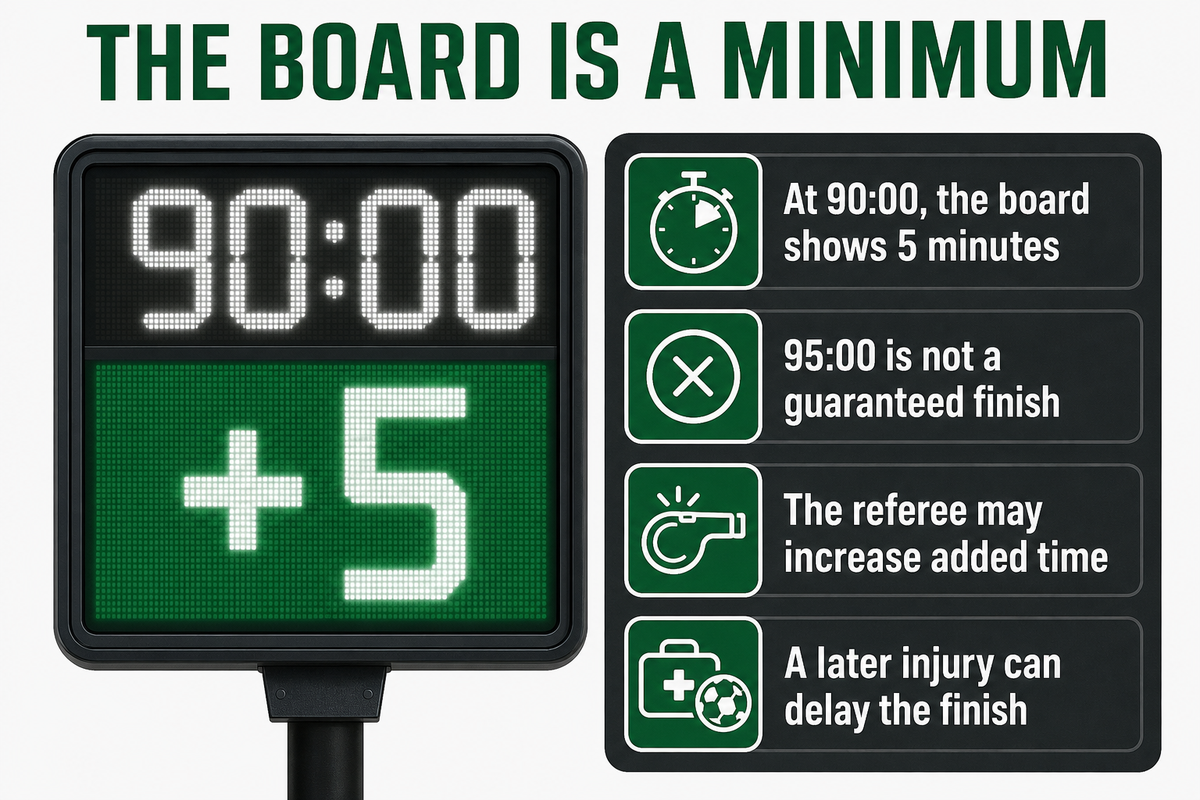
The added-time board shows a minimum, not a deadline.
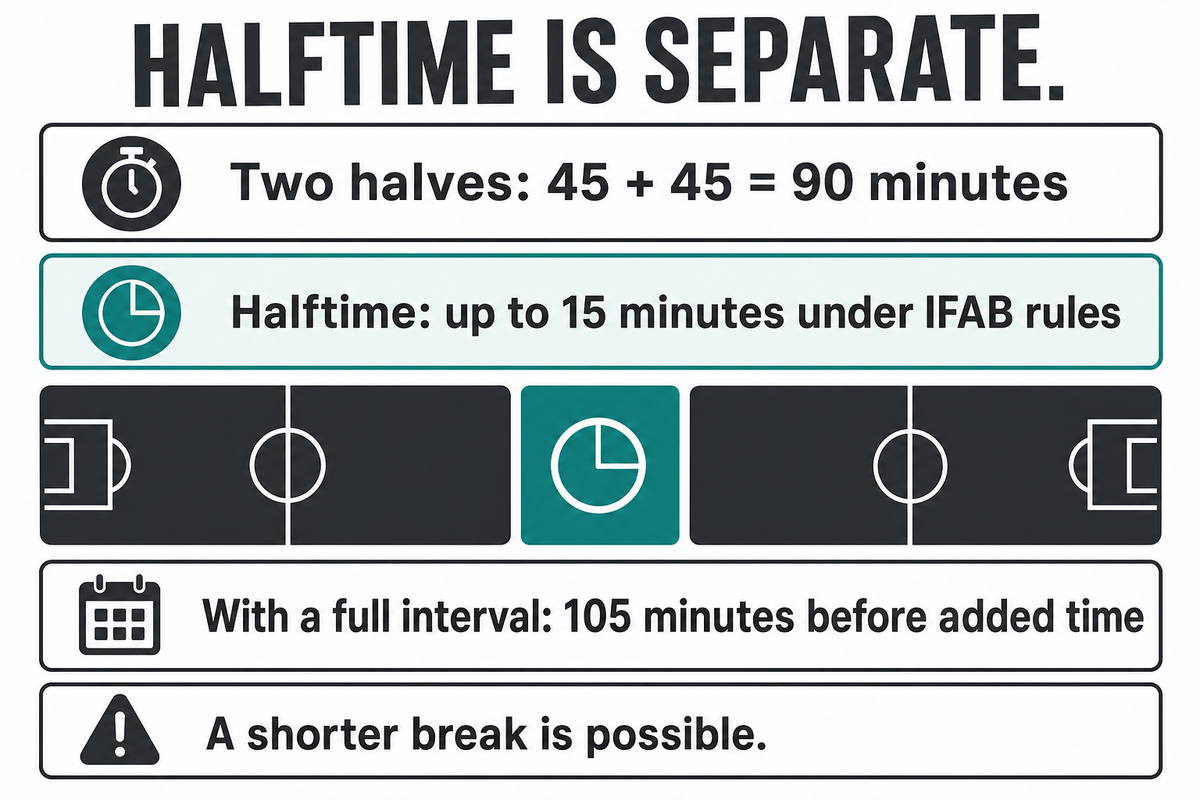
Halftime is separate from the 90 minutes of play.
A tied score doesn’t always mean extra time.
Youth and school competitions set their own game lengths.
How long is a soccer game in real time?
For a professional soccer match with a 15-minute interval, you have 105 minutes plus stoppage time from the start. The 90-minute match length describes two halves of 45 minutes, not the whole viewing window. Watching a soccer game on television may include pregame and postgame segments; a stadium visit includes time for entering and exiting the venue.
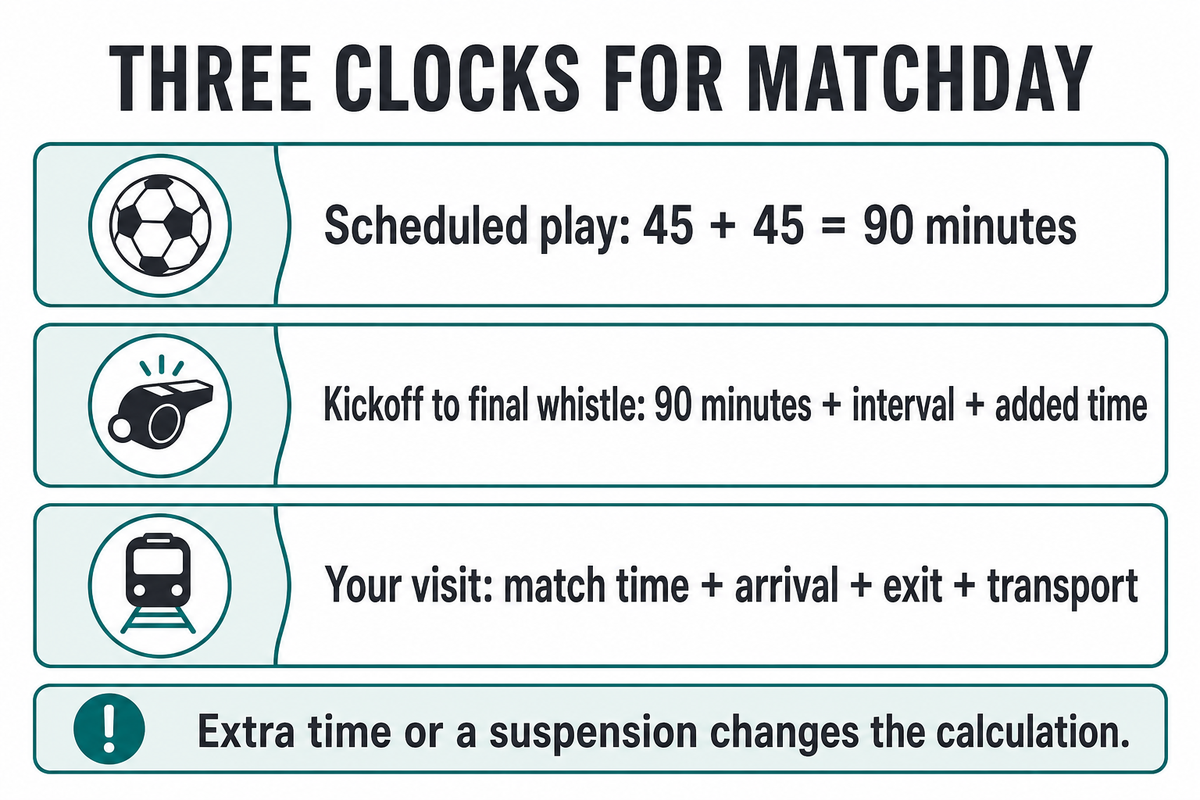
90-Minute Match, Three Clocks
Plan to take into account your arrival time, the elapsed duration of the match, and your whole visit.
Three clocks for planning a soccer match
Clock
What to count
Limitations
Scheduled play
45 + 45 = 90 minutes
Excludes halftime and added time
Kickoff to final whistle
90 minutes + interval + added time
Extra time or a suspension changes the calculation
Your visit
Match time + arrival + exit + transport
Venue and service details must be checked separately
Suppose kickoff is 3:00 p.m., the first half has 3 minutes added, halftime lasts 15 minutes and the second half has 5 minutes added. The calculation is 45 + 3 + 15 + 45 + 5 = 113 minutes, giving a 4:53 p.m. finish. Those added-time figures are assumptions, not typical values or a forecast. Interruption of the match may also extend the total time.
How long is halftime in soccer?
IFAB limits halftime to 15 minutes in a match governed by its rules, the Laws of the Game. The interval is stated in the rules of the competition and a shorter break is possible. The break sits between the two halves and doesn’t count toward the 90 minutes. A match with a full 15-minute interval therefore starts at 105 elapsed minutes before added time.
See how long halftime lasts in youth matches or short-format events. A parent’s pickup calculation should use that event’s interval, rather than automatically adding the professional halftime allowance. IFAB Law 7 provides separation of periods of play from the halftime interval.
Why does stoppage time go beyond 90 minutes?
Stoppage time in soccer makes up for time lost during each half. The game clock in soccer generally continues through interruptions. To account for stoppages, the referee adds time at the end of each half. The allowance is for time lost due to substitutions and goal celebrations, as well as video reviews. The additional time is part of that half and isn’t a separate period for breaking a tie.
“The additional time may be increased by the referee but not reduced.”
If the board shows 5 minutes at 90:00, you can’t conclude that 95:00 is the end of the half. More time is added when another injury delays play; stoppage time is referred to as injury time too. A penalty kick awarded before the half ends may also require time for completion. The referee decides how much time to add; the stadium clock can’t tell you exactly when the game ends.
The listed 90 minutes do not mean the ball was moving for every second.
What are the extra time rules in soccer?
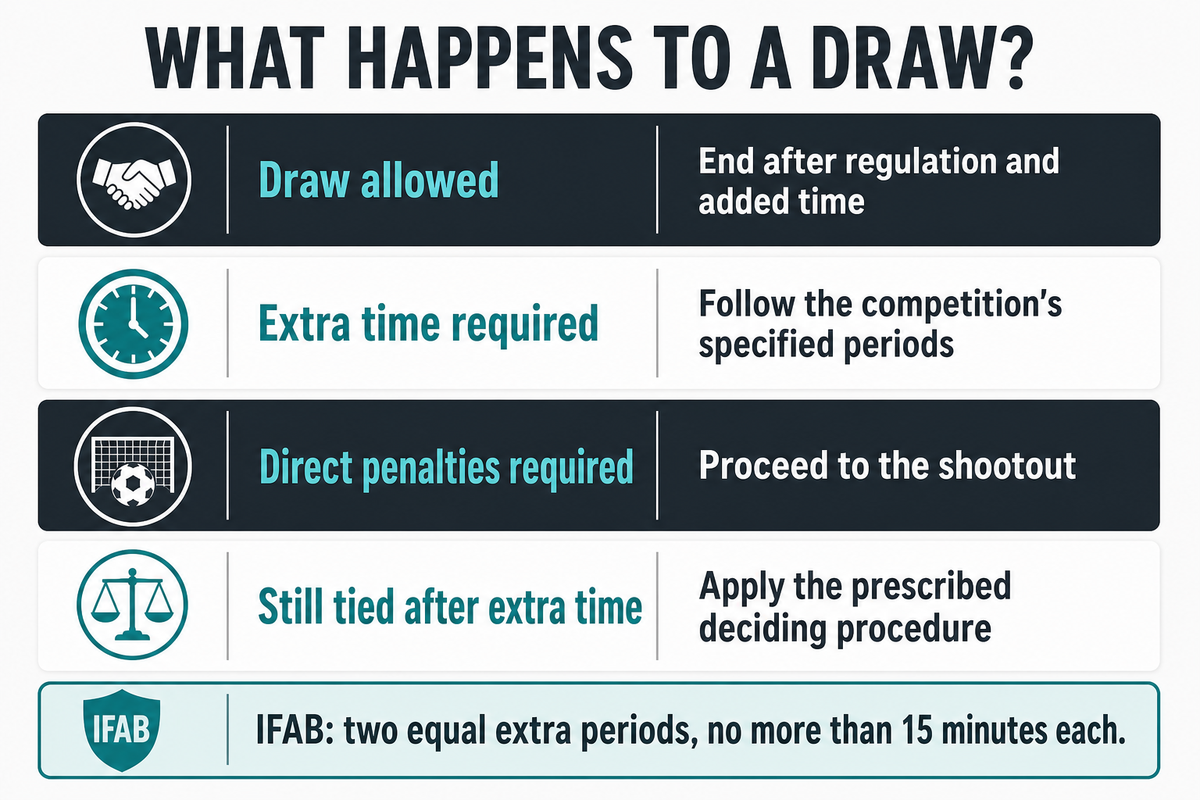
Whether a match goes into extra time depends on what the competition rules say when teams are tied at the end of regulation. IFAB permits two equal additional periods of no more than 15 minutes each when a winner is required. Not all draws stand; some competitions use extra time if needed to determine a winner. Cup tournaments can use different procedures in different rounds. Potential extra time and penalty kicks can resolve a tie; check what’s allowed in the particular round before setting aside time.
Finish-Time Branches
Follow the competition’s tie-breaking procedure before deciding how long to keep watching.
What happens when the game is tied?
Competition rule
Next step
Planning consequence
A draw is allowed
Match ends after regulation and added time
No extra 30-minute period
Extra time is required
Where the rules specify 30 minutes of extra time, extra time consists of two 15-minute halves
A full period brings scheduled playing time to 120 minutes, excluding breaks and added time
Direct penalties are required
Proceed to the shootout
Do not add an extra-time period that will not be played
Still tied after extra time
Apply the prescribed deciding procedure
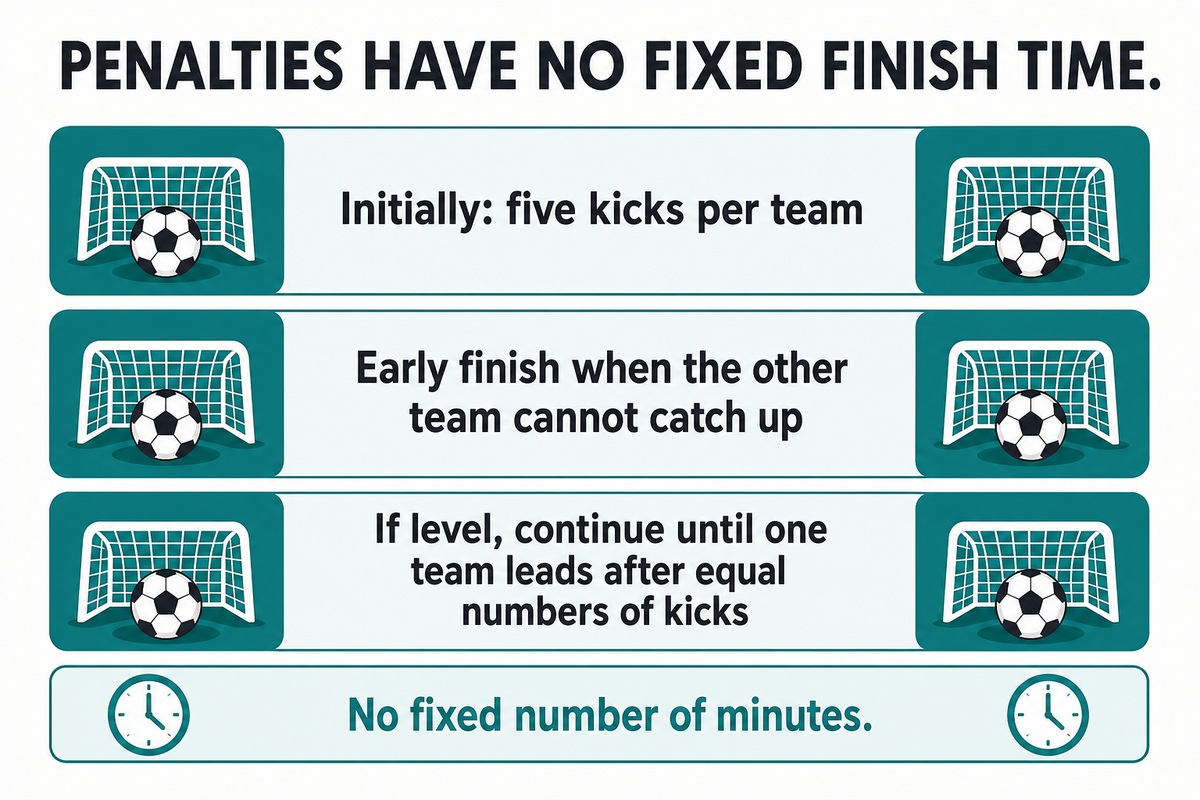
A penalty shootout has no fixed finish time
Stoppage time and extra time account for different things. One accounts for lost time, and the other is used to determine a winner. IFAB Law 10 lists the allowed methods. “Overtime” is the common American term, but schools and colleges should check their own rules.
How long does a penalty shootout take?
A penalty shootout ends when a winner is declared. A winner isn’t declared at the end of a set number of minutes. Each team initially takes five kicks, subject to an early finish when the other team cannot catch up; if the scores remain level, kicks continue until one team leads after both have taken the same number.
A shootout can end before all ten initial penalty kicks are taken. If the teams are still tied afterward, sudden death doesn’t mean that the first successful kick automatically wins. The second team has the opportunity to kick the ball. Setup and decisions make a “ten more minutes” estimate unreliable.
How long are youth soccer games?
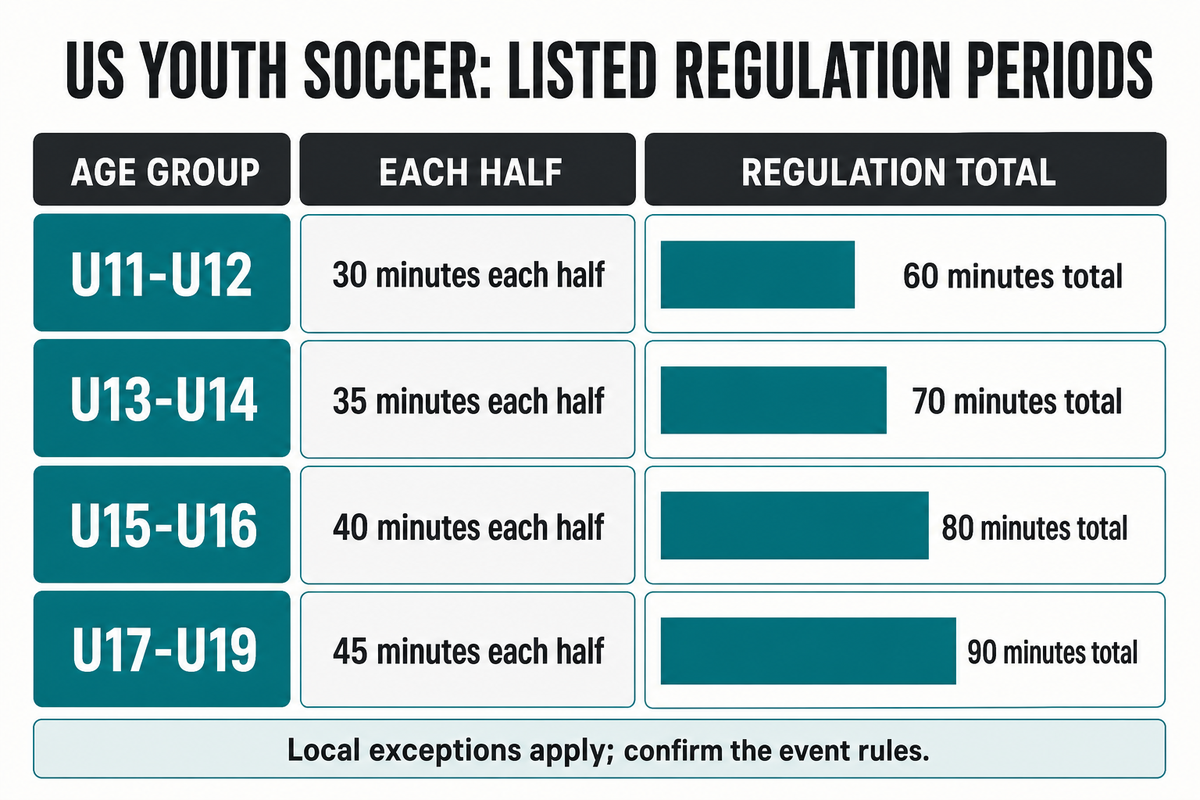
Youth soccer games vary by age group and organizer. The policy below from US Youth Soccer outlines regulated lengths from 60 to 90 minutes for U11-U19, with exceptions by the organization and its state associations. Use the policy as a named reference, and confirm with the rules for your child’s event.
US Youth Soccer Rule 303: listed regulation periods
Age group
Each half
Regulation total
U11–U12
30 minutes
60 minutes
U13–U14
35 minutes
70 minutes
U15–U16
40 minutes
80 minutes
U17–U19
45 minutes
90 minutes
The June 2026 policy doesn’t create a worldwide youth game length. Under its table, moving from U16 to U17 adds 10 regulated minutes. Talk to the organizer about halftime, overtime, and modifications to the tournament.
How long is a high school soccer game?
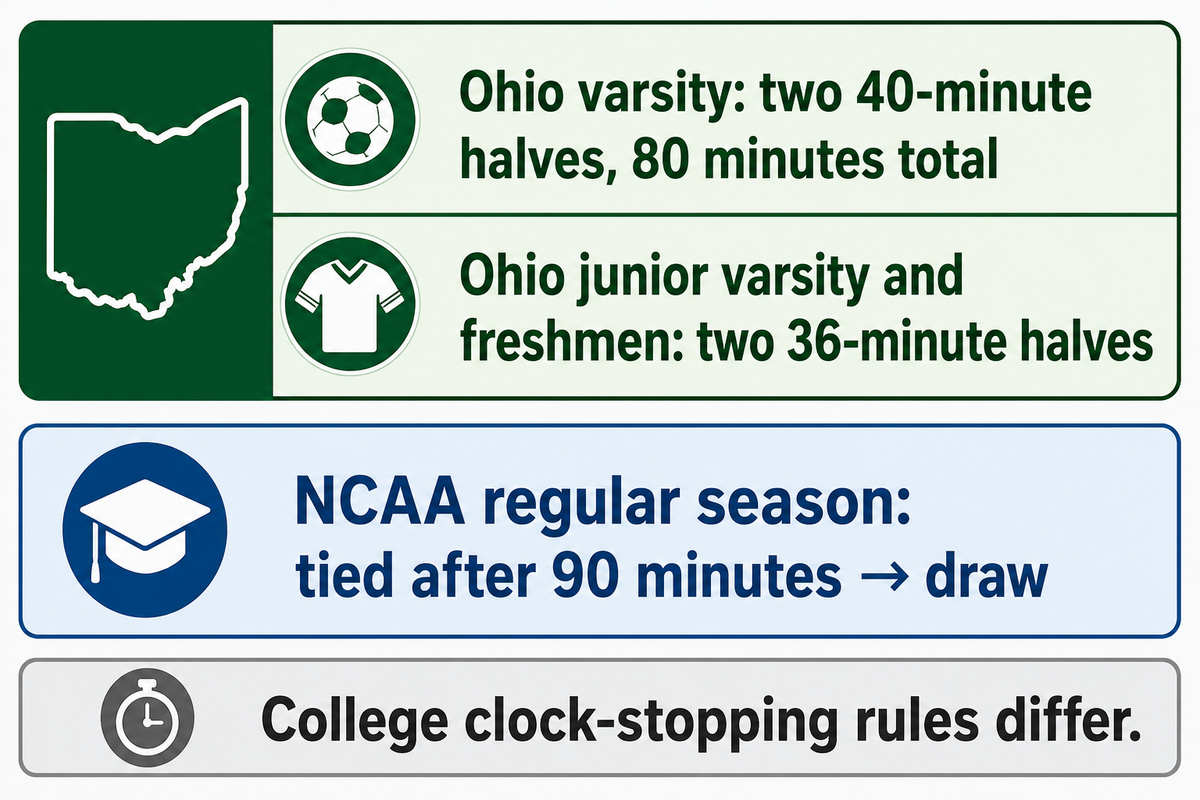
A high school soccer game’s duration is determined by the governing association and level of the team. A good example is the state of Ohio. Ohio provides a concrete example: For varsity games, the duration is two 40-minute halves, totaling 80 minutes. Its junior varsity and freshman games use two 36-minute halves. The state provisions shouldn’t be used for every school competition.
The Ohio High School Athletic Association regulations also distinguish regular-season draws from tournament overtime. Therefore, no varsity schedule can establish the game length or the tie-breaking method for a freshman schedule.
College soccer has other rules. NCAA regular-season games tied after 90 minutes finish as draws. The NCAA’s 2024 amendments restored postseason sudden-victory overtime. College clock-stopping rules also differ from the professional running-clock model, so a pro-match finish estimate can’t simply be transferred to campus.
How much time should fans set aside?
Start a viewing plan with the advertised kickoff, the scheduled halves and the interval, then leave room for added time and the competition’s tie-breaking route. Consider a scheduled window of time a personal allowance, not a guaranteed finish, and be prepared to wait for unexpected delays.
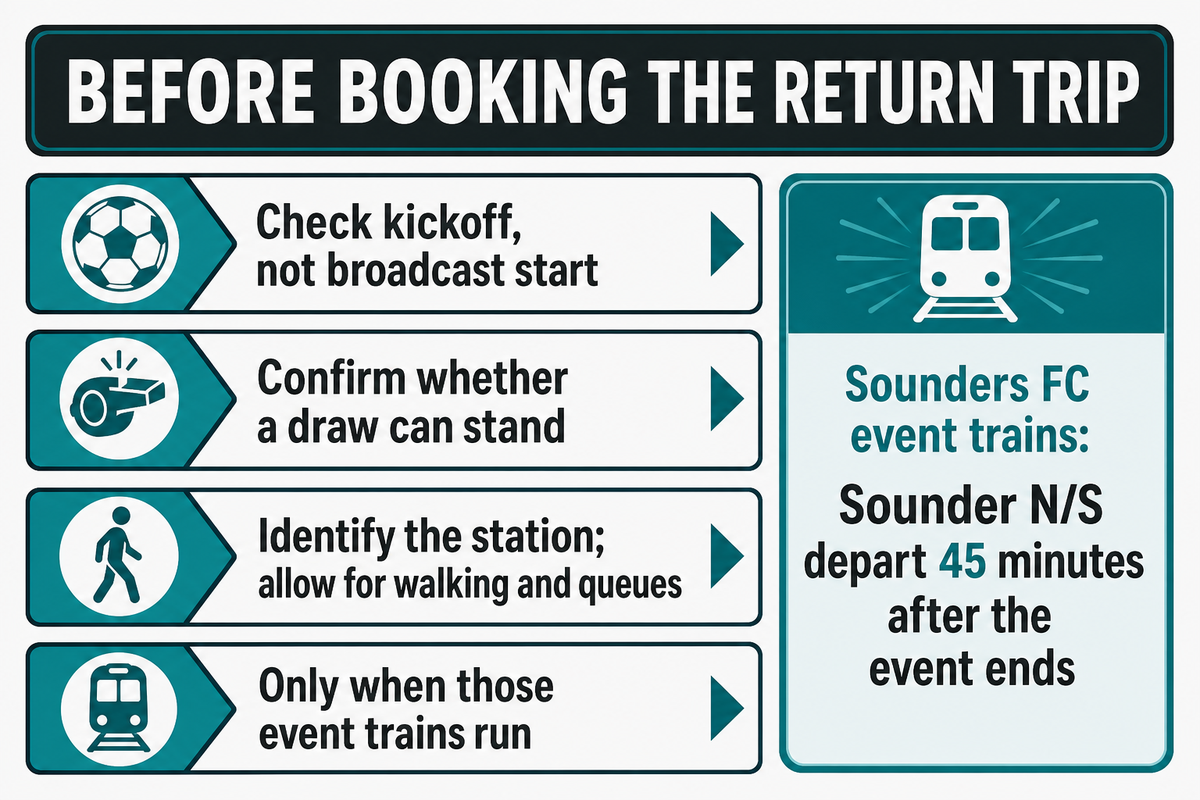
Before making another booking: Check kickoff rather than broadcast start, whether a draw can stand, and whether your return transport has a fixed departure or an event-linked schedule.
How should I plan a return train after the match?
Be prepared to estimate the end of the match and account for whether the train is scheduled to depart relative to the final whistle of a match. Read the operator’s event notice, identify the station and allow for walking and queues.
For example, Sound Transit says its special Sounder N Line and S Line trains for Sounders FC depart 45 minutes after the event ends. That applies when those event trains run, not to every Seattle service or every match.
For a hypothetical 3:00 p.m. knockout, a 5:00 p.m. train may clash with extra time before you even leave the stadium. Check a later or flexible service against the operator’s timetable. No universal “stadium exit buffer” can account for your seat, route and crowd conditions.
How long is a World Cup game?
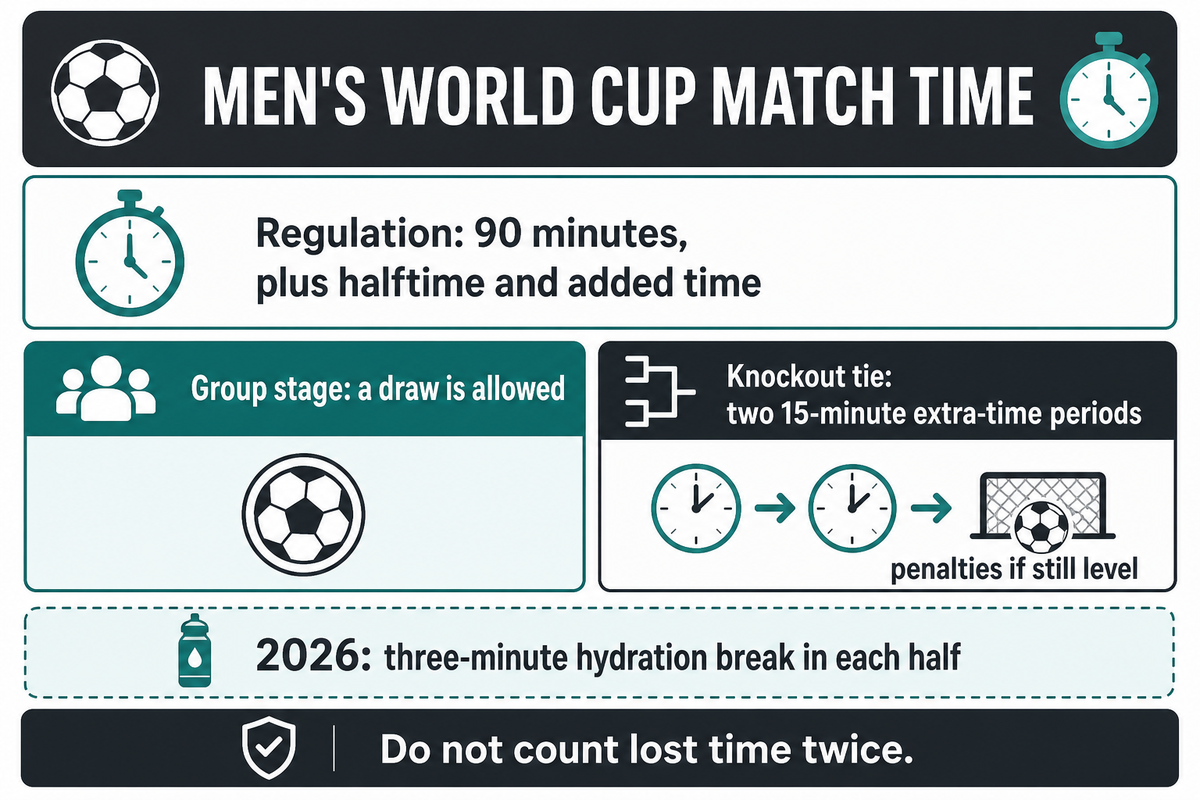
A World Cup soccer match has 90 minutes of regulation time and halftime and added time. A draw in the group stage is acceptable. In the men’s World Cup knockout stages, if a game is tied after 90 minutes and its added time, play continues through the two 15-minute extra-time periods. Penalties will follow if the scores are level at the end of the periods. The stage and score determine how long a soccer game lasts. A World Cup match listing doesn’t fix the duration of the game.
For the 2026 World Cup, FIFA announced three-minute hydration breaks in each half around the 22nd minute regardless of weather conditions. The duration of a soccer game’s regulation periods remained the same, despite those tournament-specific breaks.
Don’t add a break twice when estimating the finish; stoppage time accounts for all relevant time lost. For the next tournament, check the break and tie-breaking rules, rather than automatically assuming the 2026 arrangement will be in effect.
Frequently asked questions
How long is a soccer match including halftime?
90 minutes plus the interval and added time
With a 15-minute halftime, an adult match reaches a baseline of 105 elapsed minutes before stoppage time. The referee’s allowances in both halves extend that total. Extra time, penalties or an unusual interruption can make the event longer still. Use the competition’s format and the actual kickoff when planning; 105 minutes isn’t a promised final-whistle time.
Does every tied soccer game go to extra time?
The competition decides the next step
No. A soccer league may allow a draw, while a cup round may require a winner. Where a winner is required, the competition specifies the permitted deciding procedure. That can include extra time, penalties or a combination. Check the rules for the exact competition and round before adding 30 minutes to your viewing plan.
How long is a soccer game for 16-year-olds?
Check the registered age group and organizer
Under the cited US Youth Soccer table, U16 games have two 40-minute halves, while U17 games have two 45-minute halves. A player’s age alone doesn’t establish which competition format applies. Confirm the registered age group, local rules and halftime interval with the organizer before arranging pickup. Other organizations can prescribe different lengths.
Does the clock stop for substitutions?
The timing system matters
In the usual professional running-clock system, substitution delays are accounted for in added time. College and school rules may stop the clock in specified circumstances.
Can a soccer game last more than three hours?
Three hours is not a universal limit
Yes. A prolonged suspension, a delayed restart or an extended shootout can stretch the event. A viewing allowance can’t guarantee when an interrupted match will finish.
Timing rules here come from the named governing bodies and transport operator. The 113-minute calculation is an illustrative example with chosen inputs, not a measured average of all matches. Local competition and event notices take precedence over this for your fixture.
I write about football shirts in use and in club history. My articles compare training and match-day jerseys and revisit memorable Mohamed Salah Liverpool shirts, helping readers connect fit and purpose with the players and moments that made a kit familiar.