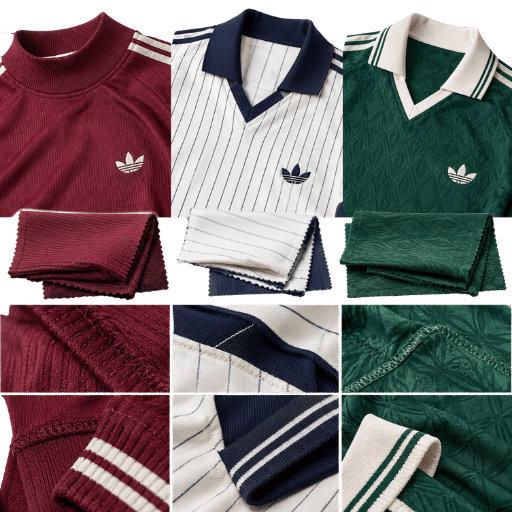
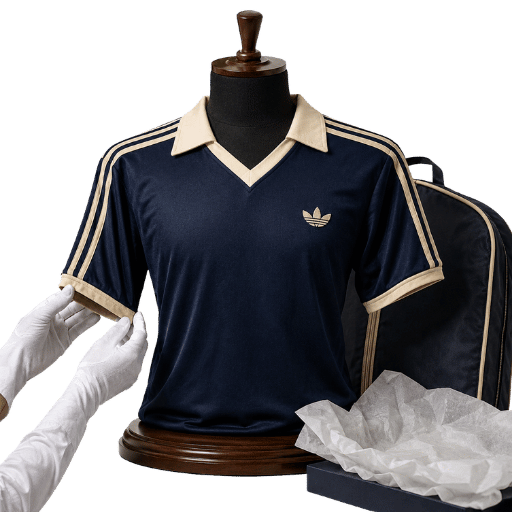
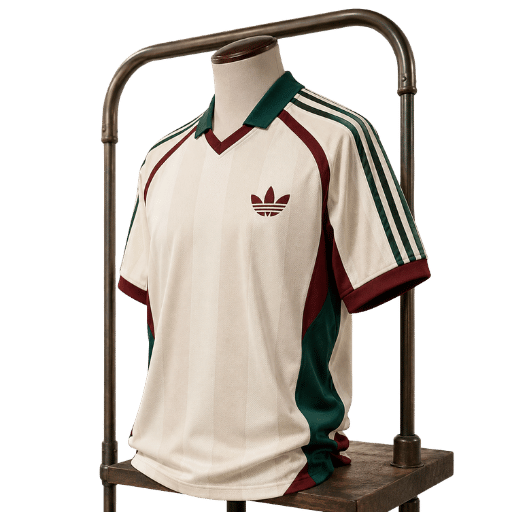
Still searching for your perfect jersey? Explore our best-selling products—we're confident you'll find a style that's just right for you in our diverse collection.
Updated June 2026 Reviewed by the Classic football shirts team
Vintage Adidas Trefoil football shirts identification is the skill of confirming a kit is a genuine 1972–1991 Adidas football shirt, and it comes down to one habit: always read the shirt, not just the badge. vintage Adidas Trefoil football shirts are original football kits (1972 to 1991) featuring the iconic three-leaf Trefoil logo of when adidas actually used it on playing kit – and not a lifestyle tee or a brand’s later logos. The snag in 2026 is that adidas re-introduced the Trefoil this year – so any logo alone doesn’t prove an old shirt is aged, rather it points to its lineage. So, as ever, this guide help identify the exact adidas age group, date a tag, and authenticate your kit using our five zones.
Simply put: An original, vintage adidas trefoil football shirt is a kit from 1972-1991 wearing the Trefoil, identified by country and tags rather than the actual badge design. Since adidas is back using the Trefoil on 2024 football shirts and other playing gear, any trefoil shirt will potentially be new – so its age comes from labels and construction, not badge choice.
Quick Specs: The Trefoil at a Glance
Logo shape
Three stylised leaves bisected by three bars (the “Trefoil”)
Designer / launch
Credited to Hans Fick, 1971; presented by adidas, 1972
Football-kit era
c. 1972–1991 (last World Cup outing 1994)
1991–2024
Lifestyle only (Adidas Originals) — not match kits
Returned to football
2024/25 third kits; 2026 World Cup away kits
What Counts as a “Vintage Adidas Trefoil Football Shirt”?
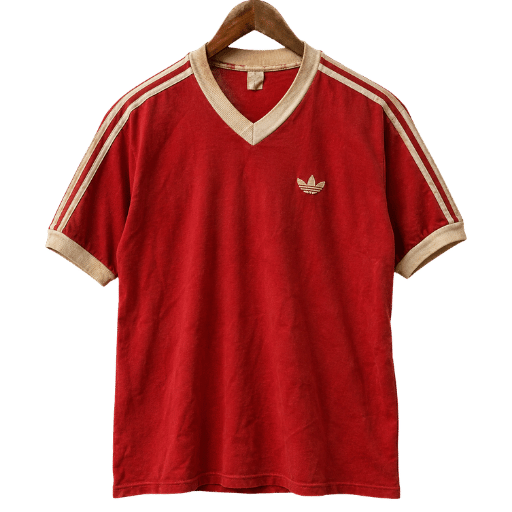
A vintage Adidas Trefoil football shirt is an original team kit made roughly between 1972 and 1991, when Adidas put its three-leaf Trefoil on the actual playing strip. It is not a modern Adidas Originals lifestyle tee, and not a 2024–2026 reissue — both wear the same badge, but neither is a period match shirt. Era, country of manufacture, and tags settle it, not the logo.
If you would rather skip the guesswork, our range of vintage retro soccer jerseys is authenticated before listing.
The vintage adidas trefoil football shirt is an original training-style jersey bearing the three leaf trefoil, dating back to the adidas period when it was worn as the official football kit trademark. One key mistake when learning how to identify these pieces is ignoring the history behind the Trefoil. That badge has appeared and disappeared throughout the decades as adidas used and stopped wearing the mark for different reasons – three times in fact, as part of its playing kit iconography. A quick field habit avoids the costliest mistake here: decide which of three buckets a shirt sit in before anything else, because the same three-leaf logo appears on all of them. At Classic Football Shirts we sort every incoming shirt this way first, since a 1985 match jersey and a 2025 reissue can look near-identical in one thumbnail photo.
German sports powerhouse adidas (founded by Adolf Dassler in 1949) has employed four recognisable adidas football club kit logos over the years, and the adidas trefoil logo is just one of them; knowing the difference between these is the first step when identifying a vintage adidas trefoil shirt:
Trefoil (three leaves) -original football team logo; used approximately 1972-1991.
Equipment / “bars” — introduced when adidas dropped the Trefoil on new performance wear; approximately 1991 onward.
Performance “mountain” (three angled bars) -from late 1990s-on;dominant performance logosfor the adidas kit collection.
Trefoil Reissue -asimilar three-leaf badge; on contemporary adidas kitand Originals (new Adidas sportswear range).
therefore,a new T-Shirt emblazoned with the trefoil worn from adidas high-street retail stores isn’t a vintage shirt but an adidas Originals sportswear item; however, a playing football kitfrom a team in a club jersey from 1980-1990s isa genuine vintage football kitandare worth considerably more than a modern kit bearing a trefoil logofrom a current adidas club team playingin a league (2024-2026 kit reissues). If buying this itemtoday, your safest approach is from sellers that authenticate authentic vintage and modern playing kits -like our range of authentic vintage adidas trefoil football shirts.
💡Key takeaway
vintage refers to an authentic playing kit from adidas in the Trefoil era. It goes without saying that, as the trefoil logo has been reintroduced by adidas on playing kits, the origin now depends on when it was manufactured — which is where the tags come in.
Spotting the right adidas logo is step one: an old-school Trefoil throwback can be a genuine vintage football shirt or a modern reissue, and only by combining the tag, badge and stitching signs can you be sure which adidas trefoil shirt you are holding.
The Trefoil Era Map: Dating Your Shirt by Logo and Design
Once you’ve nailed down that the shirt wear a Trefoil the next step is to establish “since when?” The Trefoil Era Map provides a concise tool to plot any shirt on the production window in using the logo treatment, the badge placement, and tag wording-in combination, not using the logo treatment on its own.
The Hans Fick Correction
Everywhere you’ll read that the Trefoil was “designed by Adi Dassler in 1972.” This is only half true. The Trefoil is actually attributed to adidas designer Hans Fick, with the adidas itself dated to 1972 when it announced the launch of thismark that “was here to stay.” Since these two dates are real-one is the design, the other the launch-then it’s possible to locate a Trefoil shirt with a date anywhere after 1972. Having a solid grounding for the mark’s origins is essential since counterfeiters and unscrupulous sellers perpetuate the inaccuracy.
The 9-Row Trefoil Dating Map
The Trefoil Dating Table: how a vintage Adidas Trefoil football shirt shifts by era category across four tells.
Era category
Typical Trefoil treatment
Tag wording / country
Registration mark
1972–74 early
Embroidered Trefoil, often paired with a separate brand wordmark
Woven script tags; “Made in West Germany” / France
Modern care labels; Asia-made (Cambodia/Vietnam/Indonesia)
May be absent on some reissues
2026 World Cup
Trefoil away kits — first WC return in 36 years, brand new
Modern care labels; Asia-made
May be absent
Synthesised from design-history and vintage-label dating conventions; treat each row as a cross-check, not a single pass/fail.
Moving down the table, you’ll see a shifting pattern from country of origin – from West Germany and the rest of Europe to Asian manufacturing; and the often assumed guarantee of a registration mark, that, over time, became more optional-this exactly is why relying on a Trefoil shirt badge can be completely unreliable, because as it barely changed, the information surrounding it did.
Decode the Tags: Neck Labels, Country of Manufacture and Product Codes
Reading labels by era is a discipline in itself, which is why resources like the Vintage Fashion Guild label archive exist; the registered-trademark mark beside the logo ties back to the same trademark history.
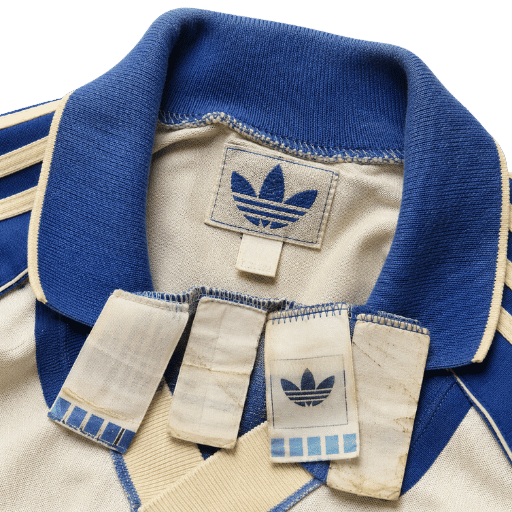
Inner tags hold the real information about the dating of a Trefoil shirt. You’ll want to consider these in the order that they’re presented-brand tag, the wash and care tag, country of manufacture tag, the article code tag, and the registration mark; the combination of these will help you determine the plausibility of a given shirt with minimal inspection of the outside of the jersey.
How do you check an Adidas jersey code?
To check an Adidas jersey code, find the printed style and article code on the inside collar or the wash-care tag, then search it online — a genuine modern shirt returns matches for that exact kit. Codes range from a six-figure number to a few letters followed by a four-digit string. One catch: this really only works on adidas shirts made after roughly 2000.
Many vintage-era 1990s and earlier adidas shirts predate this coding system, so a missing code, or one that simply doesn’t come up during a web search, doesn’t automatically indicate the jersey isn’t a genuine vintage adidas shirt. In those cases you need to pay even more careful attention to the country of manufacture, construction, and language on the garment’s tag. A few of adidas’s shirts since the early-to-mid 2000s will have a small authenticity tag, sometimes known as a ‘jock tag’, on or near the bottom hem – a helpful extra clue – but the style of that tag changes with the product design, so not having one shouldn’t cause concern with older adidas shirts.
“Product codes are simply invaluable when trying to identify a fake shirt. I’ve never come across a fake that’s used the correct product code.”
Phil Delves, Head of Content, Football Shirt Collective
Country of manufacture is the second huge tell. A shirt pre-1990 in “West Germany” is in fact possible; in the same period, kits also appeared in France, UK and other areas in Europe. That means using the country as a consistency check against which specific club shirt should be-a guide not a strict rule. What it can’t be is recent. A “Made in Cambodia”, “Vietnam”, or “Indonesia” tag mean it’s a recent shirt, not an 80s classic. Reading labels carefully is a discipline in itself, with the vintage Fashion Guild tag archives being proof because tag wording style changed with time. this logic extends tobrandstoo; you might be familiar of our guide to fabric used in vintage soccer jerseys which deals with the material part of the problem.
📐 Collector’s Note
The presence or lack of small, or in this case, next to, the Trefoil & brand names is merely another point of reference, a way of testing against an existing, ‘true’, specimen – it isn’t an official finding. Some of the official reissues omit the registered-mark which the genuine shirt match the “shirt of Lulu” carry, therefore one must assume that its presence, in the original, is a welcome assurance and its absence, in the “vintage shirt”, worthy of further investigation. Treat it as one of many indicators, not conclusive evidence of itself.
The 5-Zone Authentication Sweep: Spotting a Fake
So how do you know if it’s genuine? The truth is, if you check for these 5 features one after the other and 2 or more don’t pass (that red flag) then you should walk away. The Trefoil has five distinct physical zones. These are the zones in which fake adidas football shirts will often fail, making the 5-Zone Authentication Sweep a checkable action instead of a gut feeling. Do remember to weight the zones together and don’t hang up your hat on one particular feature.
The 5-Zone Authentication Sweep: five checks that separate a genuine vintage Adidas Trefoil football shirt from a fake.
Zone
What a genuine shirt shows
Red flag
1. Trefoil construction
Clean, evenly spaced leaves; tidy embroidery or crisp print
Letters “having a party” — drifting, overlapping, trailing stitches
2. Three-stripe alignment
Parallel stripes, consistent width and spacing
Tapering, wonky or wrongly angled stripes
3. Neck and wash tags
Era-correct fonts, country of manufacture, team-specific wording
Bleeding colours, lifting vinyl, off-centre or wrong-font crest
5. Stitching and fabric
Straight seams, locked threads, age-appropriate fabric hand
Loose threads, puckered seams, fabric too uniform for its age
Construction is made synthesized out of collectors’ authenticity process – the weights 1, 3, 5 have to make the greatest dependency of really old shirts.
One to remember from genuine Trefoils: the paired-up “d” in adidas; on the genuine version it won’t extend into the angled stripe corner unlike fakes which will appear as though its welded onto it. If a collector is sourcing an ’80’s Trefoil shirt from an FC from an obscure second division club found online and its image displays sharp Zone 4 characteristics but the washing-label is a modern-script and shows a Cambodian factory (Zone 3 fall), and a Trefoil which presents its bottom leaves merging slightly into each other (Zone 1 fall) two or more of these results should get you walking away- even if it looked like a Bargain on first glance. The order is the critical part – zones 1, 3 and 5 are where fakes will look like to be save some money, and are the zones that take age in to account.
✔ What the Sweep proves
Whether construction, tags and prints are internally consistent
Does its shirt country & format matches its shirt age”””
Whether the logo and crest meet adidas’s production standard
⚠ What it cannot prove alone
Match-worn status (needs provenance / certificates)
A flawless high-end fake passing every visible zone
Exact year without cross-checking the kit’s known release
On brand-by-brand and Club specific traps compare it with how you distinguish fake vs genuine club soccer jerseys of vintage for that matter and how to spot a fake Man-Utd Soccer jerseys as the same logo flaws are repeating amongst other Clubs.
In addition to the logo and tags, the shirt itself should feel correct for its claimed age. the parameters below are formed from collector’s practice rather than scientific testing and so should be considered trends rather than precise guidelines – you’ll find some variation across different clubs, suppliers and seasons.
A 1980s match shirt often a heavy, single layer polyester with an embroidered or woven crest and screen-printed sponsor details that may show cracking over time. Late 1990s shirts are becoming lighter more breathable with mesh panels and more often feature heat pressed graphics. Distinguishing points for identification lie in what’s consistency not what feels right for its size alone: an 80s shirt that feels like a light weight ‘body-mapped’ 2020s performance jersey should put you on alert and a crest that appears heat pressed on a shirt which should feature some form of embroidery is another one of the significant warnings. Wear and age tell their own story – vintage shirts in good nick show slight bleaching and fade in the brighter colours, old prints show slight cracks and anything that looks too ‘perfect’ for a 40 year old garment ought to raise suspicion. And watch out for sizes – the old school medium shirts from the 1980s for example are, when compared to modern medium sized items often surprisingly small and short for their labelling, so judge size against the era, not against the labels alone. Held against a known original in practice, a genuine 1985 shirt usually feels heavier in the hand than a 2025 reissue, and its crest is stitched rather than heat-pressed.
💡Pro Tip
Make the construction match the age before getting excited by the design, check the construction fits the advertised period – vintage shirt age (if its labelled), crest method, weight and natural age should all be consistent.
If you are lucky enough to become the owner then follow our guidance on caring for and keeping your vintage jerseys safe and well looked after once they arrive home.
Common Mistakes Collectors Make
Most bad buys trace back to a short list of repeated errors, and knowing them is half the protection. On the ground the costliest mistake we see is treating any Trefoil as old: because the logo ran on lifestyle gear from 1991 to 2024 and then returned to kits in 2024, a 30-second glance at the badge alone tells you almost nothing about whether a shirt is a genuine vintage original or a brand-new reissue. At Classic Football Shirts we treat the badge as the last thing to check, not the first. Collectors feel this in practice at resale, where the risk is real money: a shirt bought as a 1980s original but later identified as a 2025 reissue can lose most of its value, because rarity can’t be faked after the fact.
The five traps
Treating a Trefoil garment as a football shirt. Far most Trefoil t-shirts sold are lifestyle casual wear adidas Originals items, rarely actually played in.
Believing that Trefoil = old clothes. Adidas’s latest matchday kits are fully up to date – from the 2024-2026 seasons they’re brand new!
Assessing a buy based solely on the logo. The design on the breast has changed only subtly over the years whereas the labels provide the true proof of the garment’s authenticity.
Mistaking a 90s ‘big logo’ leisure wear jersey for a genuine matchkit The fit and cut differ, the labels differ, the badges differ too.
Taking ‘BNWT deadstock’ at face value. A thirty year old match shirt can scarcely arrive perfectly clean and unused with its original tags.
These errors get expensive because the counterfeit market is enormous and professional. UK Border Force has intercepted more than £500 million in counterfeit goods at the border, with fashion among the most demanded categories, and US Customs and Border Protection reports that wearing apparel sits among the most-seized counterfeit categories. Football shirts are a known target: an investigation by The Athletic reported a single league anti-counterfeiting programme seizing 400,000 fakes worth £28 million in one season. So when a deal feel too cheap for a genuine vintage shirt, the base rates say it probably is.
What Makes a Vintage Adidas Trefoil Shirt Valuable
What makes a vintage Adidas Trefoil shirt valuable is a short list: condition, rarity, and a link to a famous club, era, or player. A crisp 1980s match shirt with correct tags beats a mass-produced reissue every time, and a verified 1980s shirt often sells for several times the price of a 2025 reissue of the same club.
If a shirt make it through the gate of identification and verification, value can distill down to a few key ingredients. Looking through auction results and what savvy collectors focus on, the common denominators are condition and rarity, enhanced by iconic club or tournament significance, the specific era, and connection to a famous player or competition. A rare 1980s Trefoil match shirt, from a beloved kit and in crisp condition with appropriate tags, will always take precedent over a mass-produced reproduction. On the ground the gap is wide, because rarity and provenance can’t be reprinted: a verified 1980s match shirt often sells for several times the price of a 2025 reissue of the same club. At Classic Football Shirts we weigh condition, era and authentication together before pricing, and the difference between honest 40-year ageing and a suspiciously mint shirt is frequently the difference between a fair price and an expensive mistake.
Rarity – A limited release of productions, small club affiliations or one-season designs can dramatically influence desirability.
Condition – Some level of patina acquired over time is acceptable; however, the presence of holes, significant fading or repairs will negatively impact its value.
Provenance – Having documentation of game wear, a match worn history, or a clear lineage can command a premium over a simple replica.
Icon factor – Association with a celebrated player, club, or major tournament adds immense value.
To understand which shirts collectors pursue with the most ferocity, this roundup of iconic 1990s football jersey designs illuminates just how potent a combination of era and icon factor is what makes a piece desirable.
Industry Outlook: The Trefoil’s Football Comeback
This is the single greatest shift for potential shirt buyers: The return of the Trefoil to professional football has complicated rather than clarified dating methods, meaning that premium value has now migrated to verified pre-1991 originals. Since the market is being flooded with a surge in new Trefoil product, the logo has effectively lost its role as a quick age verification tool, and any vendor attempting to market based on the logo alone is inevitably, whether deliberately or unknowingly, muddying the waters between an original 1980s shirt and a contemporary 2025 version. Where this bites in real buying: at Classic Football Shirts we now watch shoppers mistake a 2024 or 2025 reissue for a 1980s original because both wear the same three-leaf mark. Risk has grown for one blunt reason — arithmetic, since the supply of genuine pre-1991 shirts is fixed while adidas added 5 new Trefoil club kits in 2024 and a fresh wave of away kits for 2026, so the safe use case is to treat the logo as decoration and the tags as the real evidence of age.
The comeback is concrete and dated. In August 2024, adidas brought the Trefoil back for the third jerseys of five major European clubsArsenal, Manchester United, Bayern Munich, Real Madrid and Juventus. For 2026, adidas is returning the Trefoil to the World Cup for the first time in 36 years on the away kits of its partner federations. Search interest reflects the renewed attention: demand around “vintage adidas” and “adidas trefoil” has held steady while the broader retro-shirt market is widely described as buoyant in 2025, those market figures are directional context, not the headline.
Practical buying advice for 2026 stems directly from the supply side. Genuine pre-1991 Trefoil match shirts are finite in number, while the supply of newer models is expanding rapidly. For serious collectors rather than those interested in wearing the garment, focusing on tags, country of manufacture, and construction-rather than merely succumbing to the novelty of the comeback-is essential, and one should only pay the premium for shirts with undeniable provenance from the original era of football.
Frequently Asked Questions
Q: How do you identify an original Adidas shirt?
View Answer
Start with the inner tags before you ever glance at the front of a potential adidas shirt. Check that the brand and wash tags use era-appropriate fonts, that the country of manufacture corresponds accurately with the stated age, and that the article number or style code can be cross-referenced online against contemporary listings. Those tags carry more truth than the badge does.
After verifying those details, carefully inspect the logo and three stripes to ensure they are clean and properly spaced, and that any crest or sponsor print is sharp and crisp. One hallmark of an authentic shirt is the consistent application of these markers across the entire garment, where as fake typically reveals a discrepancy some where in this process.
Q: How can you tell if vintage Adidas is genuine?
View Answer
Run a five-zone check: Trefoil formation, three-stripe formation, collar and wash labels, emblem and branding, and material and seams. Label each zone red, or OK. An authentic vintage shirt will possess a sharp logo, correctly detailed period-correct labels, feasible manufacturing origins, and accurate materials and ageing according to their period.
Any two red flags or more – most typically generalised “adidas JSY” tags, a modern factory stamp on a ‘dated’ shirt, or a slightly misshapen Trefoil’s letters not properly defined – and it is time to pass.
Q: How do you verify an Adidas football shirt?
View Answer
Authenticate an adidas football shirt across three completely distinct criteria: their labels (brand, care, country and code), visible construction (logo, stripes, crest, seams), and a confirmed issue from the manufacturer for that team and particular year. Search for the shirt’s article code among modern adidas shirts, compare with images from genuine official sources, and sense-check the price and the seller.
In terms of any older vintage shirts which will potentially not have any product codes, you are best off using as much as possible from the text in the tags to identify the manufacturer and year of manufacturing, alongside an analysis of construction, whilst selecting sellers who are more likely to certify them before listing.
Q: When did Adidas stop using the Trefoil on football shirts?
View Answer
Around 1991, when the Equipment logo was introduced, it largely withdrew the Trefoil from the sport of football, with its last match appearance taking place at the World Cup in 1994. Although the Trefoil’s last football appearance was in 1994, it continued to be featured on casual, non-sport specific clothing, and subsequently, from 2024, returned to professional sports kit.
Q: Are the new 2026 World Cup Trefoil kits “vintage”?
View Answer
This cannot be true. Although the team will be playing in teams featuring the Trefoil on their away kits at the 2026 World Cup, these kits are modern recreations, not original vintage versions, although they do adopt some of the old logo design. They are modern manufactured items with current adidas branding; vintage only refers to originally-produced Trefoil items produced roughly between 1972 and 1991.
Q: Are reissued Trefoil shirts worth collecting?
View Answer
Yes, this is possible but for quite distinct reasons. Official reissues along with the adidas Originals pieces are affordable and available for general wearing along with adidas Originals clothing pieces which will be labelled by vendors who carry them; this makes for a less riskier purchase. If your aim is to invest long-term, it is, however, preferable to search for the authenticity of the original pieces. The original and the earlier Pre 1991 produced match-worn shirts hold the rarity value, due to provenance which will have a bearing on their long term value on the market.
Buy Trefoil shirts that are already authenticated
Avoid the hassle of searching for yourself; every single item that’s available in our vintage range is fully inspected and assessed before we make it available. With that in mind, you’ll never be faced with purchasing a fake when ordering a vintage item, due to all authentic vintages being clearly labeled by manufacturers, so you’ll receive your shirt with everything that it should come with.
This is in an effort to provide information for a topic that’s frequently asked about our range; “is my shirt shirt from the 2026 World Cup a vintage”? In answer, there’s simply no way of telling how to work this out yourself, so instead, we would prefer to supply a quick guide. The dating timeline, sequence for the label examination and 5-zone method in this document correspond to how we inspect vintage’s prior to accepting them for sale, right here at Classic football shirts, where we’ve a huge passion for vintages and retro jerseys dating back to 2013. Checked over by the experts in charge of authenticating every kit that passes through Classic Football Shirts, teams included.
I write about football jersey fit and when different shirt styles make sense. My articles cover youth goalkeeper sizing and long-sleeve jerseys, helping players and families think through comfort, movement, weather, and the role of the shirt before they buy.