Still searching for your perfect jersey? Explore our best-selling products—we're confident you'll find a style that's just right for you in our diverse collection.
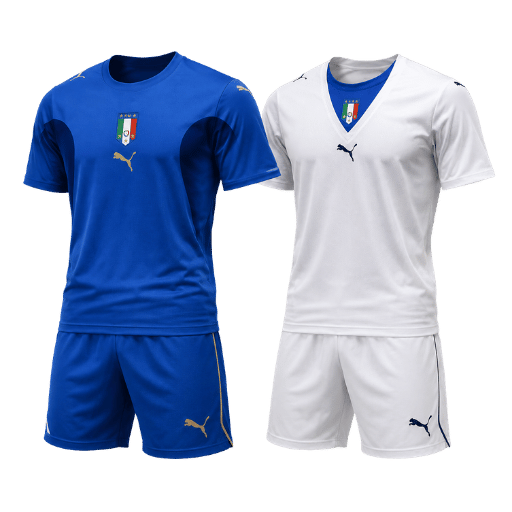
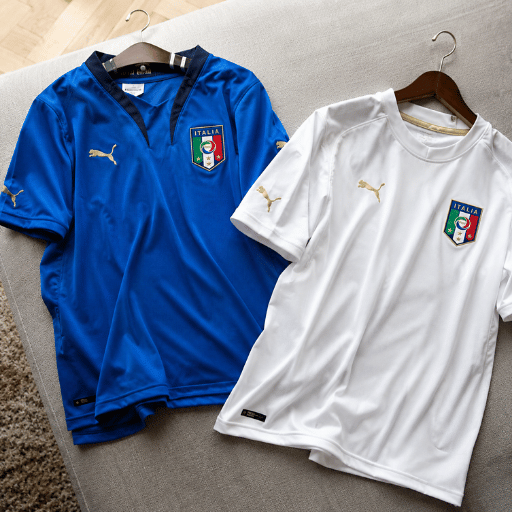
The Italy 2006 World Cup jersey comes in two versions that fans mix up constantly: the blue home shirt and the white away shirt. Knowing the difference matter, because Italy lifted the trophy in Berlin wearing the blue home kit, yet the white away shirt is the one many collectors struggle to find. This guide compares the two side by side, shows which the Azzurri actually wore on their run to the title, and explains how to tell a genuine shirt from a reproduction before you buy.
Kit At a Glance
Year / tournament
2006 FIFA World Cup, Germany
Manufacturer
Puma
Home kit
Savoy-blue (azzurro) shirt, white shorts, blue socks
Away kit
White shirt with blue trim
Result
Champions — Italy’s 4th World Cup title
Stars on the crest
3 during the tournament; a 4th added after the win
Key names
Buffon, Cannavaro, Pirlo, Totti, Del Piero, Materazzi
Italy 2006 Home vs Away Jersey, At a Glance
At a glance, the two kits are easy to separate: the home shirt is Savoy blue and the away shirt is white. But the differences run deeper than colour, and they affect both how a shirt is identified and what it’s worth. Each row below sums up the practical contrasts a buyer actually uses.
Feature
Home jersey
Away jersey
Base colour
Savoy blue (azzurro)
White with blue trim
Maker
Puma
Puma
Crest
FIGC badge with World Cup stars
FIGC badge with World Cup stars
Worn in the 2006 final
Yes — Italy wore blue in Berlin
No
Iconic status
The “winning” kit
Scarcer, less recognised
Typical availability
More common as replicas
Harder to find genuine
Does the kit change between home and away matches? Yes. In international football a team wears its first-choice (home) kit by default and switches to the away kit only when colours clash with the opponent. Italy’s blue rarely clashes, so the Azzurri wore blue for most of 2006, including the final, and the white away shirt appeared mainly as a backup. That single fact explains why the blue home shirt is the one most people picture when they think of Italy in 2006.
The Home Jersey, Azzurro Blue
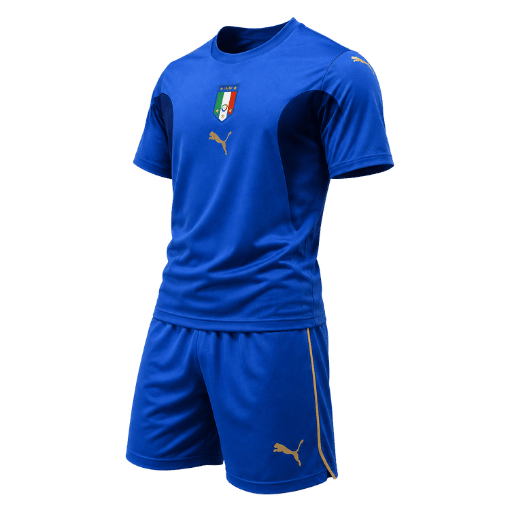
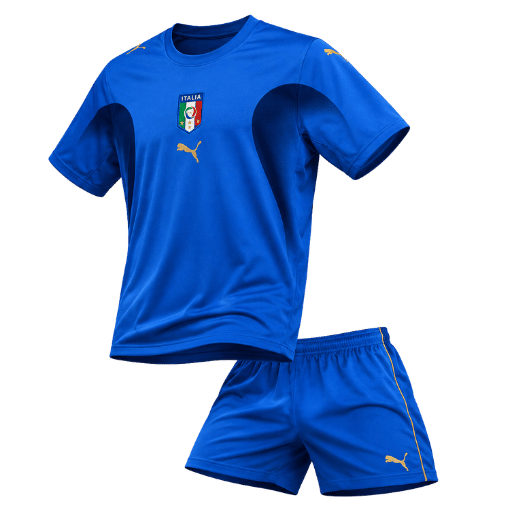
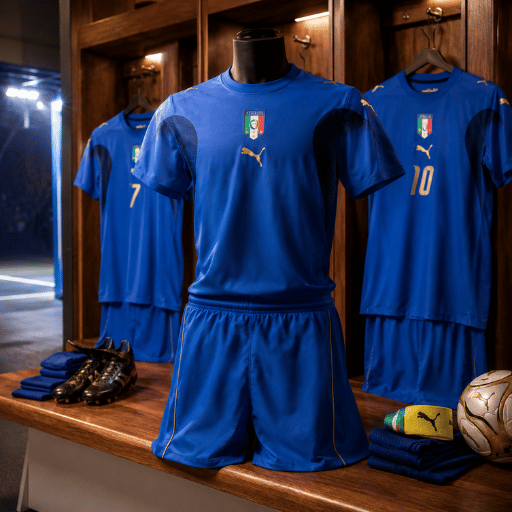
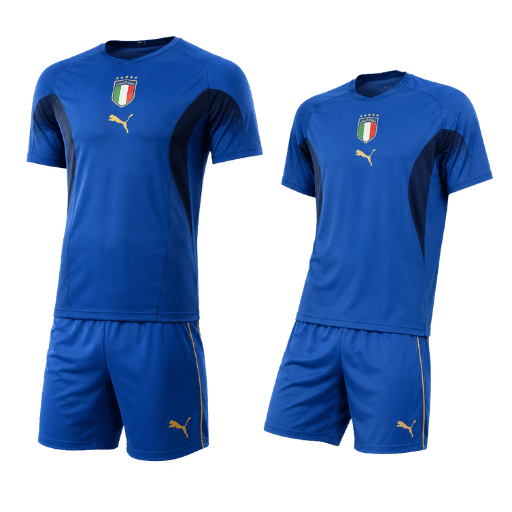
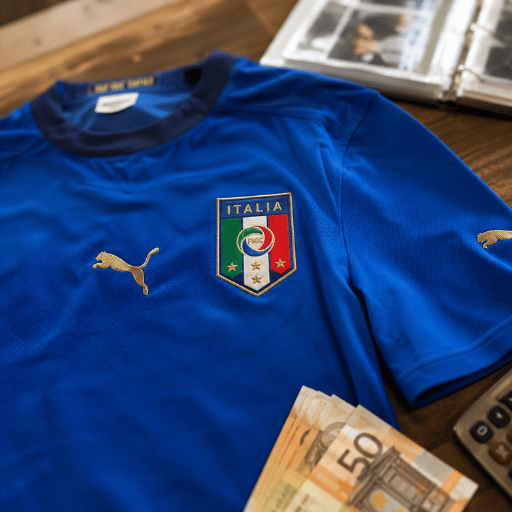
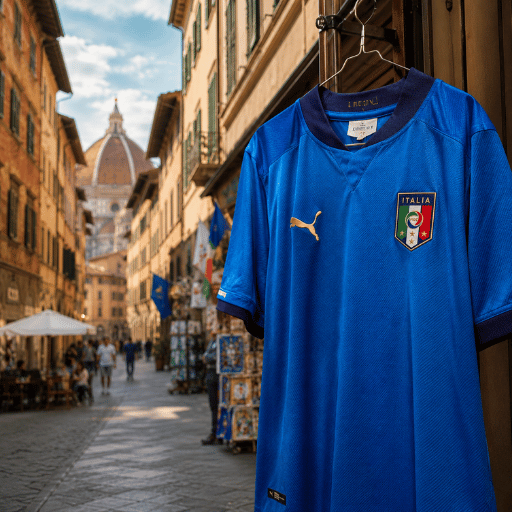
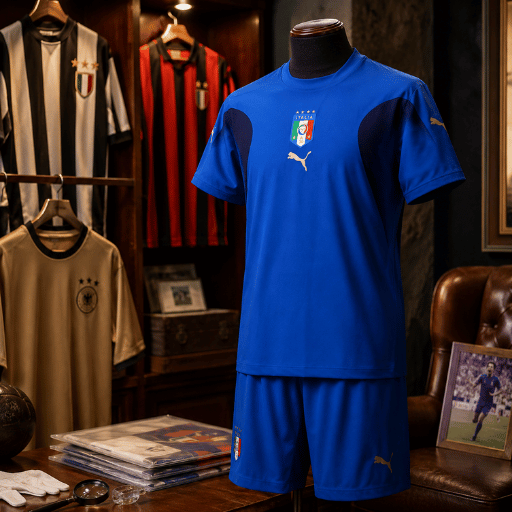
At the heart of the Italy 2006 World Cup jersey story sits the home shirt: a clean, Savoy-blue Puma design with white shorts and blue socks, carrying the FIGC (Italian Football Federation) crest on the chest and the Puma cat logo opposite it. There’s no shirt sponsor, national-team shirts don’t carry commercial sponsors, which keeps the front uncluttered and is part of why the kit has aged so well.
Why blue at all, when the Italian flag is green, white and red? That blue comes from the House of Savoy, the royal dynasty that ruled the Kingdom of Italy from 1861 to 1946. According to Wikipedia’s entry on Savoy blue, this azzurro shade has represented Italy’s national teams since their first international, against Hungary in Milan on 6 January 1911 . So the blue you see on the 2006 home shirt isn’t a marketing choice, it’s more than a century of national identity stitched into the fabric.
📐 Collector’s Note
On a genuine 2006 home shirt the Puma logo and FIGC crest are applied cleanly, embroidered or heat-pressed flat, not thickly printed. Look for a true mid blue (azzurro), not navy and not royal. Anything that reads navy under daylight is usually a later season or a reproduction.
The Away Jersey, Classic White
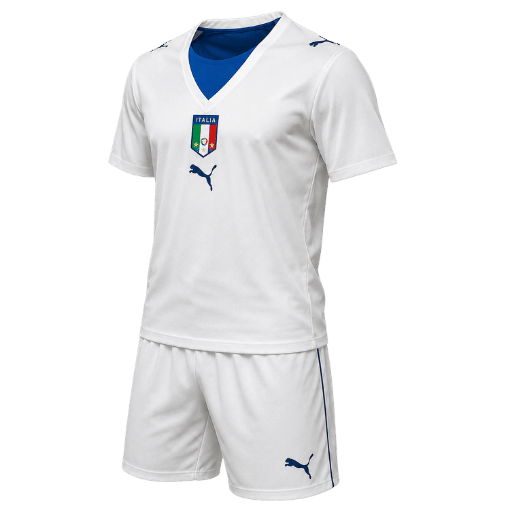
Its away counterpart flips the palette: a white body with blue trim, same Puma construction, same FIGC crest. White is the traditional change colour for Italy because it contrasts cleanly with the blue home kit and with most opponents. It’s a sharp, understated shirt, and precisely because Italy wore it so rarely in 2006, genuine examples are harder to track down than the blue.
This scarcity create a common buying trap. Because original white shirts are uncommon, the market is full of mixed listings, and one specific mismatch show up again and again: a white away shirt paired with white home shorts, or sold as a “full kit” that never existed as a matched set on the pitch. If you’re buying for accuracy rather than just to wear, check that the shorts and socks match the version you think you’re getting.
⚠️Common mistake
Treating “rare” as “valuable.” White away shirts are genuinely scarcer, but the blue home is the kit Italy won in, so demand, and usually price, follow the blue. Scarcity and desirability aren’t the same thing here.
Which Kit Did Italy Wear to Win in 2006?
If you only remember one fact from this guide, make it this: Italy won the 2006 World Cup in the blue home shirt. That settles most of the home-vs-away confusion in a single sentence, and it’s the reason the blue version carries the emotional weight for collectors.
Did Italy win the 2006 World Cup in blue or white?
Blue. In the final on 9 July 2006 at Berlin’s Olympiastadion, Italy wore the blue home kit and France wore their white away shirt. That match finished 1–1 after extra time, Zinedine Zidane scored an early penalty, Marco Materazzi equalised with a header, and Italy won 5–3 on penalties, with Fabio Grosso scoring the decisive kick. Fans also remember that night for Zidane’s red card after he headbutted Materazzi, per the match record of the 2006 World Cup Final . Captain Fabio Cannavaro, who also won the 2006 Ballon d’Or, lifted the trophy in blue.
2006 milestone
Kit worn
Group stage & knockouts (most matches)
Blue home (no colour clash)
Final vs France, Berlin, 9 July 2006
Blue home
White away
Backup only — used when colours clashed
Key takeaway: that blue home shirt is the genuine “champions” jersey of 2006. If the win is what you care about, buy blue.
Player Versions & Famous Names
Beyond home and away, the Italy 2006 jersey splits again into replica (the fan version sold at retail) and player version / player issue (the tighter, match-specification shirt). On top of that sit the named shirts of the squad that won in Germany, and those names drive a lot of collector demand.
Most sought after are goalkeeper Gianluigi Buffon (in a separate keeper colourway), captain Fabio Cannavaro, Andrea Pirlo, Francesco Totti, Alessandro Del Piero and Marco Materazzi, whose final-night story keeps his shirt in conversation. Plain blue replicas are the accessible entry point; a correctly printed Totti #10 or a player-issue Cannavaro lifts both the price and the difficulty of verification.
What’s the difference between a player version and a replica?
Replicas are the retail fan shirts, looser cut, standard fabric, made for comfort and sold in large numbers. A player version (or player issue) matches what the squad wore: slimmer fit, lighter performance fabric, and often heat-applied details rather than stitched ones. Player versions are scarcer and pricier, and they’re also the ones most worth authenticating carefully. We cover the full breakdown in our guide to the difference between a player version and a replica football shirt.
💡Pro tip
One famous name you’ll not find on a genuine 2006 squad shirt is Paolo Maldini, he had retired from the national team in 2002 and didn’t play at the 2006 World Cup. A “2006 Italy Maldini” match shirt is a red flag.
Authentic vs Replica, How to Tell Them Apart
Because the 2006 shirt is roughly twenty years old and highly desirable, reproductions are common. Genuine shirts, though, leave consistent fingerprints. Your single fastest era check is the star count, and it’s the kind of detail fakers routinely get wrong.
📐 The Star-Count Tell
Above the crest, the stars mark World Cup titles won. Italy held three titles going into 2006 (1934, 1938 and 1982), so a shirt produced during the tournament shows three stars. Only after Italy won in 2006 was a fourth star added. So a “2006 World Cup” shirt with four stars is, by definition, a post-tournament production, not a match-era piece. Collectors use exactly this check as a first filter.
Are there different versions of the Italy jersey?
Yes, and that’s the root of most confusion. Even a single season can produce a home shirt and an away shirt, each in replica and player-issue cuts, in long-sleeve and short-sleeve, plus a separate goalkeeper shirt, plus later commemorative re-issues. “Italy 2006 jersey” is therefore not one object but a small family of them. Pin down four things before buying: home or away, replica or player version, sleeve length, and star count (era).
✔ Check the star count, three stars for a 2006 tournament-era shirt, four for a later re-issue.
✔ Feel the Puma logo and crest, flat and cleanly applied on genuine shirts, thick or rubbery on many fakes.
✔ Read the inner wash/size label, correct Puma branding, sizing format and care symbols, not a generic off-brand tag.
✔ Inspect stitching and fabric weight, even seams; flimsy, light material is a warning sign.
✔ Confirm the colour, true azzurro for home, clean white for away; navy-looking “blue” is suspect.
Those same principles apply across brands and clubs, if you want a worked example, our walkthrough on how to identify a genuine shirt from a counterfeit breaks down tags, badges and stitching in detail.
“With a shirt this collectable, the era tells you more than the colour. We start every Italy 2006 check at the stars and the crest application, get those right and most reproductions fall away before you even look at the label.”
What an Original Italy 2006 Jersey Is Worth Today
Value depends almost entirely on which version you’ve. Pricing separates into a few clear tiers, and condition, sizing and player printing move a shirt up or down within each one.
✔ What raises value
Blue home (the winning kit)
Player issue over replica
Correct period printing of a star name
Excellent condition, original tags
Signed or verifiable provenance
⚠ What limits value
Later four-star re-issue sold as match-era
Mismatched shorts/socks “full kits”
Fading, cracked print, repairs
No tags or unverifiable origin
As a general guide for 2026, plain blue replicas in good condition sit at the affordable end, player-issue and named shirts command a clear premium, and signed or match-related examples reach the top of the range. Exact prices move with condition and demand, so treat any single figure as a snapshot rather than a fixed value, and always buy from a seller who can stand behind authenticity. You can browse our authentic vintage Italy and national-team jerseys to see current condition and pricing, and our overview of the best places to buy football shirts online covers what a trustworthy seller look like.
Which Italy 2006 Jersey Should You Buy?
There’s no single “best” version, it depends on why you’re buying. Use the table below to match your reason to the right shirt.
If you are buying for…
Choose
Why
Display / the 2006 win
Blue home
It is the kit Italy lifted the trophy in
A rarer, understated look
White away
Scarcer and less commonly seen
Wearing it regularly
Replica
Comfortable, durable, lower cost
Collecting / investment
Player issue or named shirt
Higher demand and provenance value
A specific hero
Buffon, Totti, Cannavaro print
Period-correct printing adds character and value
Why Italy Plays in Blue, The Azzurri Story
Italy’s 2006 shirt is one chapter in a much older story. Italy are nicknamed Gli Azzurri“the Blues” — and the colour isn’t taken from the national flag at all. It’s Savoy blue (azzurro Savoia), the colour of the House of Savoy, the dynasty that ruled the Kingdom of Italy from 1861 to 1946. The Italy national football team first wore blue in 1911 and has worn it ever since, which is why “the blue shirt” is shorthand for representing Italy in almost any sport.
That heritage is exactly why the 2006 home shirt resonates. When Cannavaro raised the trophy in Berlin, the blue he wore carried nearly a century of meaning, and the fourth star sewn on afterwards marked Italy as one of the most successful nations in World Cup history.
2006 Kit vs Other Classic Jerseys (and Collector Outlook)
Where does 2006 sit among the great national-team shirts? It belongs to a small group of “trophy kits” — shirts a country actually won a World Cup in, which gives it staying power that ordinary tournament shirts lack. If you enjoy that lineage, our look at the most iconic 1990s soccer jersey designs and the design history of Argentina’s 1986 World Cup jersey both sit naturally alongside the Azzurri’s 2006 shirt.
Collector outlook for 2026: demand for the genuine 2006 Italy shirt has held steady, with searches lifting through the summer months rather than fading. There’s a structural reason behind it, Italy failed to qualify for both the 2018 and 2022 World Cups, so there’s no newer “winning kit” to compete for attention. Nostalgia keeps concentrating on 2006 as the last Azzurri triumph. Practically, that means genuine tournament-era stock is finite and now roughly twenty years old, so if you want a verified three-star original rather than a later re-issue, it’s better to buy a confirmed one now than to wait for supply to improve.
Frequently Asked Questions
Q: Did Italy win the 2006 World Cup in blue or white?
View Answer
In blue. Italy wore the blue home kit in the final against France in Berlin on 9 July 2006 and won 5–3 on penalties after a 1–1 draw. The blue home shirt is the genuine “champions” jersey of that tournament.
Q: Who made the Italy 2006 World Cup jersey?
View Answer
Puma. Genuine shirts carry the Puma cat logo opposite the FIGC crest, with no sponsor.
Q: How many stars were on the Italy shirt in 2006?
View Answer
Three during the tournament, representing the 1934, 1938 and 1982 titles. A fourth star was added only after Italy won in 2006, so a “2006” shirt showing four stars is a later re-issue rather than a match-era piece.
Q: Why did Maldini not play for Italy in 2006?
View Answer
Paolo Maldini had already retired from the national team in 2002, so he was not part of the squad that won in 2006. A “2006 Italy Maldini” match shirt should be treated with caution.
Q: Is the home or the away shirt rarer?
View Answer
The white away is genuinely scarcer because Italy wore it so little in 2006. But the blue home is the more desirable — and usually more valuable — version, since it is the kit they won in. Rarity and value do not line up here.
Q: Does a soccer team change its jersey for home and away games?
View Answer
It changes based on colour clashes, not on whether the team is literally at home. Teams use their first-choice kit by default and only switch to the away kit when colours would clash with the opponent. Italy’s blue rarely clashes, so they wore it for most of 2006 — including the final, on their way to a fourth world title in Berlin.
Looking for a genuine Azzurri shirt? Browse verified, authentic Italy and national-team jerseys, checked for the details that matter.
We handle vintage and classic football shirts every day, and the Italy 2006 kit is one of the most-asked-about national-team shirts we see. The home-vs-away comparison, the star-count check and the player-version notes here reflect how we actually assess these shirts before they reach a buyer. Match facts are sourced from public records; condition and pricing reflect the current second-hand market.
I write about football jersey fit and when different shirt styles make sense. My articles cover youth goalkeeper sizing and long-sleeve jerseys, helping players and families think through comfort, movement, weather, and the role of the shirt before they buy.