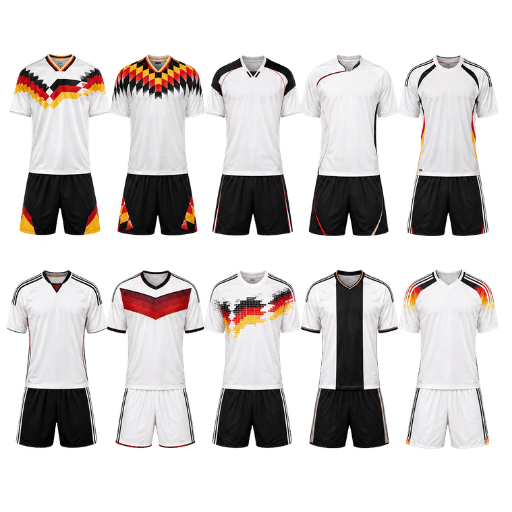
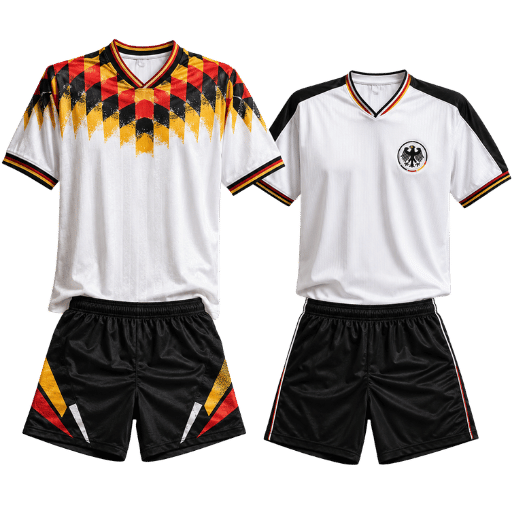
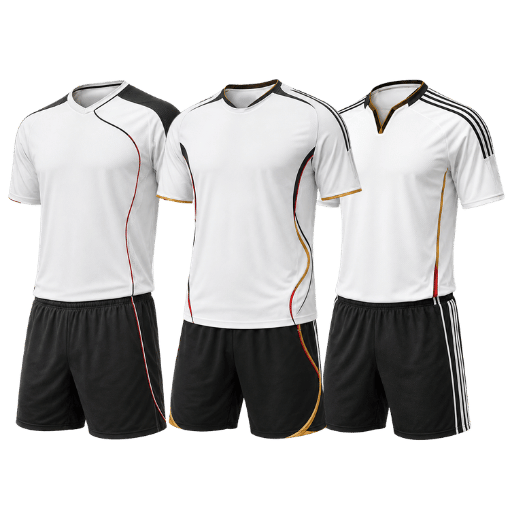
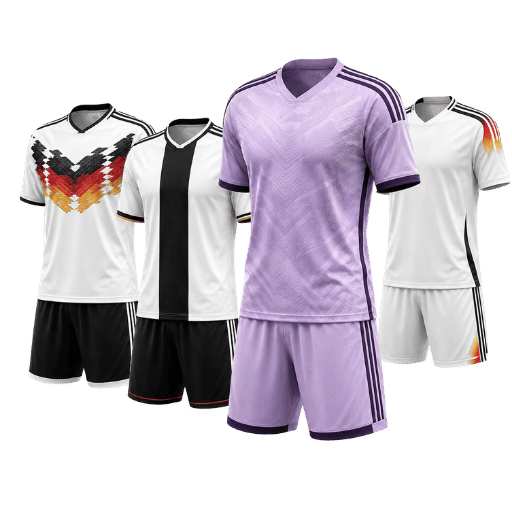
Still searching for your perfect jersey? Explore our best-selling products—we're confident you'll find a style that's just right for you in our diverse collection.
The Germany World Cup jersey evolution from 1990 to 2024 tells the story of German football in fabric: triumph, reinvention, a few misfires, and one shirt so good it’s still copied today. Over those nine tournaments the kit swung from a radical geometric statement to near-blank minimalism and back to bold retro. This guide walks through every era, explains why each design looked the way it did, and shows you how to recognise the genuine article when you go shopping.
Here’s the whole journey in one table. Three teams across this span lifted the trophy in white; two of the most loved kits came from tournaments Germany didn’t win. Note that the side that won in 1990 played as West Germany, a detail we return to below.
Year (Host)
Result
Home Kit Look
Maker
1990 (Italy)
Champions
White, black-red-gold geometric chest graphic
Adidas
1994 (USA)
Quarter-finals
White, angled flag-colour graphics
Adidas
1998 (France)
Quarter-finals
White, horizontal flag stripes, three stars
Adidas
2002 (Korea/Japan)
Runners-up
White, clean classic cut
Adidas
2006 (Germany)
Third place
White with gold and red trim
Adidas
2010 (South Africa)
Third place
White home, black away
Adidas
2014 (Brazil)
Champions
White, red chest chevron, white shorts, fourth star added
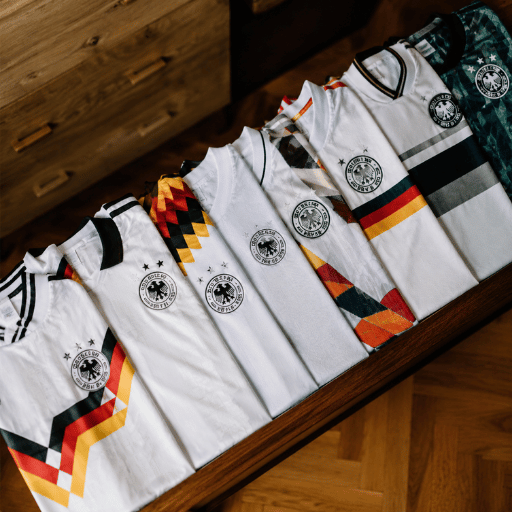
Three quick signals date any Germany shirt at a glance: the chest graphic (geometric in 1990, flat stripes in 1998, a centre stripe in 2022), the crest (a bigger eagle on older shirts, a white eagle on a black shield from the mid-90s), and the star count above the badge — none, then three from 1996, then four from 2014.
1990: The Geometric Icon That Won Italia ’90
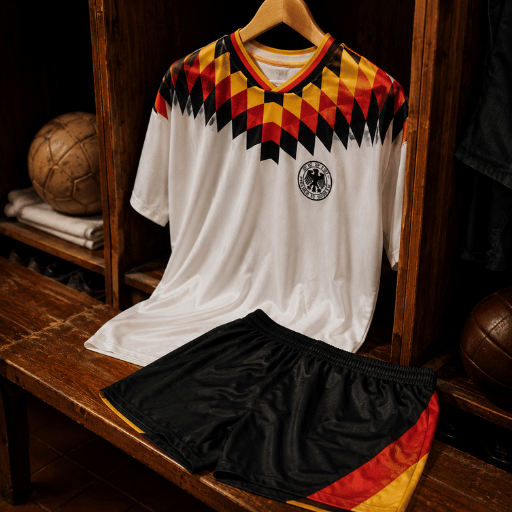
Everyone pictures the 1990 shirt first. A white base carries a hand-drawn black, red and gold band that cuts diagonally across the chest, loud and modern in a way football hadn’t really seen. It’s the design that turned a national jersey into a piece of pop culture, and decades later it remains the benchmark every retro release is measured against.
What makes the story better is who drew it. Its designer, Ina Franzmann, was 25 and had never worked in sport. Her bold, almost accidental flourish kicked off what kit historians now call a golden era of design.
“You have to view it from the time it was made. It was kind of a bang, radical for football back then.”
Did West Germany win the World Cup in 1990?
Yes, and this is the twist that makes the 1990 jersey unique. The team that beat Argentina 1–0 in the final on 8 July 1990, with Andreas Brehme converting the decisive penalty, did so as West Germany. Reunification followed on 3 October 1990, less than three months later. So the most beloved Germany kit ever was, technically, worn by a nation that had ceased to exist by the time the trophy was next defended. That shirt had already debuted at the 1988 European Championship, hosted by a still-divided Germany.
⚠️Collector note
Because the 1990 design is so widely reissued, an original is easy to confuse with a modern remake. We cover how to tell them apart further down. For broader context on the decade, see our roundup of the most iconic 1990s soccer jersey designs.
1994 and 1998: Maximalism, the Upside-Down Flag and the Reunified Eagle
Germany’s mid-90s were the busy years. At USA 1994, the first World Cup played by a reunified Germany, Adidas leaned hard into graphic flair, stacking the flag colours across the front in a way that, depending on your taste, either dazzled or simply turned the German tricolour on its head. On the pitch it was a tournament to forget: Lothar Matthäus and coach Berti Vogts went out to Bulgaria in the quarter-finals.
Between World Cups, Germany won Euro 96 at Wembley through Oliver Bierhoff’s golden goal, wearing a shirt that introduced a white eagle on a black shield. By France 1998 the home kit had calmed down: mainly white, with horizontal black-red-gold stripes laid across the chest and, crucially, three stars above the eagle marking the country’s three World Cup titles. That tournament ended at the quarter-final stage against Croatia, but the three-star template stuck for the next 16 years.
💡Why this matters for dating a shirt
Star count is the fastest fingerprint. No stars means pre-1996. Three stars points to a 1996–2014 kit. Four stars means 2014 or later. Get the star count right and you have already narrowed the era to a tight window.
2002 to 2010: Minimalism Comes Back
After the noise of the 90s, three straight tournaments dialled the design right down. That 2002 shirt was clean and classic, and it nearly carried Germany to a shock title, Oliver Kahn’s side reached the final in Korea and Japan before losing 2–0 to a Ronaldo-inspired Brazil. Four years later came the “summer fairy tale” on home soil in 2006, with Michael Ballack pulling the strings; the white kit, broken only by a splash of gold and red plus black trim, became the backdrop to a third-place finish after a painful extra-time semi-final defeat to Italy.
South Africa 2010 continued the restrained look at home and paired it with a sharp black away shirt that became a fan favourite in its own right. That young team, Özil, Müller, Schweinsteiger, again finished third and set the stage for what came next.
2014: The Champions Shirt
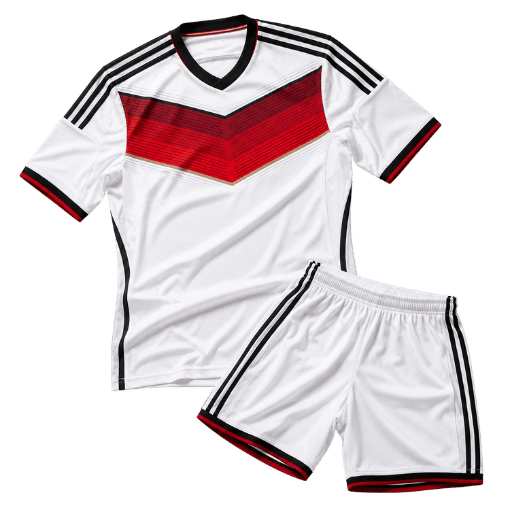
Germany’s 2014 home jersey is the modern classic. Adidas openly looked back to 1990 for inspiration, running a chevron across the chest in what the brand described as three shades of red, a nod to the black, red and gold of the flag. Germany also broke with tradition by pairing the white shirt with white shorts rather than the usual black. Then Mario Götze volleyed home in extra time of the final against Argentina, and the shirt earned its place in history.
Why are there four stars on Germany’s jersey?
Each star above the crest represents a World Cup title: 1954, 1974, 1990 and 2014. After the win in Brazil, the German Football Association added the fourth star, so any shirt produced from late 2014 onward carries four. If you’re holding a Germany jersey and counting stars, four tells you it was made in or after the 2014–15 cycle, a small but reliable dating clue when you shop our retro Germany shirt collection.
2018 to 2024: The Modern Era and a Lilac Away That Broke the Internet
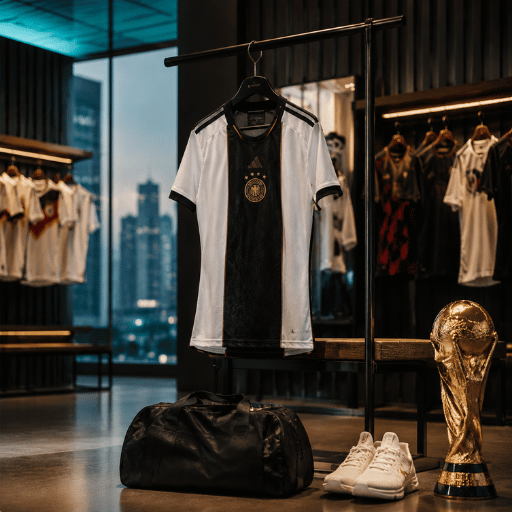
Success didn’t carry over. Russia 2018 produced about as plain a shirt as a Germany kit gets, all muted white with little adornment, and it dressed a disastrous title defence that ended in the group stage, Toni Kroos, Mesut Özil and Mats Hummels among the casualties, and Özil’s final tournament in national colours. Qatar 2022 brought a stronger idea but a similar result: a bold black stripe ran straight down the centre, a design said to echo the very first German jersey of 1908, and for the first time the men’s and women’s teams wore an identical kit. The men again fell at the group stage.
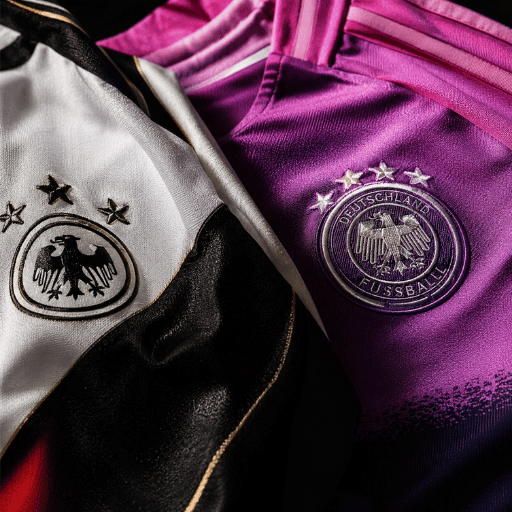
Then came the shirt nobody saw coming. For Euro 2024 the home kit stayed traditional, but the away shirt swapped Germany’s usual dark green for pink and purple. It sold out fast and split opinion just as quickly. Germany’s FA framed the choice as deliberate, saying the palette was “intended to represent the new generation of German football fans and the diversity of the country.”
A 125th-anniversary kit also appeared in this window, a thin pinstripe with a retro badge, made from recycled material, a quiet tribute to the earliest German shirts amid all the boldness.
Why Is Germany’s Away Kit Green?
Here’s where a beloved fan legend meets the paperwork. Most fans hear the romantic version first: Germany wears green to honour the Republic of Ireland, supposedly the first nation willing to play West Germany after the Second World War, with a friendly in 1951. It’s a lovely tale, and even our own social channels have seen fans repeat it.
A duller, better-supported explanation is simply administrative. As ESPN lays out in its colourful history of the Germany kit, green and white were the traditional colours of the German Football Association (DFB) itself, so the away shirt borrowed the governing body’s own identity rather than a foreign tribute. West Germany wore green in the 1986 final against Argentina, and the colour stayed in the rotation for decades, right up until that 2024 pivot to pink and purple.
⚠️Myth check
The Ireland origin story is widely shared but treated as folklore by most kit historians. The association’s own green-and-white colours are the more grounded reason. Both make for great trivia — just know which one holds up.
Adidas to Nike: The Manufacturer Story
Every shirt in this guide carries the same three stripes, and that’s no accident. Adidas has outfitted the German national team for roughly seven decades, a relationship that traces back to the boots of the 1954 World Cup winners. For German football fans, Adidas on the chest is close to a birthright.
That era is ending. Germany’s football association announced that Nike will supply the national teams from 2027, on a deal running to 2034, as reported by ESPN. Money tells you why: the Nike agreement is reportedly worth around €100 million a year, roughly double Adidas’s existing deal of about €50 million, according to SportsPro. It’s a switch that stirred real emotion in Germany, given Adidas’s home roots in Herzogenaurach.
There’s a practical takeaway for collectors: the 2026 World Cup kit will be one of the last Adidas-made Germany shirts, which gives that release a built-in sense of occasion. German club design has its own parallel stories of identity and change, see what we mean in our look at Borussia Dortmund’s kit heritage.
Which Germany Retro Should You Buy?
Once a design earns icon status, the market fills with versions of it, original match-era shirts, official reissues, and replicas at every price. None of those is “wrong” to own; they just suit different buyers. Use the table below to match your goal to the right kind of shirt, then run the authentication checklist before you pay vintage prices.
If you are…
Best target
Why
A nostalgia wearer
Modern retro reissue of 1990 or 2014
Looks the part, costs less, survives match days and washes
Authenticating a 30-year-old shirt is mostly about the details that fakers skip. Collectors on the r/SoccerJerseys community give the same advice again and again: the labels tell the truth.
✔ Check the inner neck and side-seam labels for the correct era logo, sizing format and wash symbols, reproductions often get the tags subtly wrong.
✔ Be suspicious of a “vintage” shirt that looks flawless. As one legit-check regular put it, a genuine 30-year-old kit rarely arrives without honest signs of age.
✔ Match the crest and star count to the year (use The Era Test above). A 1990 shirt with three stars is wrong.
✔ Confirm the maker for the variant, 1990 home shirts were Adidas, while some away versions were produced under licence for specific markets.
Industry Outlook: The 2026 World Cup and What Comes Next
Germany’s next chapter is already on the rack. For the 2026 World Cup in the USA, Canada and Mexico, Germany has unveiled a home shirt that openly mines its own past: black, red and gold diamonds that recall 1990, layered with a zigzag motif lifted from the 1994 USA kit. Reviving 90s graphics for a tournament back in the United States is a neat piece of storytelling, and it fits a wider retro wave running through football fashion right now.
It also marks an end. Because Nike takes over in 2027, the 2026 kit is set to be one of the final Germany shirts Adidas ever makes. For collectors, that turns an ordinary tournament release into something with a clear “last of its kind” appeal, the sort of detail that tends to matter more a decade later than it does on launch day.
If you’re planning purchases around 2026, two moves make sense. First, treat the new Adidas home shirt as a potential keeper rather than a throwaway, given the maker transition. Second, expect demand for the 1990 and 2014 designs to climb whenever Germany is in the spotlight, since those are the shirts the new kit deliberately references. Tournament years reliably push interest in the classics, so the quiet stretches between them are usually the calmer time to buy.
Frequently Asked Questions
Q: What are the best German soccer jerseys?
View Answer
The 1990 World Cup-winning shirt is the consensus favourite, with the 2014 champions kit close behind.
Q: How have soccer jerseys evolved over time?
View Answer
Germany’s kits trace the wider arc of football design across four decades. The early 90s brought heavy graphic experimentation, with the geometric 1990 shirt setting the tone. Through the 2000s the look swung hard toward minimalism, stripping shirts back to near-blank white. By the 2020s, bold colour and openly retro references returned, from the 2022 centre stripe to the 2024 lilac away and the diamond-patterned 2026 design. Fabric shifted too, moving from thick cotton-blends to lightweight, often recycled, performance materials.
Q: Who designed the 1990 Germany World Cup jersey?
View Answer
Ina Franzmann, then 25 and new to sportswear, created the geometric black-red-gold graphic for Adidas. Her design is widely credited with launching a golden era of football kit design.
Q: What is the difference between a vintage original and a retro reissue?
View Answer
A vintage original was produced in the shirt’s match era and carries period-correct tags, fabric and wear. A retro reissue is a newer remake of an old design — visually faithful but modern in its labels and materials, and usually far cheaper. Check inner labels and signs of age to tell them apart.
Q: Did Germany change its kit after reunification?
View Answer
The 1990 World Cup was won by West Germany, with reunification following on 3 October 1990. The unified team kept the same Adidas template and eagle crest into the 1994 World Cup, so the visual identity carried over rather than restarting.
Q: How many stars are on the Germany jersey and what do they mean?
View Answer
Four stars, one for each World Cup title: 1954, 1974, 1990 and 2014.
Find your era of German football
From the 1990 geometric classic to the 2014 champions shirt, browse authenticated vintage and retro Germany jerseys.
As a shop built around vintage and retro football shirts, we spend our days handling Germany kits from the geometric 1990 design to the four-star 2014 winner. This guide pull together the design history and the practical dating clues, star counts, crest styles and label tells, that we lean on when sorting an original from a reissue.