Still searching for your perfect jersey? Explore our best-selling products—we're confident you'll find a style that's just right for you in our diverse collection.
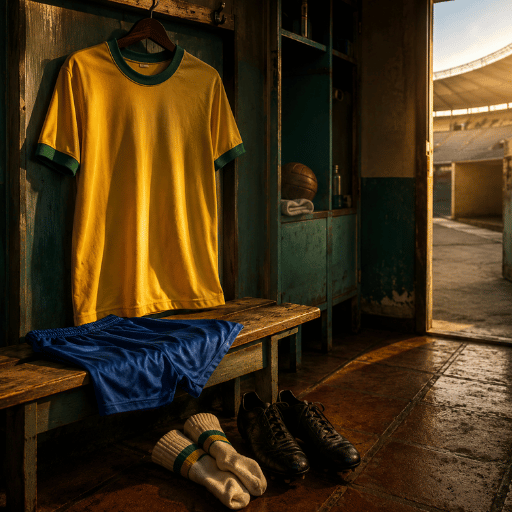
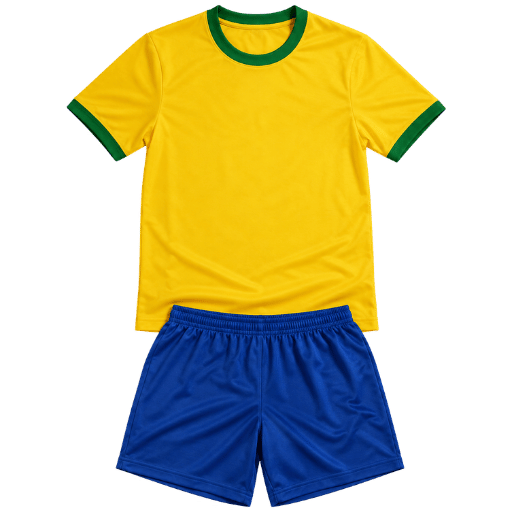
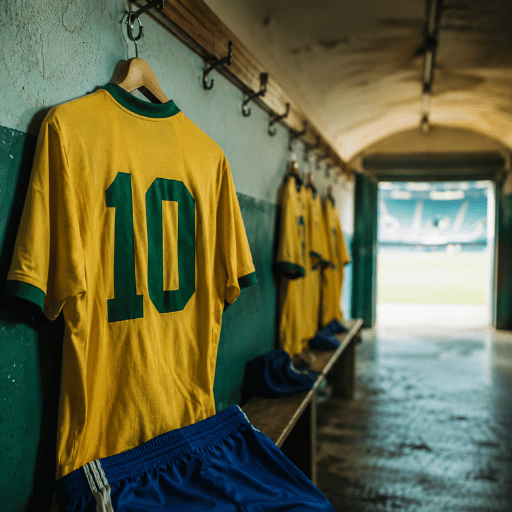
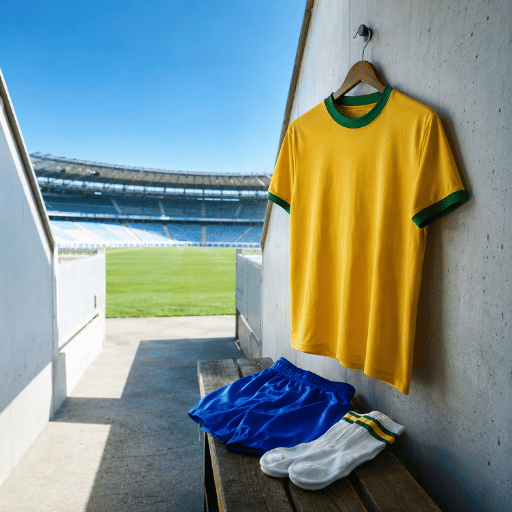
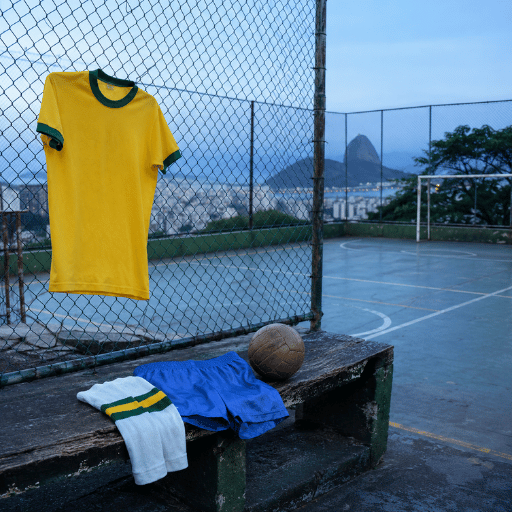
This is the brazil 1970 world cup jersey. When the rest of the world pictures the joy of football, it pictures this: solid canary yellow, a green collar, blue shorts, white socks and a number 10 stitched onto the back. But the story of how the Brazil 1970 world cup jersey became sacred is stranger and sadder than all that sunshine suggests.
The 1970 Shirt at a Glance
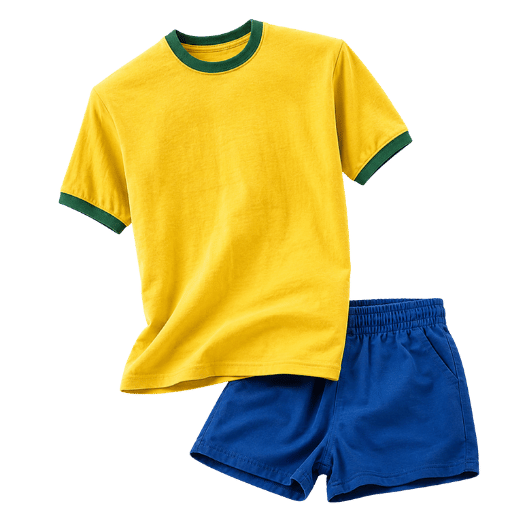
Body colour: canary (golden) yellow
Trim: green round/crew-neck collar and cuffs
Shorts and socks: blue shorts (white stripe), white socks
Maker: Athleta (domestic) — Brazil also carried a near-identical Umbro set
Branding: no manufacturer logos, no player names, just the CBD crest
Tournament: 1970 FIFA World Cup, Mexico (first broadcast in colour)
Result: champions, beat Italy 4-1 in the final, a third title
A Shirt That Defined a Golden Generation
Pick anyone from anywhere else on Earth, ask them to sketch football top from memory and they’ll sketch THIS one. From Brazil in 1970 this is perhaps one of, if not the, most iconic sports shirt on earth, as the BBC themselves have recently pointed out – alongside the New York Yankees pinstripe kit. Its popularity, of course, lies not in the shirt or in whose logo was stitched on it, but in the shirt itself and what happened inside it.
That bright yellow shirt produced many great goals, including those in the 1970 finals in Mexico by players such as Pelé, Jairzinho, Tostão, Gérson and Rivelino, representing in most minds jogo bonito, the beautiful game. Not that shirt alone made it, as 1970 was the first world cup to be broadcast in colour, meaning the canary yellow’s glorious skill was for the first time witnessed rather than read. Shirt and spectacles go hand-in-hand since then.
“For Brazilians, that yellow jersey is sacred. When we wear it, of course we feel pride but it also brings responsibility, a responsibility to inspire and to excite.”
💡Key takeaway
This shirt will be remembered primarily as much for the occasion as the design itself – the greatest generation in living memory, seen together for the first time in colour and clad in a stripped-down shirt which looks utterly classic today.
Why Brazil Wears Yellow and Green: The 1953 Redesign
This is part of the story almost all fans never discover: the Brazilians didn’t actually used to play in yellow. All the way up to the 1940s they wore white shirts with blue collars – and all of that changed on a particular afternoon in 1950.
In the decisive game of the 1950 World Cup, played in Brazil, the hosts were beaten 2-1 by Uruguay in front of a packed Maracanã stadium. This defeat became known as the Maracanazo. It was treated as a national emergency, and the blame was placed on the white jersey. As the BBC’s account of the redesign records, the white shirts were considered “unpatriotic,” and the nation decided to start again.
A newspaper, Correio da Manhã, announced a design competition in 1953 to make a new kit. That brief had just one condition, it had to use the four colours of the Brazilian flag: yellow, green, blue and white. A teenage illustrator called Aldyr Garcia Schlee, from a town in the very south called Pelotas, just near the border with Uruguayan, took part, creating some hundred designs for combinations of stripes and hoops before settling for yellow, blue shorts, white socks and a green collar. His entry, against 401 submissions, was selected.
There’s a quiet irony here. In later life Schlee, the man who gave Brazil its national emblem, admitted to the BBC that he felt “guilty” the shirt had become “about money.” Born of defeat, the most joyful jersey in world football carries a small, lifelong note of regret.
⚠️A detail that surprises everyone
Brazil didn’t actually first win a world cup in yellow – they were wearing blue, having hastily bought new shirts for the final against the host nation Sweden, in the 1958 tournament – and didn’t lift the Jules Rimet trophy wearing gold until two years later.
Decoding the 1970 Design: Canary Yellow, Green Collar and a Cotton Build
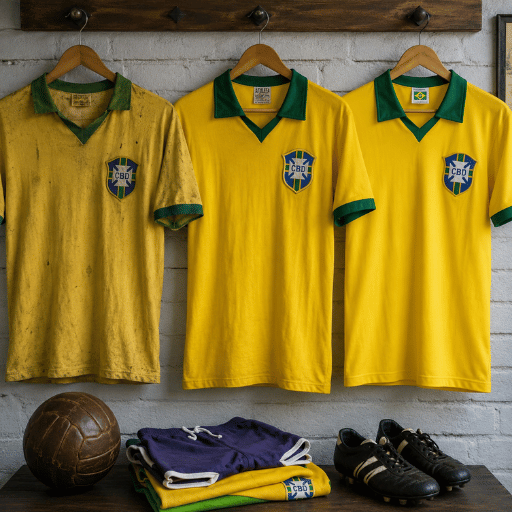
At close look, the 1970 Brazil jersey is brutally simplistic. A plain yellow jersey, with simple green trimming on the crew neck and cuffs. It bears no sponsor, and no logos from Adidas, Nike, or any other manufacturer. The jersey’s front, in particular, is incredibly sparse, and devoid of the kind of branding that covers today’s strips: nothing more than the squad number and the crest itself. A product of an era before branded apparel became commercial behemoths, this iconic design represents solely Brazil and the ideals of the sport itself.
Constructed of thick, heavy cotton and no doubt not treated for shrinkage like later versions – original copies in particular can be dense and a little scratchy to the touch – it’s the very construction of the jersey that’s of interest to collectors too: when they flew to Mexico, Brazil brought with them two versions of the strip (a locally produced one by Athleta, and a similar one manufactured by Umbro), which are distinguishable, according to Historical Football Kits, only by minor alterations to the badge design.
What is the 1970 Brazil football logo?
Pay attention and you’ll notice the badge worn here isn’t the present-day yellow and green CBF crest that you’re surely so familiar with today. Brazil competed in 1970 under the banner of the Confederação Brasileira de Desportos, or CBD. You can see that the crest on this jersey is the federation crest – an oval in the centre with stars, denoting the team as a part of a confederation, not how many world cups they had won, or what color the shirt would later be. Yes, the now famous gold stars that indicate the number of times the team has won the world cup are missing – those weren’t added as standard until some years later. So if the ‘vintage 1970’ shirt you’re considering displays a modern CBF symbol, or a stream of championship trophies, you’re actually looking at a reproduction or homage of the original, not the real deal.
💡How to read a 1970 design at a glance
Simple yellow jersey with green neck trim, no brand logos, CBD crest, heavyweight cotton.
Most of the ‘70 shirts available for sale will differ from this original design specification.
Pelé’s No.10 and the Shirts That Became Legend
Nothing has etched a part of the shirt’s myth more than Pelé’s number 10. Already a double world cup champion by 1970, It was at Mexico, though, that his image and the colour yellow on his shirt became intertwined for good on film – the leap, the grin, the celebration at his opener in the final.
Who wore the number 10 for Brazil in 1970?
Pelé was 10, but the more difficult and exciting truth is that surrounded by such a quality group of teammates, just about any of them were good enough to wear the number 10 in another context. Brazil’s attacking five, Jairzinho, Pelé, Gérson, Tostão and Rivelino, were “all number 10s in their own right,” as Wikipedia’s record of the campaign puts it, and a 10 from this vintage, worn during this tournament, has a very specific meaning to collectors.
This same shirt produced what perhaps represents the zenith of a moment of mutually respectful recognition on the field. Pelé and England skipper Bobby Moore swapped jerseys at the end of the encounter that saw Brazil win 1-0 over the Three Lions in Guadalajara and shared a grin as they did, captured in a classic image by Rare Historical Photos.
Brazil’s 1970 Starting XI: The Squad That Wore It
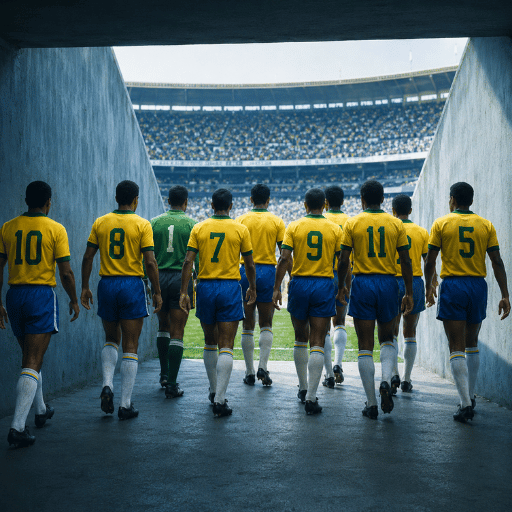
Like a good book or film, great players provide great shirts – and the players involved can’t have found a better vehicle in which to express their magic and their regard for one another. This Brazil team, managed by Mário Zagallo, would win all six of its games en route to lifting the trophy at Mexico, thanks in no small part to Jairzinho finding the back of the net in each of the six games – a unique achievement in the world cup history so far.Here’s Brazil’s lineup for the final:
Position
Player
Note
Goalkeeper
Félix
No.1
Defence
Carlos Alberto (c), Brito, Piazza, Everaldo
Captain scored the famous 4th goal
Midfield
Clodoaldo, Gérson
Gérson scored in the final
Forwards
Jairzinho, Tostão, Pelé (10), Rivelino
Pelé wore the iconic No.10
Brazil’s full starting eleven, as recorded by Wikipedia’s account of Brazil at the 1970 World Cup, was: Félix; Carlos Alberto, Brito, Piazza, Everaldo; Clodoaldo, Gérson; Jairzinho, Tostão, Pelé and Rivelino.
Mexico 1970: How the Jersey Met the Moment
And of course a truly great shirt requires a great occasion on which to wear it. Playing on the world’s most famous stage for a fourth title, Brazil took to the Estadio Azteca on 21 June 1970 to face Italy. Under the current format of the world cup, a win for Brazil would have guaranteed the Jules Rimet Trophy remains theirs. As FIFA’s record of the final notes, the final tally reached 4-1 in Brazil’s favour, with Pelé, Gérson and Jairzinho scoring before a famous fourth from Carlos Alberto completed one of the most celebrated team goals ever scored.
And it was Carlos Alberto’s stunning low drive home to finish that great move by the captain and his crew that etched that canary yellow into our consciousness. What was also in it, of course, was the country’s third world title, meaning it would be Brazil, for the first time, that got to hold onto the original prize forever. (That Trophy would sadly be stolen from a display case in Rio de Janeiro in 1983 and was never recovered.)
“Italy may have won the World Cup in 1982, but Brazil were the team who captured everyone’s imagination. As a child, those yellow shirts were exotic, the football they played was breathtaking.”
From Ginga to Glory: How the Shirt Captured Brazil’s Identity
Why does a basic yellow shirt feel so poignant? Because by 1970 it had established itself as the visual identity of a whole style of playing. If you talk about ginga – that swaying dance-like improvisation, born of rhythm and borrowed from dance and capoeira, renounced for its lack of structure and panache – then Brazil’s 1970 team were its greatest example ever.
Is ginga style real?
Ginga is genuine as a cultural notion, even if it’s difficult to articulate. It’s the relaxed, body-orientated movement that forms the basis of many a childhood in Brazil; and it’s regarded as a global trait of Brazilian football, rather than a tactical concept. It’s difficult to draw a line between mystique and actuality: some Brazilians don’t play with ginga, and many who do aren’t Brazilian; but the 1970 Brazil team embodied the ideals so well that the yellow shirt and the notion of ginga were merged in people’s minds. Buying a vintage Brazil shirt today involves an awareness of this connection.
Owning a Piece of History: Originals, Reissues and Replicas
Once you’re introduced to the 1970 shirt, practicality takes over – which one do you buy? There are a few reliable options, and the confusion of categories is the trouble that most newcomers run into. A genuine match-worn original is a museum piece, a Pelé-worn jersey sold for £158,000 at Christie’s in 2002, as reported by the BBC, and his 1970-era shirts have changed hands for comparable sums since. Most fans, sensibly, are weighing up either an official reissue or a more contemporary replica.
Type
Typical price band
What you get
Best for
Match-worn original
Tens of thousands to £100k+
A specific 1970 shirt with provenance/certification
Serious investors and museums
Period original (unworn / fan)
Hundreds to low thousands
An actual early-1970s Athleta/Umbro shirt, cotton build, CBD crest
Collectors wanting the real fabric and era
Official reissue
Roughly £60–£120
A modern, licensed re-creation of the 1970 look
Fans who want the design, new and wearable
Replica / tribute
£20–£50
An unlicensed or generic “retro” yellow shirt
Casual wear and matchday
Prices are guides and depend on condition, provenance and availability, so treat these figures as a starting point rather than a guarantee. If you’re buying an original, the safest bet is a long-standing specialist rather than a generic listing. You can browse curated vintage and retro soccer jerseys to compare era-correct shirts side by side.
How to spot an authentic vintage Brazil shirt
Your fastest authenticity check is the badge and branding, a method vintage-shirt specialists such as Cult Kits recommend. Work through these in order:
First, the crest: one of the true 70’s versions (though not technically authentic for the colours) will merely show the shield, not the modern CBF logo or the star sequence.
Second, look for sponsor or maker branding – shirts for the 70’s had no sponsor, no manufacturer name on the front of the shirts.
Third, feel the fabric. Early shirts were made of heavyweight cotton, not thin synthetic fabric.
Fourth, compare the label and stitching with the classic Athleta and Umbro shapes of the period.
Finally, demand provenance. Any shirt which is said to have been match-used without paperwork should be treated with suspicion.
The 1970 Shirt’s Comeback: Brazil’s 2026 Kit and the Retro Revival
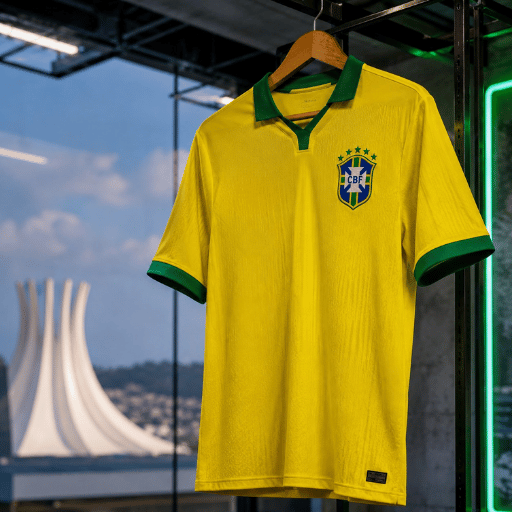
Far from being just nostalgia, the 1970 design became news again in 2025. Nike’s Brazil 2026 home shirt pays direct homage to Brazil’s 1970 home shirt, returning to a clean canary yellow and a retro cut, as reported by Footy Headlines and AS. For the away shirt, Brazil are working with Jordan Brand for the first time, another sign of how much commercial weight the national identity now carries.
This revival is measurable, not just sentimental. Interest in the original 1970 kit climbed sharply around mid-2025, the time of the new release, which tells you appetite for the original design is rising in step with Brazil’s 2026 World Cup build-up. For fans and collectors attending the upcoming world cup, this means a torrent of 1970-inspired special edition releases, as well as sustained demand for original period pieces. A simple proactive step can be taken: if you’re keen to acquire a genuine antique jersey instead of a modern take, purchase prior to the tournament hype reaching its crescendo.
Frequently Asked Questions
What is the history of the Brazil soccer jersey?
View Answer
In 1940, Brazil sported a white kit for games. However, after the devastating 1950 world cup final loss to Uruguay in the Maracanã Stadium-a match forever known in Brazilian folklore as “the trauma”-the white kit was abandoned. An open contest was organized in 1953 for fans to design a new kit featuring the four colors of the Brazilian flag.
The yellow and green jersey that ultimately won that contest made its debut in the 1954 world cup, and Brazil has worn variations of this iconic design ever since, including the 1970 kit to which this article is dedicated.
What was the Maracanã incident (Maracanazo)?
View Answer
the Maracanazo of 1950 is the name of the 2-1 loss to Uruguay in the determining match of the world cup at the home of the Maracanã Stadium, regarded as the single most traumatic moment in the history of Brazilian football which led to the abandoning of white jersey.
Who designed Brazil’s yellow and green jersey?
View Answer
A teenage newspaper illustrator from Pelotas named Aldyr Garcia Schlee. He beat out 401 entries in the 1953 Correio da Manhã competition with a yellow shirt, blue shorts, white socks and green collar detailing.
What brand made the Brazil 1970 World Cup jersey?
View Answer
Athleta, a Brazilian supplier. Brazil also carried a virtually identical Umbro set, but neither shirt bore a manufacturer’s logo or player names.
How much is an original 1970 Brazil shirt worth?
View Answer
It depends entirely on provenance. At auction, a Pelé match-worn shirt sold for £158,000 at Christie’s in 2002, and his 1970-era shirts have matched or topped that price since. Period fan or unworn originals run from the hundreds into the low thousands, while licensed reissues sit around £60–£120.
Is Brazil’s 2026 kit based on the 1970 jersey?
View Answer
Yes. The 2026 home kit for Brazil by Nike takes stylistic elements from their 1970 home jersey, with the kit presenting a refined canary yellow and a more dated style.
The accompanying away kit marks their debut collaboration with Jordan Brand, and its style deviates significantly, leaning towards contemporary aesthetics.
Thinking of getting hold of an authentic vintage Brazil top and not a general replica?
We see plenty of vintage and retro football shirts daily and arguably the one that’s most talked about and more often, misunderstood is the 1970 Brazil kit. Here we draw together the facts about the kit (CBD crest, absence of manufacturer logo, the Athleta and Umbro sets), together with the context, so you can recognize a true 1970 kit before you purchase!